更激进的死代码删除.
在 llvm/lib/Transforms/Scalar/ADCE.cpp:
其中 auto *DT = FAM.getCachedResult<DominatorTreeAnalysis>(F); 是支配树, auto &PDT = FAM.getResult<PostDominatorTreeAnalysis>(F); 是后支配树. ADCEPass 的核心实现就是 AggressiveDeadCodeElimination(F, DT, PDT).performDeadCodeElimination();. 在看 AggressiveDeadCodeElimination 类之前, 让我们简单回忆一下必经节点, 后必经节点, 支配, 支配树, 后支配树等概念:
我们先看这两个储存指令和基本块信息的结构体:
回到 AggressiveDeadCodeElimination:
我们跟着 performDeadCodeElimination 中的调用看一看, 首先是 initialize:
瞄一眼
再看看 markLive:
可以看到 markLive 还是做了很多的, 两个重载对指令和块处理:
在来看 markLiveInstructions:
在来看看 removeDeadInstructions:
对比 DCEPass 与 ADCEPass
使用一下:
可以看到 BB2 被正确处理了.
更新地址: b7bK9s2c8@1M7s2y4Q4x3@1q4Q4x3V1k6Q4x3V1k6Y4K9i4c8Z5N6h3u0Q4x3X3g2U0L8$3#2Q4x3V1k6F1L8%4c8Z5K9h3&6Y4i4K6u0V1x3U0x3K6x3#2)9J5c8X3I4D9N6X3#2Q4x3X3c8H3j5i4y4K6i4K6u0V1L8r3g2S2M7X3^5`.
PreservedAnalyses ADCEPass::run (Function &F, FunctionAnalysisManager &FAM) {
auto *DT = FAM.getCachedResult<DominatorTreeAnalysis>(F);
auto &PDT = FAM.getResult<PostDominatorTreeAnalysis>(F);
ADCEChanged Changed =
AggressiveDeadCodeElimination (F, DT, PDT).performDeadCodeElimination ();
if (!Changed.ChangedAnything)
return PreservedAnalyses::all ();
PreservedAnalyses PA;
if (!Changed.ChangedControlFlow) {
PA.preserveSet<CFGAnalyses>();
if (!Changed.ChangedNonDebugInstr) {
PA.preserve<MemorySSAAnalysis>();
}
}
PA.preserve<DominatorTreeAnalysis>();
PA.preserve<PostDominatorTreeAnalysis>();
return PA;
}
struct InstInfoType {
bool Live = false ;
struct BlockInfoType *Block = nullptr ;
};
struct BlockInfoType {
bool Live = false ;
bool UnconditionalBranch = false ;
bool HasLivePhiNodes = false ;
bool CFLive = false ;
InstInfoType *TerminatorLiveInfo = nullptr ;
BasicBlock *BB = nullptr ;
Instruction *Terminator = nullptr ;
unsigned PostOrder;
bool terminatorIsLive () const return TerminatorLiveInfo->Live; }
};
AggressiveDeadCodeElimination (Function &F, DominatorTree *DT,
PostDominatorTree &PDT)
: F (F), DT (DT), PDT (PDT) {}
ADCEChanged AggressiveDeadCodeElimination::performDeadCodeElimination () {
initialize ();
markLiveInstructions ();
return removeDeadInstructions ();
}
void AggressiveDeadCodeElimination::initialize () auto NumBlocks = F.size ();
BlockInfo.reserve (NumBlocks);
size_t NumInsts = 0 ;
for (auto &BB : F) {
NumInsts += BB.size ();
auto &Info = BlockInfo[&BB];
Info.BB = &BB;
Info.Terminator = BB.getTerminator ();
Info.UnconditionalBranch = isUnconditionalBranch (Info.Terminator);
}
InstInfo.reserve (NumInsts);
for (auto &BBInfo : BlockInfo)
for (Instruction &I : *BBInfo.second.BB)
InstInfo[&I].Block = &BBInfo.second;
for (auto &BBInfo : BlockInfo)
BBInfo.second.TerminatorLiveInfo = &InstInfo[BBInfo.second.Terminator];
for (Instruction &I : instructions (F))
if (isAlwaysLive (I))
markLive (&I);
if (!RemoveControlFlowFlag)
return ;
if (!RemoveLoops) {
using StatusMap = DenseMap<BasicBlock *, bool >;
class DFState : public StatusMap {
public :
std::pair<StatusMap::iterator, bool > insert (BasicBlock *BB) {
return StatusMap::insert (std::make_pair (BB, true ));
}
void completed (BasicBlock *BB) this )[BB] = false ; }
bool onStack (BasicBlock *BB) auto Iter = find (BB);
return Iter != end () && Iter->second;
}
} State;
State.reserve (F.size ());
for (auto *BB: depth_first_ext (&F.getEntryBlock (), State)) {
Instruction *Term = BB->getTerminator ();
if (isLive (Term))
continue ;
for (auto *Succ : successors (BB))
if (State.onStack (Succ)) {
markLive (Term);
break ;
}
}
}
for (const auto &PDTChild : children<DomTreeNode *>(PDT.getRootNode ())) {
auto *BB = PDTChild->getBlock ();
auto &Info = BlockInfo[BB];
if (isa<ReturnInst>(Info.Terminator)) {
LLVM_DEBUG (dbgs () << "post-dom root child is a return: " << BB->getName ()
<< '\n' ;);
continue ;
}
for (auto *DFNode : depth_first (PDTChild))
markLive (BlockInfo[DFNode->getBlock ()].Terminator);
}
auto *BB = &F.getEntryBlock ();
auto &EntryInfo = BlockInfo[BB];
EntryInfo.Live = true ;
if (EntryInfo.UnconditionalBranch)
markLive (EntryInfo.Terminator);
for (auto &BBInfo : BlockInfo)
if (!BBInfo.second.terminatorIsLive ())
BlocksWithDeadTerminators.insert (BBInfo.second.BB);
}
bool Instruction::mayHaveSideEffects () const return mayWriteToMemory () || mayThrow () || !willReturn ();
}
bool AggressiveDeadCodeElimination::isAlwaysLive (Instruction &I) if (I.isEHPad () || I.mayHaveSideEffects ()) {
if (isInstrumentsConstant (I))
return false ;
return true ;
}
if (!I.isTerminator ())
return false ;
if (RemoveControlFlowFlag && (isa<BranchInst>(I) || isa<SwitchInst>(I)))
return false ;
return true ;
}
void AggresiveDeadCodeElimination::markLive (Instruction *I) auto &Info = InstInfo[I];
if (Info.Live)
return ;
LLVM_DEBUG (dbgs () << "mark live: " ; I->dump ());
Info.Live = true ;
Worklist.push_back (I);
if (const DILocation *DL = I->getDebugLoc ())
collectLiveScopes (*DL);
auto &BBInfo = *Info.Block;
if (BBInfo.Terminator == I) {
BlocksWithDeadTerminators.remove (BBInfo.BB);
if (!BBInfo.UnconditionalBranch)
for (auto *BB : successors (I->getParent ()))
markLive (BB);
}
markLive (BBInfo);
}
void AggressiveDeadCodeElimination::markLive (BlockInfoType &BBInfo) if (BBInfo.Live)
return ;
LLVM_DEBUG (dbgs () << "mark block live: " << BBInfo.BB->getName () << '\n' );
BBInfo.Live = true ;
if (!BBInfo.CFLive) {
BBInfo.CFLive = true ;
NewLiveBlocks.insert (BBInfo.BB);
}
if (BBInfo.UnconditionalBranch)
markLive (BBInfo.Terminator);
}
void AggressiveDeadCodeElimination::markLiveInstructions () do {
while (!Worklist.empty ()) {
Instruction *LiveInst = Worklist.pop_back_val ();
LLVM_DEBUG (dbgs () << "work live: " ; LiveInst->dump (););
for (Use &OI : LiveInst->operands ())
if (Instruction *Inst = dyn_cast<Instruction>(OI))
markLive (Inst);
if (auto *PN = dyn_cast<PHINode>(LiveInst))
markPhiLive (PN);
}
markLiveBranchesFromControlDependences ();
} while (!Worklist.empty ());
}
void AggressiveDeadCodeElimination::markPhiLive (PHINode *PN) auto &Info = BlockInfo[PN->getParent ()];
if (Info.HasLivePhiNodes)
return ;
Info.HasLivePhiNodes = true ;
for (auto *PredBB : predecessors (Info.BB)) {
auto &Info = BlockInfo[PredBB];
if (!Info.CFLive) {
Info.CFLive = true ;
NewLiveBlocks.insert (PredBB);
}
}
}
void AggressiveDeadCodeElimination::markLiveBranchesFromControlDependences () if (BlocksWithDeadTerminators.empty ())
return ;
LLVM_DEBUG ({
dbgs () << "new live blocks:\n" ;
for (auto *BB : NewLiveBlocks)
dbgs () << "\t" << BB->getName () << '\n' ;
dbgs () << "dead terminator blocks:\n" ;
for (auto *BB : BlocksWithDeadTerminators)
dbgs () << "\t" << BB->getName () << '\n' ;
});
const SmallPtrSet<BasicBlock *, 16 > BWDT (llvm::from_range,
BlocksWithDeadTerminators);
SmallVector<BasicBlock *, 32 > IDFBlocks;
ReverseIDFCalculator IDFs (PDT) ;
IDFs.setDefiningBlocks (NewLiveBlocks);
IDFs.setLiveInBlocks (BWDT);
IDFs.calculate (IDFBlocks);
NewLiveBlocks.clear ();
for (auto *BB : IDFBlocks) {
LLVM_DEBUG (dbgs () << "live control in: " << BB->getName () << '\n' );
markLive (BB->getTerminator ());
}
}
ADCEChanged AggressiveDeadCodeElimination::removeDeadInstructions () {
ADCEChanged Changed;
Changed.ChangedControlFlow = updateDeadRegions ();
LLVM_DEBUG ({
for (Instruction &I : instructions (F)) {
if (isLive (&I))
continue ;
if (auto *DII = dyn_cast<DbgVariableIntrinsic>(&I)) {
if (AliveScopes.count (DII->getDebugLoc ()->getScope ()))
continue ;
for (Value *V : DII->location_ops ()) {
if (Instruction *II = dyn_cast<Instruction>(V)) {
if (isLive (II)) {
dbgs () << "Dropping debug info for " << *DII << "\n" ;
break ;
}
}
}
}
}
});
for (Instruction &I : llvm::reverse (instructions (F))) {
for (DbgRecord &DR : make_early_inc_range (I.getDbgRecordRange ())) {
if (DbgVariableRecord *DVR = dyn_cast<DbgVariableRecord>(&DR);
DVR && DVR->isDbgAssign ())
if (!at::getAssignmentInsts (DVR).empty ())
continue ;
if (AliveScopes.count (DR.getDebugLoc ()->getScope ()))
continue ;
I.dropOneDbgRecord (&DR);
}
if (isLive (&I))
continue ;
Changed.ChangedNonDebugInstr = true ;
Worklist.push_back (&I);
salvageDebugInfo (I);
}
for (Instruction *&I : Worklist)
I->dropAllReferences ();
for (Instruction *&I : Worklist) {
++NumRemoved;
I->eraseFromParent ();
}
Changed.ChangedAnything = Changed.ChangedControlFlow || !Worklist.empty ();
return Changed;
}
bool AggressiveDeadCodeElimination::updateDeadRegions () LLVM_DEBUG ({
dbgs () << "final dead terminator blocks: " << '\n' ;
for (auto *BB : BlocksWithDeadTerminators)
dbgs () << '\t' << BB->getName ()
<< (BlockInfo[BB].Live ? " LIVE\n" : "\n" );
});
bool HavePostOrder = false ;
bool Changed = false ;
SmallVector<DominatorTree::UpdateType, 10 > DeletedEdges;
for (auto *BB : BlocksWithDeadTerminators) {
auto &Info = BlockInfo[BB];
if (Info.UnconditionalBranch) {
InstInfo[Info.Terminator].Live = true ;
continue ;
}
if (!HavePostOrder) {
computeReversePostOrder ();
HavePostOrder = true ;
}
BlockInfoType *PreferredSucc = nullptr ;
for (auto *Succ : successors (BB)) {
auto *Info = &BlockInfo[Succ];
if (!PreferredSucc || PreferredSucc->PostOrder < Info->PostOrder)
PreferredSucc = Info;
}
assert ((PreferredSucc && PreferredSucc->PostOrder > 0 ) &&
"Failed to find safe successor for dead branch" );
SmallPtrSet<BasicBlock *, 4 > RemovedSuccessors;
bool First = true ;
for (auto *Succ : successors (BB)) {
if (!First || Succ != PreferredSucc->BB) {
Succ->removePredecessor (BB);
RemovedSuccessors.insert (Succ);
} else
First = false ;
}
makeUnconditional (BB, PreferredSucc->BB);
for (auto *Succ : RemovedSuccessors) {
if (Succ != PreferredSucc->BB) {
LLVM_DEBUG (dbgs () << "ADCE: (Post)DomTree edge enqueued for deletion"
<< BB->getName () << " -> " << Succ->getName ()
<< "\n" );
DeletedEdges.push_back ({DominatorTree::Delete, BB, Succ});
}
}
NumBranchesRemoved += 1 ;
Changed = true ;
}
if (!DeletedEdges.empty ())
DomTreeUpdater (DT, &PDT, DomTreeUpdater::UpdateStrategy::Eager)
.applyUpdates (DeletedEdges);
return Changed;
}
void AggressiveDeadCodeElimination::computeReversePostOrder () 16 > Visited;
unsigned PostOrder = 0 ;
for (auto &BB : F) {
if (!succ_empty (&BB))
continue ;
for (BasicBlock *Block : inverse_post_order_ext (&BB,Visited))
BlockInfo[Block].PostOrder = PostOrder++;
}
}
define i32 @Test(i32 %A, i32 %B) {
BB1:
        br label %BB4

BB2:            ; No predecessors!
        %tmp = add i32 1, 2
        br label %BB3

BB3:            ; preds = %BB4, %BB2
        %ret = phi i32 [ %X, %BB4 ], [ %B, %BB2 ]               ; <i32> [#uses=1]
        ret i32 %ret

BB4:            ; preds = %BB1
        %X = phi i32 [ %A, %BB1 ]               ; <i32> [#uses=1]
        br label %BB3
}
./build/bin/opt -passes=adce -S /tmp/a.ll
; ModuleID = '/tmp/a.ll'
source_filename = "/tmp/a.ll"

define i32 @Test(i32 %A, i32 %B) {
BB1:
  br label %BB4

BB2:                                              ; No predecessors!
  br label %BB3

BB3:                                              ; preds = %BB4, %BB2
  %ret = phi i32 [ %X, %BB4 ], [ %B, %BB2 ]
  ret i32 %ret

BB4:                                              ; preds = %BB1
  %X = phi i32 [ %A, %BB1 ]
  br label %BB3
}
想象一个 cfg: 有很多基本块(包括基本块 A 与 B), 有各种语句.
支配节点与支配: A 支配 B = 从入口走到 B, 必须经过 A, 则 A 是 B 的支配节点. 每个块支配自己.
严格支配: A 支配 B, A ≠ B, A 严格支配 B.
必经节点: 离 B 最近的支配节点是必经节点. 则每个节点只有一个必经节点.
支配树: 将所有的直接支配关系链接起来就是一棵树(由 "每个节点只有一个必经节点" 可以推是树不是环). 树上从根到任何节点的路径 = 支配链.
后支配节点: A 后支配 B = 从 B 走到函数出口, 必须经过 A. 每个块后支配自己.
后必经节点: 离 B 最近的后支配节点是后必经节点, 则每个节点只有一个后必经节点.
后支配树: 把所有直接后支配关系连起来, 也是一棵树
支配边界: A 支配 B 的某个前驱块, A 不严格支配 B, B 是 A 的支配边界. 也就是说 A 能管住一条到 B 的路, 但管不住所有到 B 的路, 那么 B 是 A 的支配边界. (phi 节点所在块, 必须是「不同分支中变量定义块」的支配边界, 这个后续 SSA 再谈)
后支配边界: 支配边界定义反过来, B 被 A 的某个后继块后支配, B 不被 A 严格后支配, B 是 A 的后支配边界. 也就是说 A 有多条路走向出口, 其中一部分路会经过 B, 另一部分不经过 B, 那么 B 就是 A 的后支配边界.
迭代支配边界: DF 的迭代 = 把所有间接能影响到的块全都算进去, 即 IDF(X) = DF(X) ∪ DF(DF(X)) ∪ DF(DF(DF(X)))...
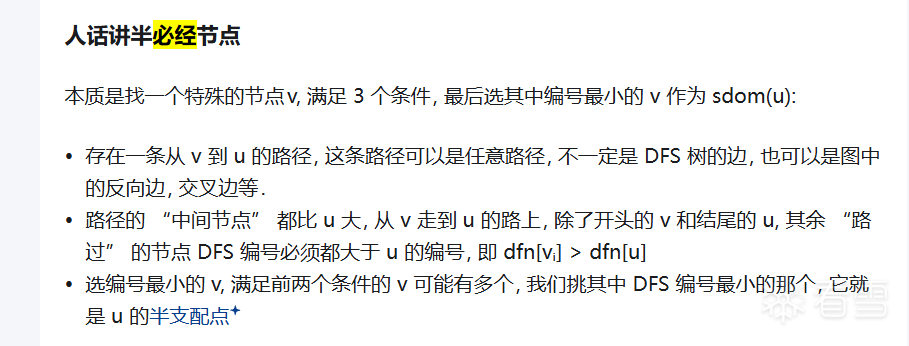
半支配节点: 只用于高效算支配树, 是个工具节点, Lengauer-Tarjan 算法.
维护 Worklist 等, 方便后续处理
收集调试信息
以条件分支指令为终止指令的基本块, 将其及其后继标记为活
无条件分支标记其为活
[内核课程]《Windows内核攻防实战》!从零到实战,融合AI与Windows内核攻防全技术栈,打造具备自动化能力的内核开发高手。