首页
课程
问答
CTF
社区
招聘
峰会
发现
排行榜
知识库
工具下载
看雪20年
看雪商城
证书查询
登录
注册
首页
社区
课程
招聘
发现
问答
CTF
排行榜
知识库
工具下载
峰会
看雪商城
证书查询
社区
Android安全
发新帖
15
13
[原创]DEX文件格式解析:深入Android字节码结构
发表于: 2025-12-20 17:49
88876
[原创]DEX文件格式解析:深入Android字节码结构
A0tem
2025-12-20 17:49
88876
# 大体框架 Dex(Dalvik Executable)是Android系统中Java字节码的优化格式,相比传统的class文件,Dex具有更高的执行效率和更小的文件体积。 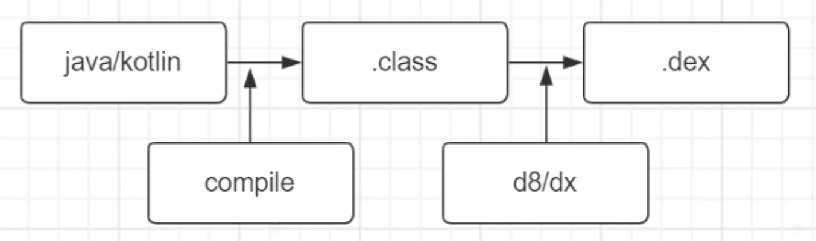 Dex文件整体架构 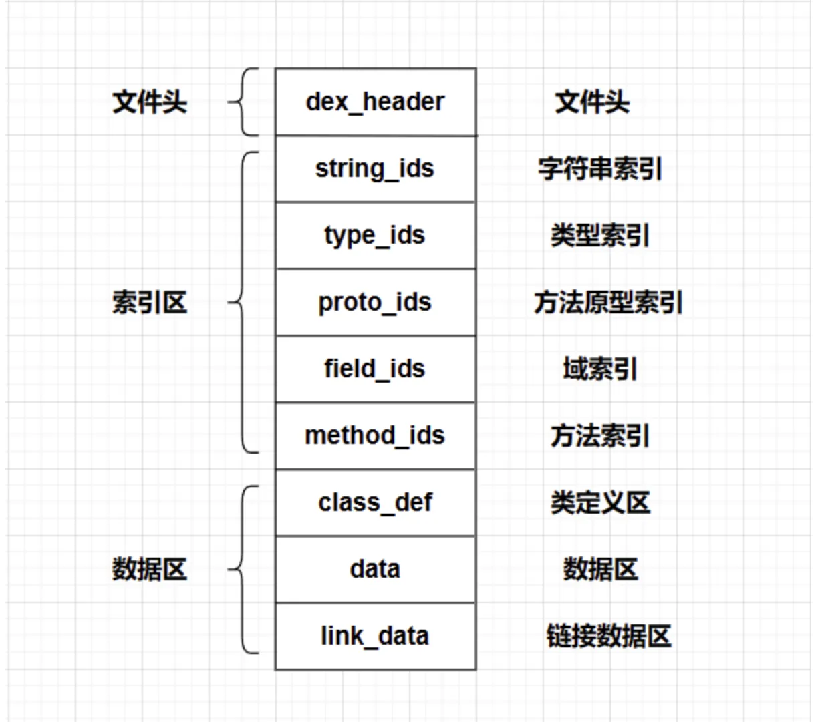 Dex文件采用索引+数据的分离设计,所有索引区在前,实际数据在后。这种设计优化了内存访问和加载速度。 ```plain 文件偏移 区域名称 作用 0x00 dex_header 文件头信息 0x70 string_ids 字符串索引表 ... type_ids 类型索引表 ... proto_ids 方法原型索引表 ... field_ids 字段索引表 ... method_ids 方法索引表 ... class_defs 类定义表 ... call_site_ids 调用点索引表(API 26+) ... method_handles 方法句柄表(API 26+) ... data 实际数据区 ... link_data 链接数据(可选) ``` # 数据类型 下面是解析Dex结构可能用到的数据类型 Android源码 定义了dex文件用到的数据结构 | 自定义类型 | 原类型 | 含义 | | :--- | :--- | :--- | | s1 | int8_t | 有符号单字节 | | u1 | uint8_t | 无符号单字节 | | s2 | int16_t | | | u2 | uint16_t | | | s4 | int32_t | | | u4 | uint32_t | | | s8 | int64_t | | | u8 | uint64_t | | | sleb128 | 无 | 有符号LEB128,可变长度 | | uleb128 | 无 | 无符号LEB128,可变长度 | | uleb128p1 | 无 | 等于ULEB128加1,可变长度 | ## LEB128 sleb128、uleb128、uleb128p1是**Dex文件中特有的LEB128类型**.在下述Android源码位置可以找到LEB128的实现. sleb128:有符号LEB128 uleb128:无符号LEB128 uleb128p1:uleb128+1 每个LEB128由1-5字节组成,所有字节组合在一起表示一个32位的数据, 每个字节只有**低7位为有效位**,**最高位标识是否需要使用额外字节** 如果第1个字节的最高位为1,表示LEB128需要使用第2个字节,如果第2个字节的最高位为1,表示会使用第3个字节,依次类推,直到最后一个字节的最高位为0 uleb128读取代码如下 值得注意的是参数为二级指针,也就是说,调用该函数时会移动一级指针,一级指针的偏移量即为读取到的uleb128的大小 ```plain int readUnsignedLeb128(const u1** pStream) { const u1* ptr = *pStream; //初始化 int result = *(ptr++); //获取第一个字节 if (result > 0x7f) { //如果第一个字节大于0x7f,那么就还有第二个字节 int cur = *(ptr++); //第二个字节 result = (result & 0x7f) | ((cur & 0x7f) << 7); //把两个字节合并 if (cur > 0x7f) { //继续处理 cur = *(ptr++); result |= (cur & 0x7f) << 14; if (cur > 0x7f) { cur = *(ptr++); result |= (cur & 0x7f) << 21; if (cur > 0x7f) { /* * Note: We don't check to see if cur is out of * range here, meaning we tolerate garbage in the * high four-order bits. */ cur = *(ptr++); result |= cur << 28; } } } } *pStream = ptr; return result; } ``` 将LEB128编码的字节序列解码为32位无符号整数。 合并两个字节的操作十分巧妙: ```plain 步骤1:result & 0x7f result = 0xAC = 1010 1100 0x7f = 0x7F = 0111 1111 result & 0x7f = 0010 1100 = 0x2C = 44 作用:去掉第一个字节的继续标志,只保留数据位 步骤2:cur & 0x7f cur = 0x02 = 0000 0010 0x7f = 0x7F = 0111 1111 cur & 0x7f = 0000 0010 = 0x02 = 2 作用:去掉第二个字节的继续标志(虽然本来就是0) 步骤3:(cur & 0x7f) << 7 (cur & 0x7f) = 2 = 0000 0010 左移7位后 = 0000 0010 0000 0000 = 256 作用:将第二个字节的数据放到正确的位置(bit 7-13) 步骤4:最终合并 (result & 0x7f) = 44 = 0000 0000 0010 1100 ((cur & 0x7f) << 7) = 256 = 0000 0001 0000 0000 ───────────────────── 最终result = 44 | 256 = 300 = 0000 0001 0010 1100 ``` ## encode_value encoded_value是Dex文件中用于**存储常量值**的通用编码格式。它可以表示各种类型的常量数据,如数字、字符串、类型引用等。 1. 注解参数值:@MyAnnotation(name="test", value=42) 2. 静态字段初始值:public static final String TAG = "MyClass" 3. 数组常量:public static final int[] NUMBERS = {1,2,3} ```plain // encoded_value不是固定结构体,而是变长的数据格式 // 由头字节 + 可变长度数据组成 struct encoded_value { u1 type_and_arg; // 头字节:(value_arg << 5) | value_type u1 data[]; // 可变长度数据,根据类型和参数决定长度 }; ``` ### 编码结构解析 头字节解析(1字节) ```plain // 格式:(value_arg << 5) | value_type // 位布局:AAA TTTTT // A = value_arg(高3位,0-7) // T = value_type(低5位,0-31) u1 header = (value_arg << 5) | value_type; // 解析方式 u1 value_type = header & 0x1F; // 提取低5位 u1 value_arg = (header >> 5) & 0x07; // 提取高3位 ``` value_type含义(低五位) 指定数据的类型格式: ```plain #define VALUE_BYTE 0x00 // 字节值 #define VALUE_SHORT 0x02 // 短整型 #define VALUE_CHAR 0x03 // 字符 #define VALUE_INT 0x04 // 整型 #define VALUE_LONG 0x06 // 长整型 #define VALUE_FLOAT 0x10 // 浮点数 #define VALUE_DOUBLE 0x11 // 双精度浮点数 #define VALUE_METHOD_TYPE 0x15 // 方法类型 #define VALUE_METHOD_HANDLE 0x16 // 方法句柄 #define VALUE_STRING 0x17 // 字符串索引 #define VALUE_TYPE 0x18 // 类型索引 #define VALUE_FIELD 0x19 // 字段索引 #define VALUE_METHOD 0x1A // 方法索引 #define VALUE_ENUM 0x1B // 枚举值 #define VALUE_ARRAY 0x1C // 数组 #define VALUE_ANNOTATION 0x1D // 注解 #define VALUE_NULL 0x1E // null值 #define VALUE_BOOLEAN 0x1F // 布尔值 ``` value_arg函数(高3位) 根据类型不同,含义不同: 对于数值类型:value_arg = 字节数 - 1 ```plain // 整数42只需1字节存储 value_arg = 1 - 1 = 0 // 整数65536需要3字节存储 value_arg = 3 - 1 = 2 ``` 对于布尔类型:value_arg直接表示值 ```plain // true: value_arg = 1 // false: value_arg = 0 ``` 对于索引类型(STRING、TYPE、FIELD、METHOD) value_arg = 索引字节数 - 1 ```plain // 字符串索引15,需要1字节 value_type = VALUE_STRING (0x17) value_arg = 1 - 1 = 0 header = (0 << 5) | 0x17 = 0x17 // 字符串索引300,需要2字节 value_type = VALUE_STRING (0x17) value_arg = 2 - 1 = 1 header = (1 << 5) | 0x17 = 0x37 ``` 对于特殊类型(NULL,ARRAY等) value_arg通常为0或有特殊含义 ```plain // NULL值 value_type = VALUE_NULL (0x1E) value_arg = 0 // 固定为0 header = (0 << 5) | 0x1E = 0x1E // 数组 value_type = VALUE_ARRAY (0x1C) value_arg = 0 // 固定为0,大小用uleb128单独编码 header = (0 << 5) | 0x1C = 0x1C ``` ## encoded_array encoded_array是Dex文件中用于存储数组常量的数据结构,主要用于: 1. 静态字段初始值数组 2. 注解参数中的数组值 3. 枚举值列表 数据结构定义: ```plain encoded_array { uleb128 size; // 数组元素个数 encoded_value values[]; // 数组元素,每个都是encoded_value } ``` | 名称 | 格式 | 说明 | | :--- | :--- | :--- | | size | uleb128 | 数组中的元素数量 | | values | encoded_value[size] | 采用本部分所指定格式的一系列 `size`<br/>`encoded_value`<br/> 字节序列;依序串联。 | 由于encoded_array.values数组元素为encoded_value,所以每个元素的大小不固定,不能当作一般的数组解析 ## encoded_annotation encoded_annotation是Dex文件中用于**存储注解实例**的数据结构,它表示一个具体的注解及其参数值。 ```plain encoded_annotation { uleb128 type_idx; // 注解类型的type_ids索引 uleb128 size; // 注解元素个数 annotation_element elements[]; // 注解元素数组 } annotation_element { uleb128 name_idx; // 元素名称的string_ids索引 encoded_value value; // 元素值 } ``` 该类型主要在DexClassDef的Annotations部分使用,此处仅做介绍 | 名称 | 格式 | 说明 | | :--- | :--- | :--- | | type_idx | uleb128 | 注释的类型。这种类型必须是“类”(而非“数组”或“基元”)。 | | size | uleb128 | 此注解中 name-value 映射的数量 | | elements | annotation_element[size] | 注解的元素,直接以内嵌形式(不作为偏移量)表示。元素必须按 `string_id`<br/> 索引以升序进行排序。 | 注解是什么? ```plain @Override // 这是注解 public String toString() { return "MyClass"; } @MyAnnotation(value = "test", count = 42) // 带参数的注解 public class MyClass { @Nullable // 标记可能为null private String name; @Inject // 依赖注入标记 private UserService userService; } ``` 特点: + 编译后保留在字节码中 + 程序运行时可以读取和处理 + 影响程序的实际行为 + 可以携带参数和数据 # 文件头 官方好像不支持头文件,所以我们需要手搓或者偷一个,这里直接去安卓源码copy一下 <a href="elink@f05K9s2c8@1M7s2y4Q4x3@1q4Q4x3V1k6Q4x3V1k6S2L8X3c8J5L8$3W2V1i4K6u0W2k6$3!0G2k6$3I4W2M7$3!0#2M7X3y4W2i4K6u0W2j5$3!0E0i4K6u0r3M7r3I4S2N6r3k6G2M7X3#2Q4x3V1k6V1j5h3I4$3K9h3E0Q4x3V1k6Q4x3V1u0Q4x3V1k6J5k6h3k6K6i4K6u0r3K9r3g2S2k6s2y4Q4x3V1k6E0j5i4y4@1k6i4u0Q4x3V1k6D9K9h3u0V1k6i4S2Q4x3V1k6p5k6i4S2r3K9h3I4W2i4K6u0W2K9l9`.`."><mark class="encrypted">6e9K9s2c8@1M7s2y4Q4x3@1q4Q4x3V1k6Q4x3V1k6S2L8X3c8J5L8$3W2V1i4K6u0W2k6$3!0G2k6$3I4W2M7$3!0#2M7X3y4W2i4K6u0W2j5$3!0E0i4K6u0r3M7r3I4S2N6r3k6G2M7X3#2Q4x3V1k6V1j5h3I4$3K9h3E0Q4x3V1k6Q4x3V1u0Q4x3V1k6J5k6h3k6K6i4K6u0r3K9r3g2S2k6s2y4Q4x3V1k6E0j5i4y4@1k6i4u0Q4x3V1k6D9K9h3u0V1k6i4S2Q4x3V1k6p5k6i4S2r3K9h3I4W2i4K6u0W2K9l9`.`.</mark></a> <a href="elink@661K9s2c8@1M7s2y4Q4x3@1q4Q4x3V1k6Q4x3V1k6S2L8X3c8J5L8$3W2V1i4K6u0W2k6$3!0G2k6$3I4W2M7$3!0#2M7X3y4W2i4K6u0W2j5$3!0E0i4K6u0r3M7r3I4S2N6r3k6G2M7X3#2Q4x3V1k6S2M7Y4c8Q4x3V1k6Q4x3V1u0Q4x3V1k6J5k6h3k6K6i4K6u0r3K9r3g2S2k6s2y4Q4x3V1k6E0j5i4y4@1k6i4u0Q4x3V1k6D9K9h3u0V1k6i4S2X3K9h3I4W2i4K6u0r3k6r3g2^5i4K6u0r3k6r3g2^5i4K6g2X3k6X3W2D9k6g2)9J5k6h3R3`."><mark class="encrypted">ac4K9s2c8@1M7s2y4Q4x3@1q4Q4x3V1k6Q4x3V1k6S2L8X3c8J5L8$3W2V1i4K6u0W2k6$3!0G2k6$3I4W2M7$3!0#2M7X3y4W2i4K6u0W2j5$3!0E0i4K6u0r3M7r3I4S2N6r3k6G2M7X3#2Q4x3V1k6S2M7Y4c8Q4x3V1k6Q4x3V1u0Q4x3V1k6J5k6h3k6K6i4K6u0r3K9r3g2S2k6s2y4Q4x3V1k6E0j5i4y4@1k6i4u0Q4x3V1k6D9K9h3u0V1k6i4S2X3K9h3I4W2i4K6u0r3k6r3g2^5i4K6u0r3k6r3g2^5i4K6g2X3k6X3W2D9k6g2)9J5k6h3R3`.</mark></a> copy之后还需要修改,让ai来即可 ```plain struct dex_header { // 文件标识部分 uint8_t magic[8]; // "dex\n035\0" 魔数标识 uint32_t checksum; // 文件完整性校验 uint8_t signature[20]; // SHA-1数字签名 // 文件基本信息 uint32_t file_size; // 整个dex文件大小 uint32_t header_size; // 头部大小(固定0x70) uint32_t endian_tag; // 字节序标记 // 链接信息 uint32_t link_size; // 链接段大小 uint32_t link_off; // 链接段偏移 uint32_t map_off; // 映射表偏移 // 各索引区的大小和位置 uint32_t string_ids_size; // 字符串数量 uint32_t string_ids_off; // 字符串索引偏移 uint32_t type_ids_size; // 类型数量 uint32_t type_ids_off; // 类型索引偏移 uint32_t proto_ids_size; // 方法原型数量 uint32_t proto_ids_off; // 方法原型偏移 uint32_t field_ids_size; // 字段数量 uint32_t field_ids_off; // 字段索引偏移 uint32_t method_ids_size; // 方法数量 uint32_t method_ids_off; // 方法索引偏移 uint32_t class_defs_size; // 类定义数量 uint32_t class_defs_off; // 类定义偏移 // 数据区信息 uint32_t data_size; // 数据段大小 uint32_t data_off; // 数据段偏移 }; ``` ```plain Hello, Welcome to DexHeader Analyse Magic: dex 035 Version: 035 Checksum: 0x9d09f34b Signature: 1ec3d2fc52b75c887f9f4fd540e7d7366ce53740 File size: 3028 bytes Header size: 112 bytes Endian tag: 0x12345678 Link size: 0 Link offset: 0x00000000 Map offset: 0x00000b04 String IDs size: 60 String IDs offset: 0x00000070 Type IDs size: 20 Type IDs offset: 0x00000160 Proto IDs size: 4 Proto IDs offset: 0x000001b0 ``` 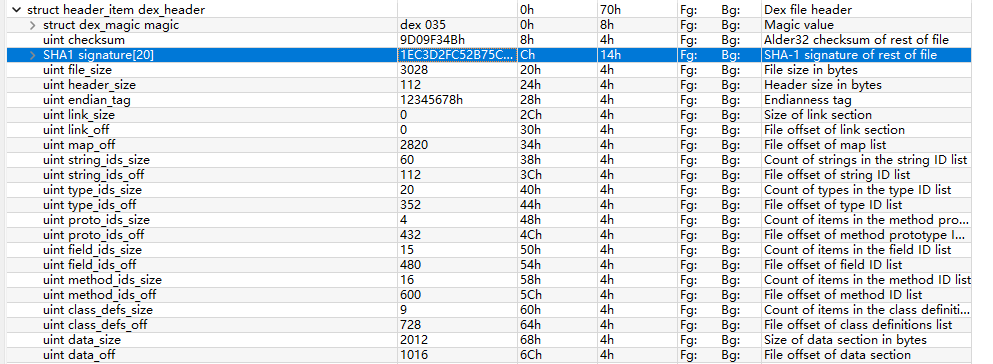 ## 文件头字段解析字段解析 **Magic** 魔数和版本 ```plain u1 magic[8]; // "dex\n035\0" 或 "dex\n038\0" ``` 作用:标识文件类型和DEX格式版本 格式: 1. 前4字节:"dex\n" (0x64 0x65 0x78 0x0A) - 文件标识 2. 中3字节:版本号,如 "035" (Android 5.0-7.1) 或 "038" (Android 8.0+) 3. 最后1字节:\0 空字符 用途:快速识别文件是否为DEX文件,以及使用的格式版本 **checksum校验和** ```plain u4 checksum; // Adler-32校验和 ``` 作用:验证文件完整性 计算范围:从signature字段开始到文件末尾的所有数据 算法:Adler-32(比CRC32更快但稍弱的校验算法) 用途:检测文件是否被损坏或篡改 **signature[20]-sha1签名** ```plain u1 signature[20]; // SHA-1哈希值 ``` 作用:文件的唯一标识和完整性验证 计算范围:从file_size字段开始到文件末尾 算法:SHA-1(160位/20字节) 用途: 1. 唯一标识DEX文件 2. 更强的完整性验证 3. 用于签名验证和缓存机制 **filesize-文件大小** ```plain u4 file_size; // 整个DEX文件的大小(字节) ``` 作用:记录DEX文件的总大小 用途: 1. 内存分配 2. 文件完整性检查 3. 确定文件边界 **Header_size-头部大小** ```plain u4 header_size; // 固定为0x70 (112字节) ``` 作用:DEX头部结构的大小 固定值:0x70 (112字节) 用途: 1. 向后兼容性 2. 确定数据区的起始位置 **endian_tag-字节序标记** ```plain u4 endian_tag; // 0x12345678 (小端) 或 0x78563412 (大端) ``` 作用:标识文件使用的字节序 标准值:0x12345678(小端序,Android标准) 用途: 1. 跨平台兼容性 2. 确定如何读取多字节数据 3. Android DEX文件统一使用小端序 **link_size & link_off 链接段** ```plain u4 link_size; // 链接段大小 u4 link_off; // 链接段偏移 ``` 作用:静态链接数据(很少使用) 通常值:都为0 用途:预留给静态链接的DEX文件使用(实际很少见) m**ap_off-映射表偏移** ```plain u4 map_off; // 映射表的文件偏移 ``` 作用:指向DEX文件的映射表(map_list) 用途: 1. 描述DEX文件的整体结构 2. 列出所有数据区的类型、大小和位置 3. 用于验证和解析DEX文件 ```plain struct map_list { u4 size; // 映射条目数量 struct map_item list[]; // 映射条目数组 }; ``` ```plain // 映射表项 struct map_item { u2 type; // 数据类型 u2 unused; // 未使用,对齐填充 u4 size; // 该类型的条目数量 u4 offset; // 该数据区在文件中的偏移 }; ``` 映射表具体指的是什么:映射表是Dex文件的完整目录 映射表在文件末尾(例子中在 0x00000b04),它会列出所有数据区: ```plain HEADER_ITEM → DEX头部 STRING_ID_ITEM → 字符串索引表 STRING_DATA_ITEM → 字符串实际内容 ← Header没有! TYPE_ID_ITEM → 类型索引表 TYPE_LIST → 参数类型列表 ← Header没有! PROTO_ID_ITEM → 方法原型表 FIELD_ID_ITEM → 字段表 METHOD_ID_ITEM → 方法表 CLASS_DEF_ITEM → 类定义表 CLASS_DATA_ITEM → 类的具体数据 ← Header没有! CODE_ITEM → 字节码 ← Header没有! DEBUG_INFO_ITEM → 调试信息 ← Header没有! ANNOTATION_ITEM → 注解 ← Header没有! MAP_LIST → 映射表自己 ``` 假设要找字符串"hello world" 方法一:只用Header ```plain 1. 读Header → string_ids_off = 0x70 2. 去0x70位置 → 找到string_id_item[5] = 0x000001f8 3. 0x000001f8是什么?不知道!Header没说字符串数据在哪 ``` 方法二:用映射表 ```plain 1. 读Header → map_off = 0xb04 2. 去0xb04读映射表 → 找到TYPE_STRING_DATA_ITEM在0x1e0 3. 读Header → string_ids_off = 0x70 4. 去0x70位置 → 找到string_id_item[5] = 0x000001f8 5. 去0x1f8位置 → 读到 "Hello World" ``` **** 解析代码 ```plain void AnalyseMapList(struct dex_header* header) { u4 map_off = header->map_off; // 定位到map_list struct map_list* map = (struct map_list*)(dex_data + map_off); printf("\n========== Map List (Mapping table) ==========\n"); printf("Mapping table offset: 0x%08x\n", map_off); printf("Number of mapping entries: %u\n\n", map->size); printf("%-30s %-10s %-10s\n", "TYPE", "SIZE", "OFFSET"); printf("------------------------------------------------------\n"); for (u4 i = 0; i < map->size; i++) { const char* type_name = get_map_type_name(map->list[i].type); u4 size = map->list[i].size; u4 offset = map->list[i].offset; printf("%-30s %-10u 0x%08x\n", type_name, size, offset); } return; } ``` ```plain const char* get_map_type_name(u2 type) { switch (type) { case TYPE_HEADER_ITEM: return "HEADER_ITEM"; case TYPE_STRING_ID_ITEM: return "STRING_ID_ITEM"; case TYPE_TYPE_ID_ITEM: return "TYPE_ID_ITEM"; case TYPE_PROTO_ID_ITEM: return "PROTO_ID_ITEM"; case TYPE_FIELD_ID_ITEM: return "FIELD_ID_ITEM"; case TYPE_METHOD_ID_ITEM: return "METHOD_ID_ITEM"; case TYPE_CLASS_DEF_ITEM: return "CLASS_DEF_ITEM"; case TYPE_CALL_SITE_ID_ITEM: return "CALL_SITE_ID_ITEM"; case TYPE_METHOD_HANDLE_ITEM: return "METHOD_HANDLE_ITEM"; case TYPE_MAP_LIST: return "MAP_LIST"; case TYPE_TYPE_LIST: return "TYPE_LIST"; case TYPE_ANNOTATION_SET_REF_LIST: return "ANNOTATION_SET_REF_LIST"; case TYPE_ANNOTATION_SET_ITEM: return "ANNOTATION_SET_ITEM"; case TYPE_CLASS_DATA_ITEM: return "CLASS_DATA_ITEM"; case TYPE_CODE_ITEM: return "CODE_ITEM"; case TYPE_STRING_DATA_ITEM: return "STRING_DATA_ITEM"; case TYPE_DEBUG_INFO_ITEM: return "DEBUG_INFO_ITEM"; case TYPE_ANNOTATION_ITEM: return "ANNOTATION_ITEM"; case TYPE_ENCODED_ARRAY_ITEM: return "ENCODED_ARRAY_ITEM"; case TYPE_ANNOTATIONS_DIRECTORY_ITEM: return "ANNOTATIONS_DIRECTORY_ITEM"; default: return "UNKNOWN"; } } ``` 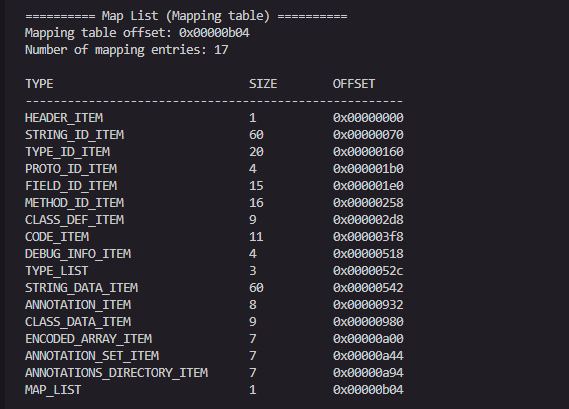 **string_ids_size & string_ids_off-字符串索引表** ```plain u4 string_ids_size; // 字符串数量 u4 string_ids_off; // 字符串索引表偏移 ``` 作用:管理DEX中所有的字符串 内容:类名、方法名、字段名、常量字符串等 结构:每个条目4字节,指向实际字符串数据 用途: 1. 字符串去重(所有相同字符串只存储一次) 2. 通过索引快速访问字符串 **type_ids_size&type_ids_off-类型索引表** ```plain u4 type_ids_size; // 类型数量 u4 type_ids_off; // 类型索引表偏移 ``` 作用:存储所有类型描述符 内容:类类型、基本类型、数组类型等 格式:每个条目4字节,指向string_ids中的类型描述符 **proto_ids_size & proto_ids_off-方法原型索引表** ```plain u4 proto_ids_size; // 方法原型数量 u4 proto_ids_off; // 方法原型索引表偏移 ``` 作用:存储方法签名(参数类型+返回类型) 内容:方法的参数列表和返回类型组合 结构:每个条目12字节 用途: 1. 方法签名去重 2. 快速匹配方法调用 ** field_ids_size & field_ids_off - 字段索引表** ```plain u4 field_ids_size; // 字段数量 u4 field_ids_off; // 字段索引表偏移 ``` 作用:**存储所有字段的引用** 内容:所属类、字段类型、字段名 结构:每个条目8字节 用途:字段访问和引用 **method_ids_size & method_ids_off - 方法索引表** ```plain u4 method_ids_size; // 方法数量 u4 method_ids_off; // 方法索引表偏移 ``` 作用:**存储所有方法的引用** 内容:所属类、方法原型、方法名 结构:每个条目8字节 用途: 1. 方法调用 2. 方法查找 3. Hook点定位(逆向分析重点) **class_defs_size & class_defs_off - 类定义表** ```plain u4 class_defs_size; // 类定义数量 u4 class_defs_off; // 类定义表偏移 ``` 作用:存储DEX中定义的所有类 内容:类的完整信息(字段、方法、访问标志等) 结构:每个条目32字节 用途: 1. 类加载 2. 反射 3. 逆向分析的主要目标 **data_size & data_off - 数据段** ```plain u4 data_size; // 数据段大小 u4 data_off; // 数据段偏移 ``` 作用:存储实际的代码和数据 内容: 1. 字节码指令 2. 字符串数据 3. 注解 4. 调试信息等 特点:通常占DEX文件的大部分空间 直接打印即可 ```plain void AnalyseDexHeader(struct dex_header* header) { printf("Hello, Welcome to DexHeader Analyse\n"); printf("Magic: %.8s\n", header->magic); printf("Version: %.3s\n", &header->magic[4]); // 版本号在magic字段的第4-6字节 printf("Checksum: 0x%08x\n", header->checksum); printf("Signature: "); for (int i = 0; i < 20; i++) { printf("%02x", header->signature[i]); } printf("\n"); printf("File size: %u bytes\n", header->file_size); printf("Header size: %u bytes\n", header->header_size); printf("Endian tag: 0x%08x\n", header->endian_tag); printf("Link size: %u\n", header->link_size); printf("Link offset: 0x%08x\n", header->link_off); printf("Map offset: 0x%08x\n", header->map_off); printf("String IDs size: %u\n", header->string_ids_size); printf("String IDs offset: 0x%08x\n", header->string_ids_off); printf("Type IDs size: %u\n", header->type_ids_size); printf("Type IDs offset: 0x%08x\n", header->type_ids_off); printf("Proto IDs size: %u\n", header->proto_ids_size); printf("Proto IDs offset: 0x%08x\n", header->proto_ids_off); return; } ``` 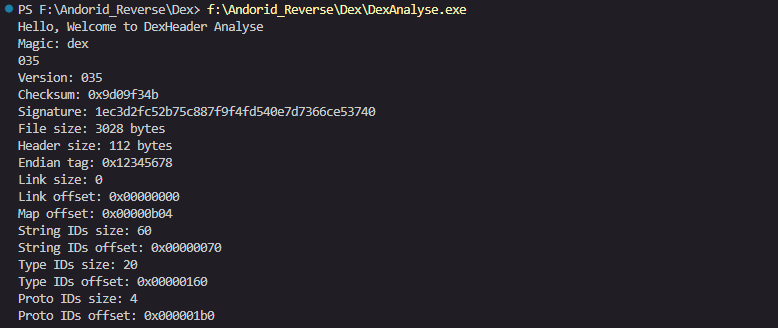 # 索引区 ## string_ids字符串索引区 ```plain struct string_id_item { uint32_t string_data_off; // 指向data区中字符串数据的偏移 }; ``` 实际字符串数据格式(在data区) ```plain struct string_data_item { uleb128 utf16_size; // UTF-16长度 uint8_t data[]; // MUTF-8编码的字符串 + 0x00结尾 }; ``` utf16_size: 数据类型:ULEB128变长编码 含义:字符串的UTF-16字符数量(不是字节数) 为什么用UTF-16长度:因为Java内部使用UTF-16编码,这个长度对应Java String的length()方法返回值 举例:字符串"Hello"的utf16_size = 5,中文"你好"的utf16_size = 2 data[]字段: 编码格式:MUTF-8 (Modified UTF-8) 结尾标记:必须以0x00字节结尾 长度:变长,实际字节数取决于字符内容和编码 什么是MUTF-8编码? MUTF-8 (Modified UTF-8) 是Java虚拟机使用的一种UTF-8变体,与标准UTF-8有几个关键区别 1. MUTF-8使用1~3字节编码 2. 大于16位的Unicode编码U+10000~U+10ffff使用3字节编码 3. U+000采用2字节编码 4. 以0x00空字符作为字符串结尾 需要注意MUTF-8编码和UTF-8编码不同的情况只有: 1. 遇到NULL字符 2. 遇到四字节字符如emoji MUTF-8字符串头部保存的是字符串长度,是uleb128类型 二级索引结构 ```plain DEX文件 ┌─────────────────────────────────────────────────────┐ │ Header │ │ string_ids_size = 60 │ │ string_ids_off = 0x70 ──────────────┐ │ ├─────────────────────────────────────────│───────────┤ │ 0x70: String IDs 表(索引表) │ │ │ ┌─────────────────────────────────────┘ │ │ ↓ │ │ string_id_item[0].string_data_off = 0x3a8 ───┐ │ │ string_id_item[1].string_data_off = 0x3b0 ───│─┐ │ │ string_id_item[2].string_data_off = 0x3b8 ───│─│─┐│ │ ... │ │ ││ ├────────────────────────────────────────────────│─│─│┤ │ 0x3a8: String Data(实际字符串内容) │ │ ││ │ ┌────────────────────────────────────────────┘ │ ││ │ ↓ │ ││ │ 0x3a8: [len=3] "dex" │ ││ │ 0x3b0: [len=3] "035" ←─────────────────────────┘ ││ │ 0x3b8: [len=1] "V" ←────────────────────────────┘│ │ ... │ └─────────────────────────────────────────────────────┘ ``` 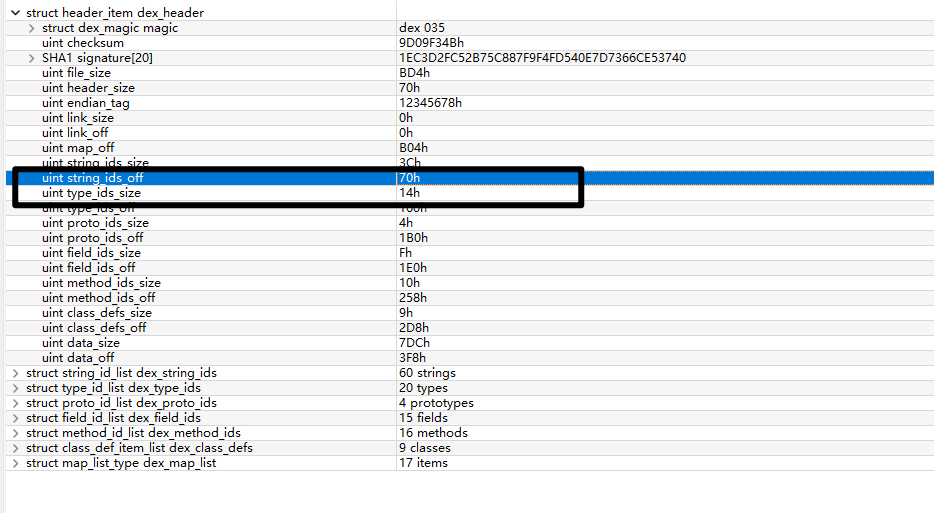 所以0x70就是string_id的起始位置,0x3C转换即为60,也就是string_id的数量 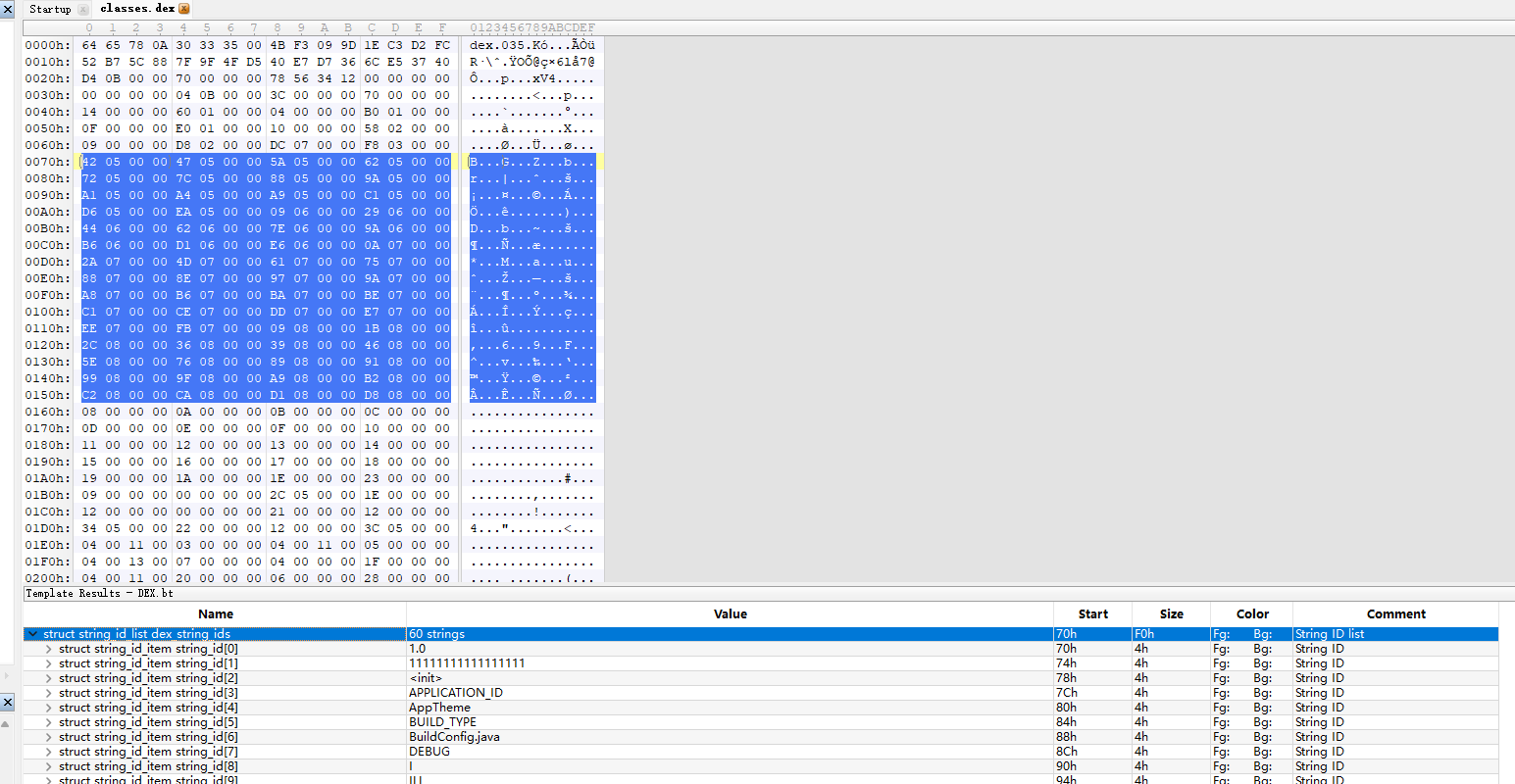 可以看到存储的字符串为"1.0" 我们看一下第一个字符串  可以看到string_data_off为0x542 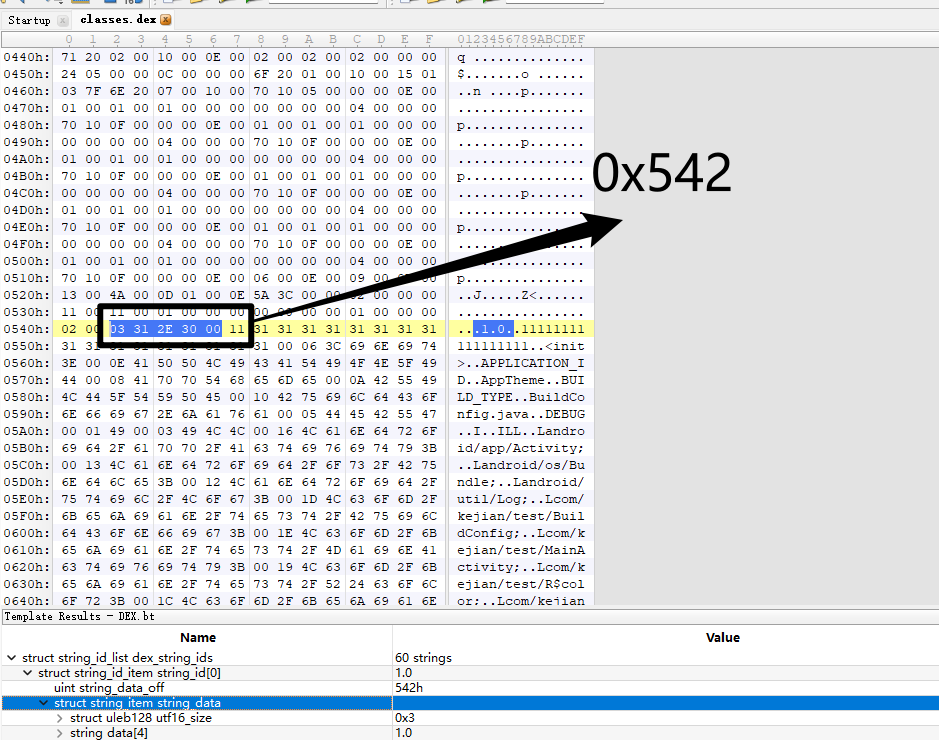 03 31 2E 30 00 0x3表示长度为UTF-16字符长度为3 MUTF-8编码的字符串数据为"1.0"结尾为00 我们再以一个最长的为例子 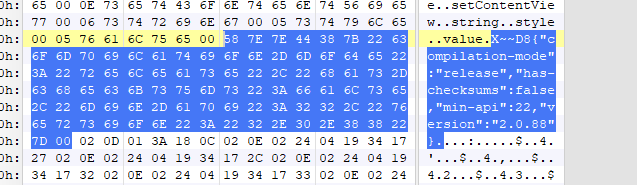 ```plain 58 7E 7E 44 38 7B 22 63 6F 6D 70 69 6C 61 74 69 6F 6E 2D 6D 6F 64 65 22 3A 22 72 65 6C 65 61 73 65 22 2C 22 68 61 73 2D 63 68 65 63 6B 73 75 6D 73 22 3A 66 61 6C 73 65 2C 22 6D 69 6E 2D 61 70 69 22 3A 32 32 2C 22 76 65 72 73 69 6F 6E 22 3A 22 32 2E 30 2E 38 38 22 7D 00 ``` 首先第一个字节0x58即为后面data的长度88,由于结尾还有00,即为89 解析代码 ```plain void AnalyseDexString(struct dex_header* header) { u4 string_ids_size = header->string_ids_size; printf("\n========== String IDs (String table) ==========\n"); printf("Total number of strings: %u\n\n", string_ids_size); // 遍历每个字符串,使用辅助函数 for (u4 i = 0; i < string_ids_size; i++) { const char* str = get_string_by_idx(i); printf("String[%u]: \"%s\"\n", i, str); } return; } ``` 辅助函数为: ```plain const char* get_string_by_idx(u4 string_idx) { if (string_idx >= header->string_ids_size) { return "INVALID_STRING_INDEX"; } struct string_id_item* string_ids = (struct string_id_item*)(dex_data + header->string_ids_off); u4 string_data_off = string_ids[string_idx].string_data_off; u1* ptr = dex_data + string_data_off; // 跳过ULEB128长度 while (*ptr & 0x80) ptr++; ptr++; return (const char*)ptr; } ``` 辅助函数处理不同长度的data[]利用了c语言字符串以NULL结尾的特性。 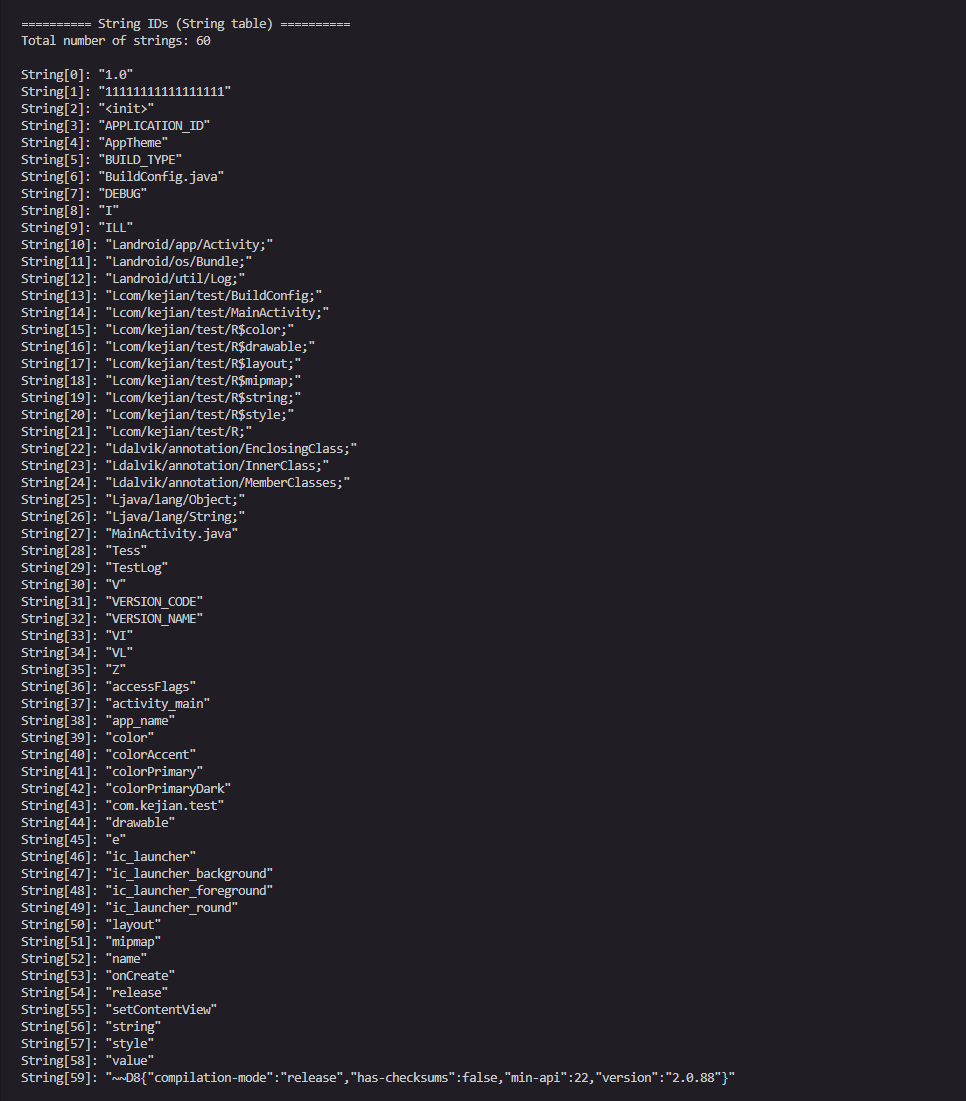 ## type_ids类型索引区 ```plain struct type_id_item { uint32_t descriptor_idx; // 指向string_ids的索引 }; ``` 作用:类型系统的核心 + 基本类型:I(int), Z(boolean), V(void) + 对象类型:Ljava/lang/String; + 数组类型:[I(int数组) 和string一样,读取的只是索引 ```plain Type IDs表 (0x160) String IDs表 (0x70) String Data ┌─────────────────┐ ┌─────────────────┐ ┌─────────────────┐ │ type_ids[0] │ │ string_ids[0] │ │ │ │ descriptor_idx│──┐ │ string_data_off│ │ │ │ = 15 │ │ ├─────────────────┤ │ │ ├─────────────────┤ │ │ string_ids[1] │ │ │ │ type_ids[1] │ │ │ ... │ │ │ │ descriptor_idx│ │ ├─────────────────┤ │ │ │ = 23 │ │ │ ... │ │ │ ├─────────────────┤ │ ├─────────────────┤ ├─────────────────┤ │ ... │ └─────>│ string_ids[15] │────────>│ "Ljava/lang/ │ └─────────────────┘ │ string_data_off│ │ Object;" │ │ = 0x2a0 │ ├─────────────────┤ ├─────────────────┤ │ │ │ ... │ │ │ └─────────────────┘ └─────────────────┘ ``` 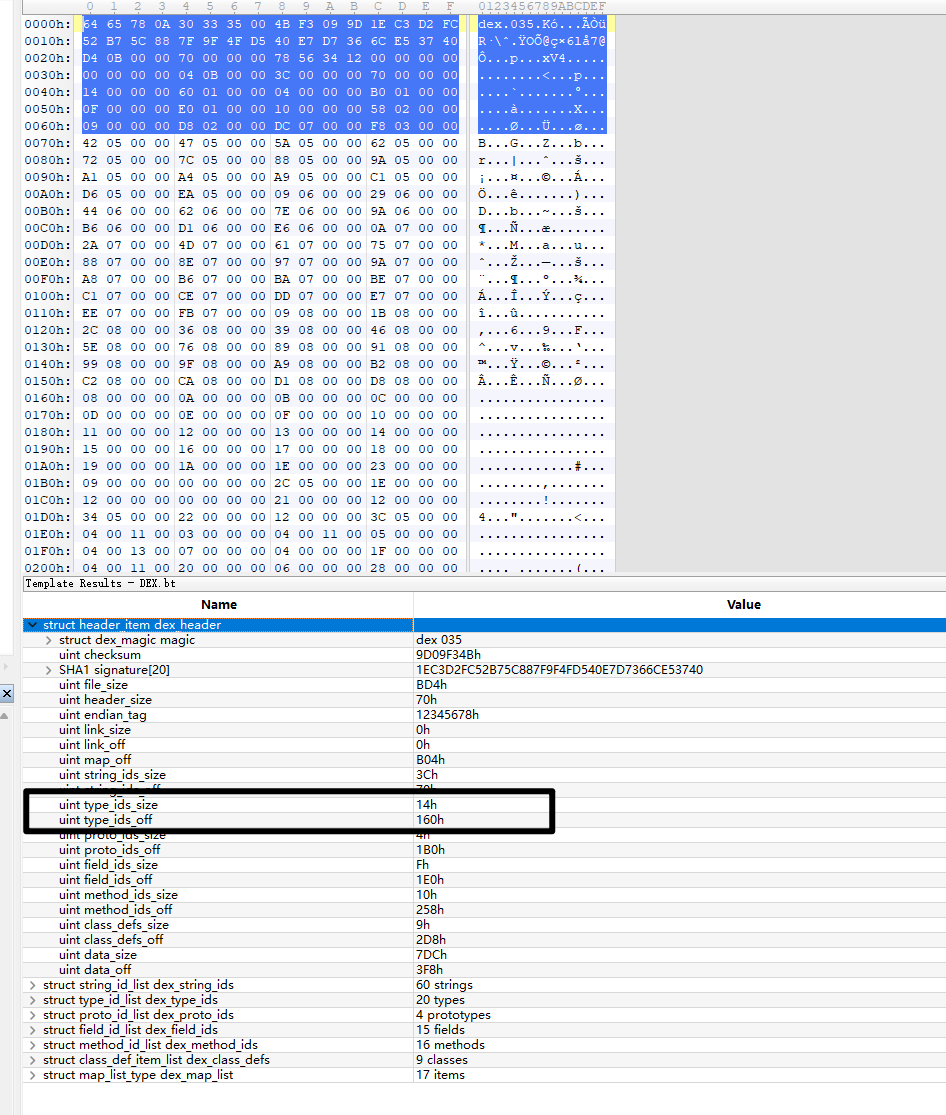 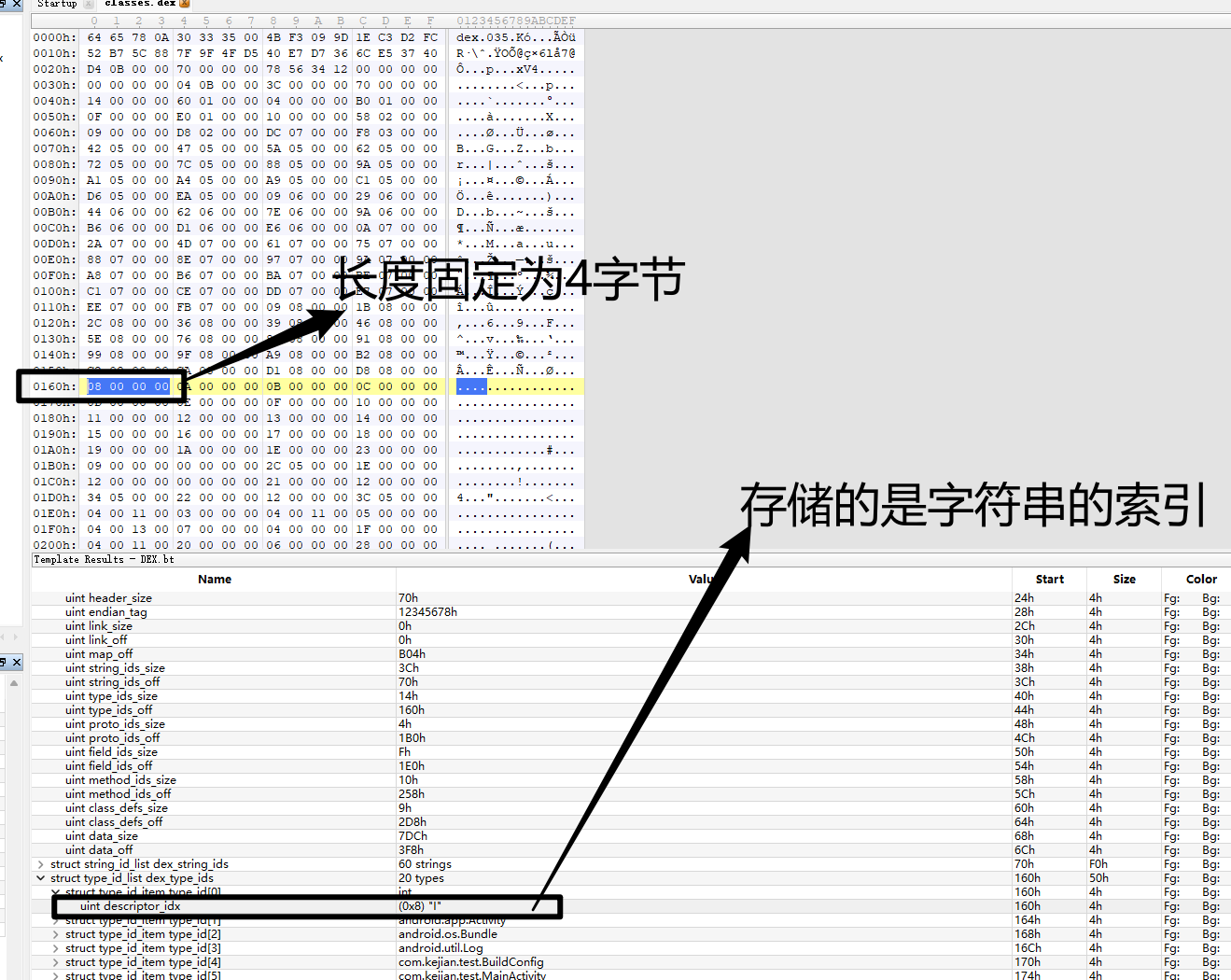 所以我们直接读取字符串即可获取类型了 ```plain 1. 读取 type_ids[i].descriptor_idx = 15 ↓ 2. 用15作为索引,读取 string_ids[15].string_data_off = 0x2a0 ↓ 3. 去0x2a0位置读取字符串 = "Ljava/lang/Object;" ``` ```plain void AnalyseTypeId(struct dex_header* header) { u4 type_ids_size = header->type_ids_size; printf("\n========== Type IDs (Type descriptor) ==========\n"); printf("Total number of types: %u\n\n", type_ids_size); // 遍历每个类型,使用辅助函数 for (u4 i = 0; i < type_ids_size; i++) { const char* type_desc = get_type_by_idx(i); printf("Type[%u]: %s\n", i, type_desc); } return; } ``` 辅助函数 ```plain const char* get_type_by_idx(u4 type_idx) { //安全性检查 if (type_idx >= header->type_ids_size) { return "INVALID_TYPE_INDEX"; } struct type_id_item* type_ids = (struct type_id_item*)(dex_data + header->type_ids_off); return get_string_by_idx(type_ids[type_idx].descriptor_idx); } ``` 这个辅助函数其实还是调用get_string_by_idx函数,只需要传进去正确的索引即可 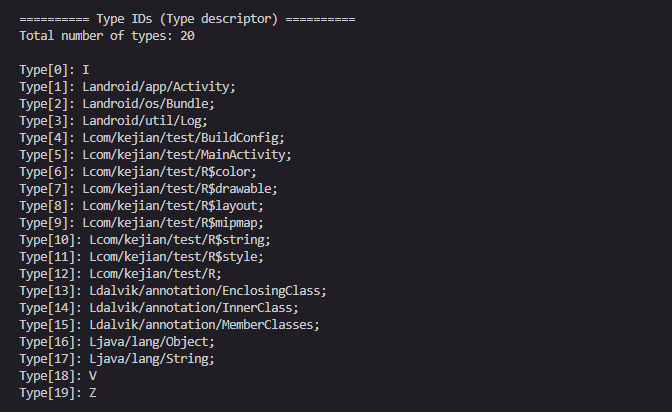 ## proto_ids方法原型索引区 ```plain struct proto_id_item { uint32_t shorty_idx; // 简短描述符的string_ids索引→ String IDs → "LLL" uint32_t return_type_idx; // 返回类型的type_ids索引→ Type IDs → "Ljava/lang/String;" uint32_t parameters_off; // 参数列表偏移(指向type_list)→ type_list → 参数类型列表 }; ``` shorty_idx和return_type_idx其实我们已经知道是什么了,那么parameters_off呢? 参数列表结构: ```plain struct type_list { uint32_t size; // 参数个数 struct type_item list[]; // 参数类型数组 }; struct type_item { uint16_t type_idx; // type_ids索引 }; ``` 其实这个还是指向type_ids 在我们逆向的时候,ProtoIDs就是我们见到的 ```plain String concat(String str1, String str2) ``` 对应的type_list ```plain struct type_list { size = 2, // 两个参数 list = [17, 17] // 都指向type_ids[17] = "Ljava/lang/String;" } ```  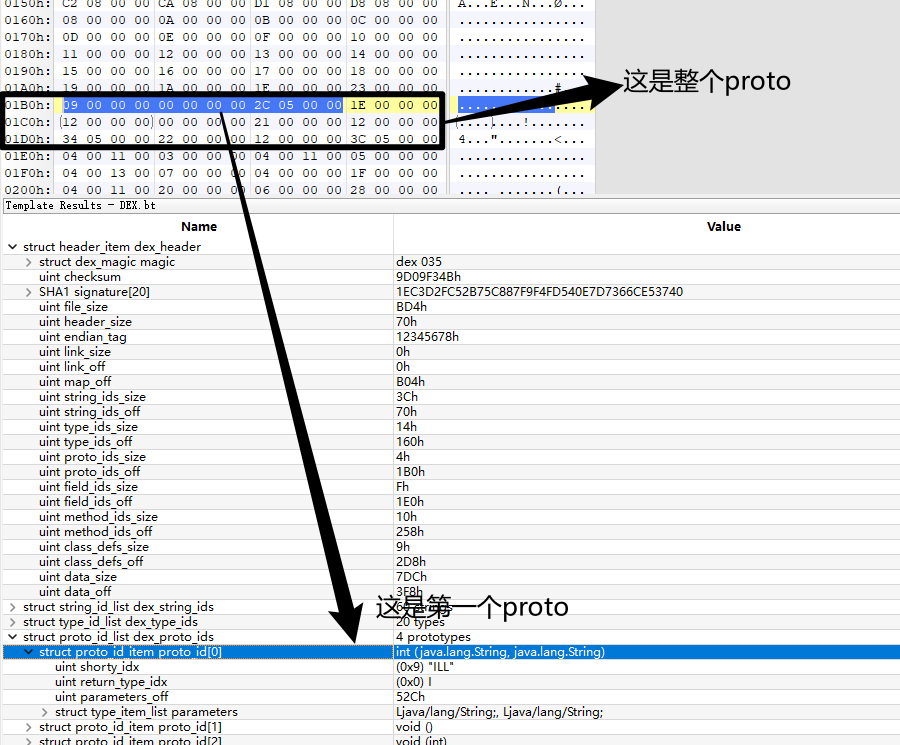  第一个在字符串的索引为9,第二个type_idx为0,那么就按照type_idx的解析方式解析,type_idx为0,对应的string为I 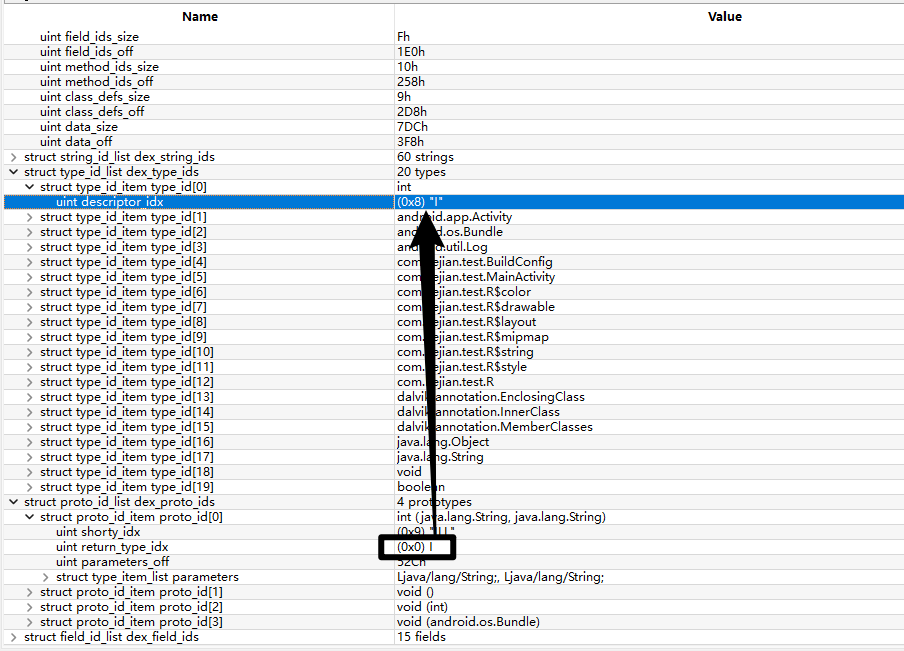 现在我们去找一下uint parameters_off值为0x52C 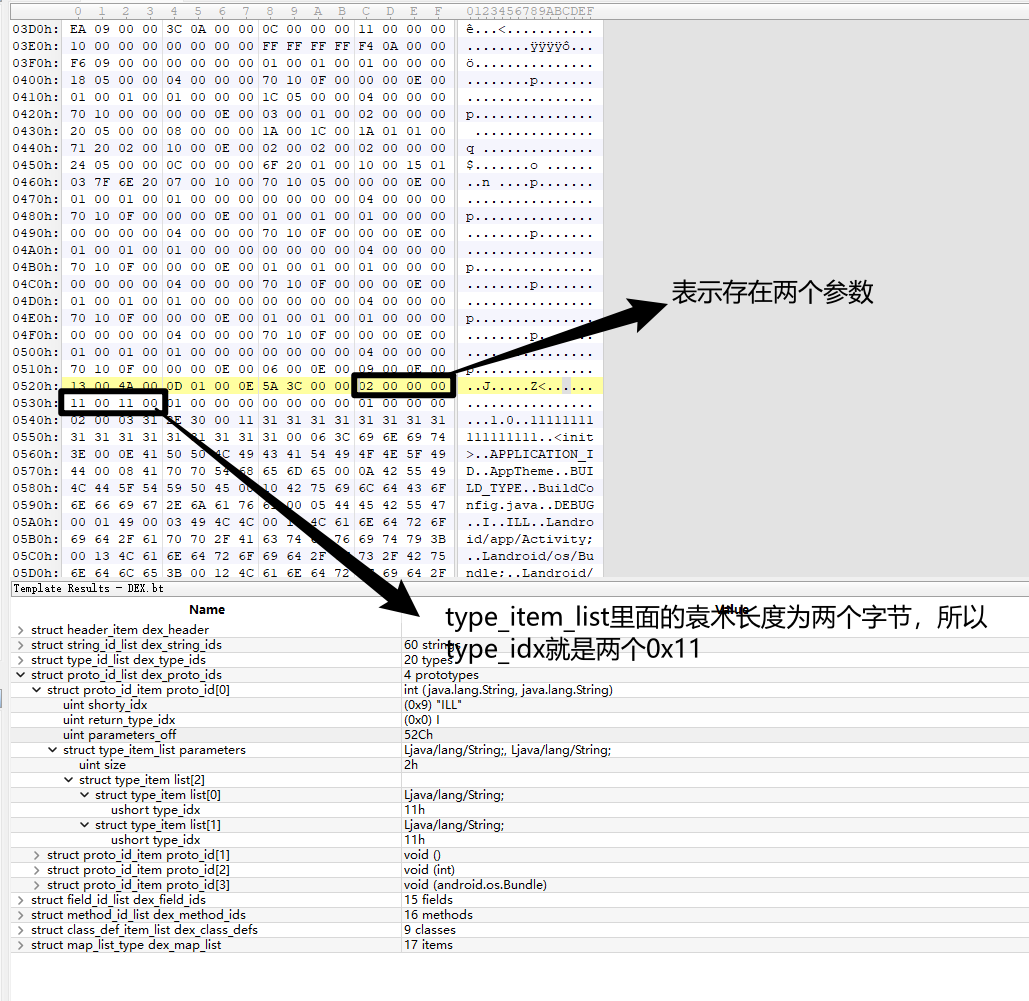 0x11也就是17,即  可以和上图对照验证 解析代码 ```plain void AnalyseProtoId(struct dex_header* header) { u4 proto_ids_size = header->proto_ids_size; u4 proto_ids_off = header->proto_ids_off; // 定位到proto_ids表 struct proto_id_item* proto_ids = (struct proto_id_item*)(dex_data + proto_ids_off); printf("\n========== Proto IDs (Method prototype) ==========\n"); printf("Total number of method prototypes: %u\n\n", proto_ids_size); for (u4 i = 0; i < proto_ids_size; i++) { // 获取简短描述符 (shorty) const char* shorty = get_string_by_idx(proto_ids[i].shorty_idx); // 获取返回类型 const char* return_type = get_type_by_idx(proto_ids[i].return_type_idx); // 获取参数列表偏移 u4 parameters_off = proto_ids[i].parameters_off; printf("Proto[%u]:\n", i); printf(" Shorty: %s\n", shorty); printf(" Return: %s\n", return_type); // 解析参数列表 if (parameters_off == 0) { printf(" Params: (none)\n"); } else { struct type_list* params = (struct type_list*)(dex_data + parameters_off); printf(" Params: ("); for (u4 j = 0; j < params->size; j++) { const char* param_type = get_type_by_idx(params->list[j]); printf("%s", param_type); if (j < params->size - 1) printf(", "); } printf(")\n"); } printf("\n"); } return; } ``` 辅助函数都是原来用过的,就不讲解了 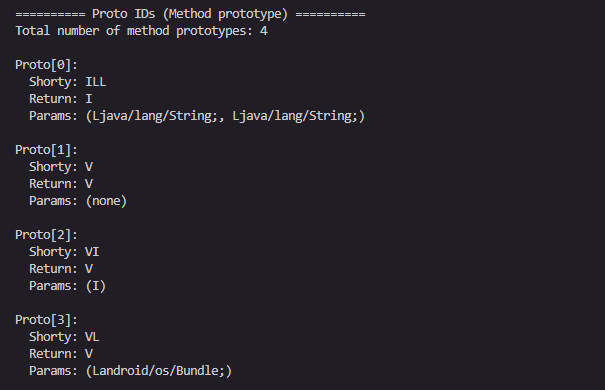 ## field_ids字段索引区 存储所有字段的索引 ```plain struct field_id_item { uint16_t class_idx; // 所属类的type_ids索引 uint16_t type_idx; // 字段类型的type_ids索引 uint32_t name_idx; // 字段名的string_ids索引 }; ``` 对应java代码 ```plain public class MainActivity { private String TAG = "test"; // Field: MainActivity -> String TAG private int count = 0; // Field: MainActivity -> int count } ```  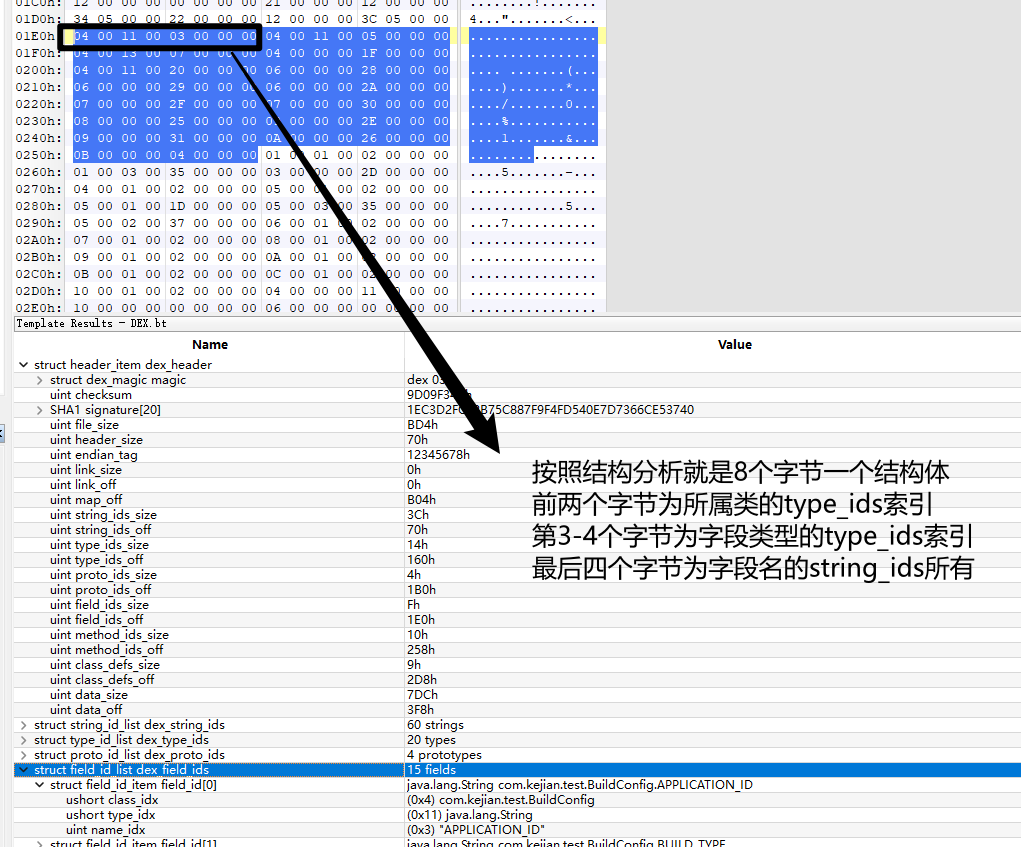 这个比较简单,都是我们刚才学过的概念 ```plain void AnalyseFieldId(struct dex_header* header) { u4 field_ids_size = header->field_ids_size; u4 field_ids_off = header->field_ids_off; // 定位到field_ids表 struct field_id_item* field_ids = (struct field_id_item*)(dex_data + field_ids_off); printf("\n========== Field IDs (Field table) ==========\n"); printf("Total number of fields: %u\n\n", field_ids_size); for (u4 i = 0; i < field_ids_size; i++) { // 获取所属类 const char* class_name = get_type_by_idx(field_ids[i].class_idx); // 获取字段类型 const char* field_type = get_type_by_idx(field_ids[i].type_idx); // 获取字段名 const char* field_name = get_string_by_idx(field_ids[i].name_idx); printf("Field[%u]: %s -> %s %s\n", i, class_name, field_type, field_name); } return; } ``` 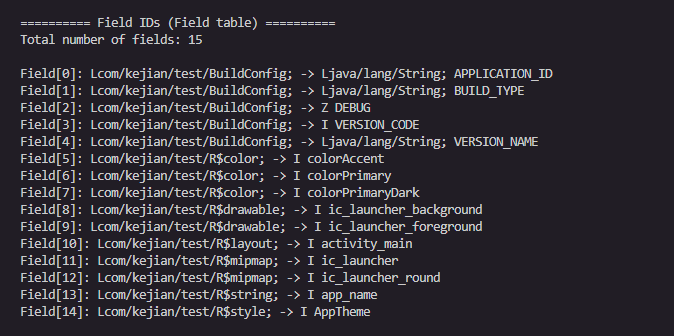 ## method_ids方法索引区 存储所有方法的引用 ```plain struct method_id_item { uint16_t class_idx; // 所属类的type_ids索引 uint16_t proto_idx; // 方法原型的proto_ids索引 uint32_t name_idx; // 方法名的string_ids索引 }; ``` 类似 ```plain Method IDs[i] │ ├── class_idx ──→ Type IDs ──→ "Lcom/kejian/test/MainActivity;" │ ├── proto_idx ──→ Proto IDs ──→ shorty="VL", return="V", params=(Bundle) │ └── name_idx ──→ String IDs ──→ "onCreate" ``` 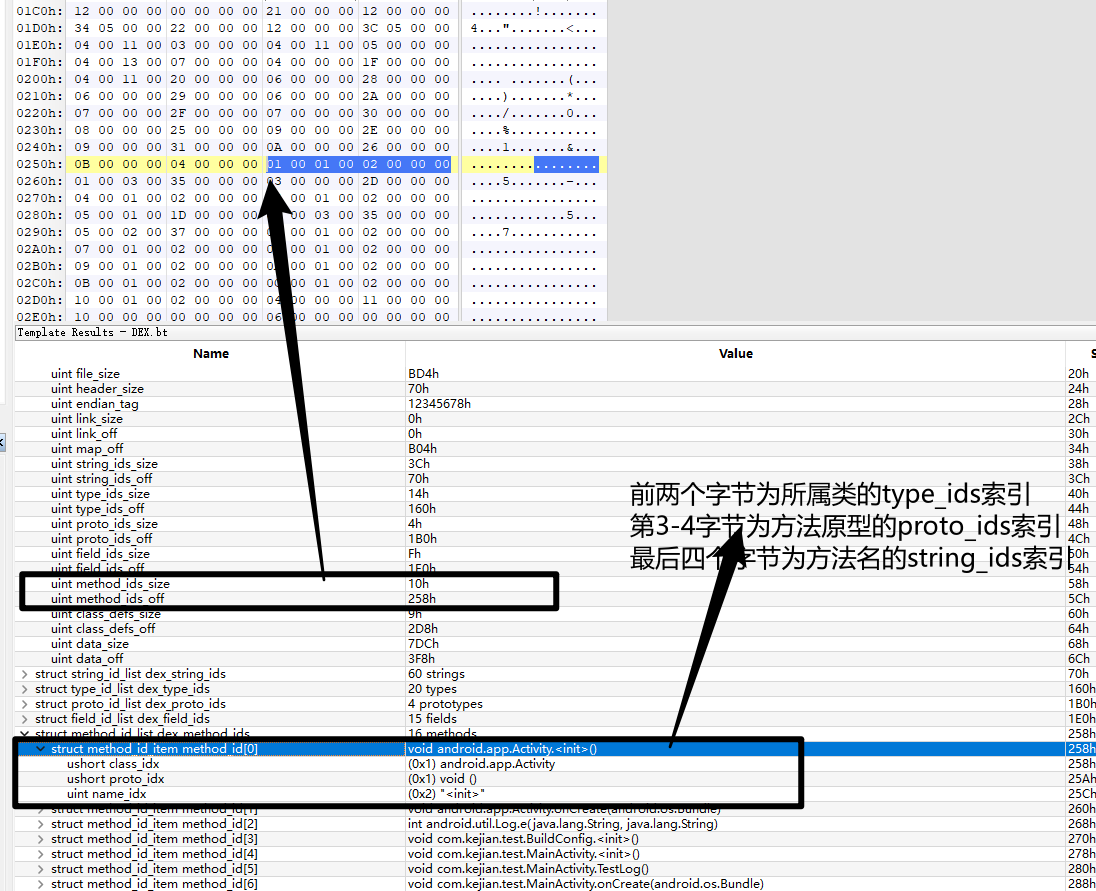 第二个字段proto_idx 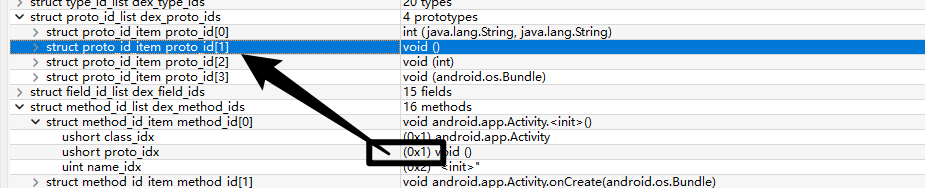 解析代码 ```plain void AnalyseMethodId(struct dex_header* header) { u4 method_ids_size = header->method_ids_size; u4 method_ids_off = header->method_ids_off; // 定位到method_ids表 struct method_id_item* method_ids = (struct method_id_item*)(dex_data + method_ids_off); // 定位到proto_ids表(用于获取方法原型) struct proto_id_item* proto_ids = (struct proto_id_item*)(dex_data + header->proto_ids_off); printf("\n========== Method IDs (Method table) ==========\n"); printf("Total number of methods: %u\n\n", method_ids_size); for (u4 i = 0; i < method_ids_size; i++) { // 获取所属类 const char* class_name = get_type_by_idx(method_ids[i].class_idx); // 获取方法名 const char* method_name = get_string_by_idx(method_ids[i].name_idx); // 获取方法原型的简短描述符 u2 proto_idx = method_ids[i].proto_idx; const char* shorty = get_string_by_idx(proto_ids[proto_idx].shorty_idx); const char* return_type = get_type_by_idx(proto_ids[proto_idx].return_type_idx); printf("Method[%u]: %s -> %s %s() [%s]\n", i, class_name, return_type, method_name, shorty); } return; } ``` 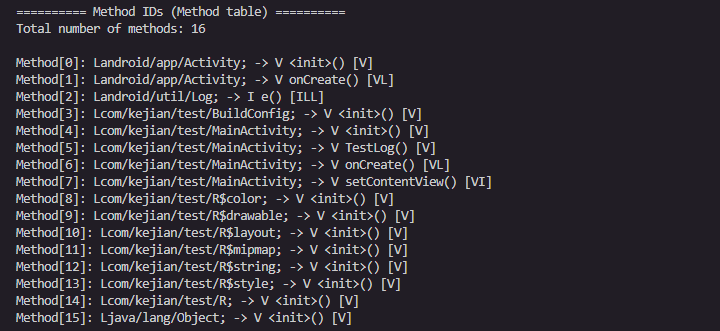 # 数据区 **这是最复杂的部分** ## class_def(类定义) Class Defs(类定义)是DEX文件中本DEX定义的类的完整信息。 ```plain struct class_def_item { u4 class_idx; // 类名索引 u4 access_flags; // 访问标志 (public/final/abstract等) u4 superclass_idx; // 父类索引 u4 interfaces_off; // 接口列表偏移 u4 source_file_idx; // 源文件名索引 u4 annotations_off; // 注解信息 u4 class_data_off; // 类数据(字段和方法的具体定义) u4 static_values_off; // 静态字段初始值 }; ``` ### **class_idx-类标识** 含义: 指向**type_ids表**,标识这个类的类型 示例: type_ids[5] → "Lcom/example/MainActivity;" 用途: 获取类的完整限定名,也就是类名 ### **superclass_idx-父类** **** 含义: 指向**type_ids表**,标识父类 特殊值: 0xFFFFFFFF (DEX_NO_INDEX) 表示没有父类 注意: 只有java.lang.Object没有父类 ### **source_file_idx-源文件** **** 含义: 指向**string_ids表**,表示源文件名 示例: "MainActivity.java" 可选:可能为DEX_NO_INDEX(混淆或优化时) ```plain void AnalyseClassDef(struct dex_header* header) { u4 class_defs_size = header->class_defs_size; u4 class_defs_off = header->class_defs_off; // 定位到class_defs表 struct class_def_item* class_defs = (struct class_def_item*)(dex_data + class_defs_off); printf("\n========== Class Defs (Class Definition table) ==========\n"); printf("Total number of class definitions: %u\n\n", class_defs_size); for (u4 i = 0; i < class_defs_size; i++) { printf("==================== Class[%u] ====================\n", i); // 获取类名 const char* class_name = get_type_by_idx(class_defs[i].class_idx); // 获取父类名 (0xFFFFFFFF表示无父类,即java.lang.Object) const char* superclass_name = "none"; if (class_defs[i].superclass_idx != DEX_NO_INDEX) { superclass_name = get_type_by_idx(class_defs[i].superclass_idx); } // 获取源文件名 (可能为空) const char* source_file = "unknown"; if (class_defs[i].source_file_idx != DEX_NO_INDEX) { source_file = get_string_by_idx(class_defs[i].source_file_idx); } ...... ``` 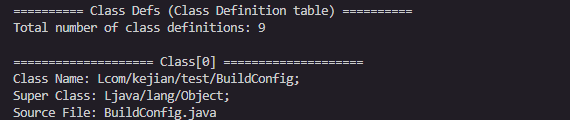 <font style="color:rgb(255, 255, 255);">限定名限定名限定名</font> ### **access_flags-访问标志** **** 含义: 描述类的访问权限和特性 可能的值为: ```plain #define ACC_PUBLIC 0x00000001 // public类 #define ACC_FINAL 0x00000010 // final类 #define ACC_SUPER 0x00000020 // 使用新的invokespecial语义 #define ACC_INTERFACE 0x00000200 // 接口 #define ACC_ABSTRACT 0x00000400 // 抽象类 #define ACC_SYNTHETIC 0x00001000 // 编译器生成 #define ACC_ANNOTATION 0x00002000 // 注解类型 #define ACC_ENUM 0x00004000 // 枚举类型 ``` ```plain #define ACC_PUBLIC 0x0001 // public #define ACC_PRIVATE 0x0002 // private #define ACC_PROTECTED 0x0004 // protected #define ACC_STATIC 0x0008 // static #define ACC_FINAL 0x0010 // final #define ACC_VOLATILE 0x0040 // volatile #define ACC_TRANSIENT 0x0080 // transient #define ACC_SYNTHETIC 0x1000 // 编译器生成 #define ACC_ENUM 0x4000 // 枚举常量 ``` ```plain #define ACC_PUBLIC 0x0001 // public #define ACC_PRIVATE 0x0002 // private #define ACC_PROTECTED 0x0004 // protected #define ACC_STATIC 0x0008 // static #define ACC_FINAL 0x0010 // final #define ACC_SYNCHRONIZED 0x0020 // synchronized #define ACC_BRIDGE 0x0040 // 桥接方法 #define ACC_VARARGS 0x0080 // 可变参数 #define ACC_NATIVE 0x0100 // native #define ACC_ABSTRACT 0x0400 // abstract #define ACC_STRICT 0x0800 // strictfp #define ACC_SYNTHETIC 0x1000 // 编译器生成 #define ACC_CONSTRUCTOR 0x10000 // 构造函数 #define ACC_DECLARED_SYNCHRONIZED 0x20000 // 声明同步 ``` 解析代码 ```plain u4 access_flags = class_defs[i].access_flags; printf("Access Flags: 0x%04x (%s)\n", access_flags, get_access_flags_string(access_flags, 0)); //此处在分析类,所以第二个参数为0 ``` ```plain // 获取访问标志字符串 const char* get_access_flags_string(u4 flags, int is_method) { static char flag_str[256]; flag_str[0] = '\0'; //如果是类的访问标志 if (flags & ACC_PUBLIC) strcat(flag_str, "public "); if (flags & ACC_PRIVATE) strcat(flag_str, "private "); if (flags & ACC_PROTECTED) strcat(flag_str, "protected "); if (flags & ACC_STATIC) strcat(flag_str, "static "); if (flags & ACC_FINAL) strcat(flag_str, "final "); if (flags & ACC_SYNCHRONIZED) strcat(flag_str, "synchronized "); if (flags & ACC_VOLATILE) strcat(flag_str, "volatile "); if (flags & ACC_TRANSIENT) strcat(flag_str, "transient "); if (flags & ACC_NATIVE) strcat(flag_str, "native "); if (flags & ACC_INTERFACE) strcat(flag_str, "interface "); if (flags & ACC_ABSTRACT) strcat(flag_str, "abstract "); if (flags & ACC_STRICT) strcat(flag_str, "strictfp "); if (flags & ACC_SYNTHETIC) strcat(flag_str, "synthetic "); if (flags & ACC_ANNOTATION) strcat(flag_str, "annotation "); if (flags & ACC_ENUM) strcat(flag_str, "enum "); //如果是方法的访问标志 if (is_method) { if (flags & ACC_BRIDGE) strcat(flag_str, "bridge "); if (flags & ACC_VARARGS) strcat(flag_str, "varargs "); if (flags & ACC_CONSTRUCTOR) strcat(flag_str, "constructor "); if (flags & ACC_DECLARED_SYNCHRONIZED) strcat(flag_str, "declared_synchronized "); } return flag_str; } ``` 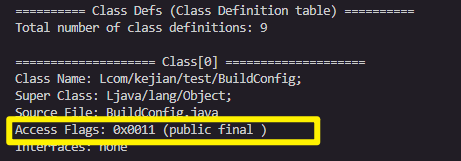 ### **interfaces_off-接口列表** **** 含义: 指向**type_list结构**的偏移,包含实现的接口列表 值为0: 表示不实现任何接口 结构: 与方法参数的type_list相同格式 ```plain struct type_list { uint32_t size; // 接口数量 uint16_t list[size]; // 接口类型索引数组 }; ``` ```plain class_def_item ┌─────────────────────┐ │ class_idx │ │ access_flags │ │ superclass_idx │ │ interfaces_off ─────┼──────┐ │ ... │ │ └─────────────────────┘ │ ▼ type_list (接口列表) ┌─────────────────────┐ │ size = 3 │ // 实现了3个接口 ├─────────────────────┤ │ list[0] = 5 │ → Type[5]: Ljava/io/Serializable; │ list[1] = 8 │ → Type[8]: Ljava/lang/Comparable; │ list[2] = 12 │ → Type[12]: Ljava/lang/Cloneable; └─────────────────────┘ ``` 与其他结构的关系 ```plain ┌─────────────────────────────────────────────────────────────┐ │ DEX 文件结构 │ ├─────────────────────────────────────────────────────────────┤ │ string_ids → 存储所有字符串 │ │ ↑ │ │ type_ids → 存储类型描述符 (引用 string_ids) │ │ ↑ │ │ type_list → 接口列表 (引用 type_ids) │ │ ↑ │ │ class_def → 类定义 (interfaces_off 指向 type_list) │ └─────────────────────────────────────────────────────────────┘ ``` 解析代码 ```plain if (class_defs[i].interfaces_off != 0) { printf("\n--- Interfaces ---\n"); parse_interfaces(class_defs[i].interfaces_off); } else { printf("Interfaces: none\n"); } ``` ```plain // 解析接口列表 void parse_interfaces(u4 interfaces_off) { struct type_list* interfaces = (struct type_list*)(dex_data + interfaces_off); printf("Interface count: %u\n", interfaces->size); for (u4 i = 0; i < interfaces->size; i++) { const char* interface_name = get_type_by_idx(interfaces->list[i]); printf(" [%u] %s\n", i, interface_name); } } ``` ### **class_data_off-类数据** **** 含义: 指向class_data_item结构 重要性: 包含类的字段和方法定义 值为0: 表示没有字段和方法(如接口的某些情况) ```plain // 注意:这个结构使用 ULEB128 编码,不是固定大小! struct class_data_item { uleb128 static_fields_size; // 静态字段数量 uleb128 instance_fields_size; // 实例字段数量 uleb128 direct_methods_size; // 直接方法数量 uleb128 virtual_methods_size; // 虚方法数量 encoded_field static_fields[static_fields_size]; // 静态字段数组 encoded_field instance_fields[instance_fields_size]; // 实例字段数组 encoded_method direct_methods[direct_methods_size]; // 直接方法数组 encoded_method virtual_methods[virtual_methods_size]; // 虚方法数组 }; ``` ```plain struct encoded_field { uleb128 field_idx_diff; // 字段索引差值 (相对于前一个字段) uleb128 access_flags; // 访问标志 }; ``` 字段索引差值是什么 ```plain 实际索引 = 前一个索引 + 当前差值 示例: 字段索引序列: 3, 4, 7, 8 存储的差值: 3, 1, 3, 1 (第一个是绝对值,后面是差值) ``` ```plain struct encoded_method { uleb128 method_idx_diff; // 方法索引差值 (相对于前一个方法) uleb128 access_flags; // 访问标志 uleb128 code_off; // 代码偏移 (指向 code_item,0表示无代码) }; ``` encoded_method比encoded_field多了一个code_off ```plain struct code_item { u2 registers_size; // 寄存器数量 u2 ins_size; // 输入参数数量 (包括 this) u2 outs_size; // 调用其他方法时的参数数量 u2 tries_size; // try-catch 块数量 u4 debug_info_off; // 调试信息偏移 u4 insns_size; // 指令数量 (16位单元) u2 insns[insns_size]; // 字节码指令 // 如果 tries_size > 0,后面还有 try_item 和 handler }; struct debug_info_item { uleb128 line_start; // 起始行号 uleb128 parameters_size; // 参数数量 uleb128 parameter_names[]; // 参数名索引数组 u1 state_machine[]; // 调试状态机操作码 }; ``` 内存布局示意图 ```plain class_def_item │ ├── class_idx ──────────→ type_ids ──→ 类名 ├── superclass_idx ─────→ type_ids ──→ 父类名 ├── interfaces_off ─────→ type_list ──→ 接口列表 ├── annotations_off ────→ 注解目录 ├── static_values_off ──→ 静态字段初始值 │ └── class_data_off │ ▼ class_data_item │ ├── static_fields[] │ └── field_idx_diff ──→ field_ids ──→ 字段名/类型 │ ├── instance_fields[] │ └── field_idx_diff ──→ field_ids ──→ 字段名/类型 │ ├── direct_methods[] │ ├── method_idx_diff ──→ method_ids ──→ 方法名/原型 │ └── code_off ──→ code_item ──→ 字节码 │ └── virtual_methods[] ├── method_idx_diff ──→ method_ids ──→ 方法名/原型 └── code_off ──→ code_item ──→ 字节码 ``` 解析代码 ```plain // 解析类数据(字段和方法) if (class_defs[i].class_data_off != 0) { printf("\n--- Class Data ---\n"); parse_class_data(class_defs[i].class_data_off, class_name); } else { printf("Class Data: none (interface or empty class)\n"); } ``` ```plain // 解析类数据(字段和方法) void parse_class_data(u4 class_data_off, const char* class_name) { u1* ptr = dex_data + class_data_off; u1* data_end = dex_data + file_size; // 读取字段和方法数量 注意这里传递的是二级指针,修改的是ptr的地址 u4 static_fields_size = read_uleb128(&ptr, data_end); u4 instance_fields_size = read_uleb128(&ptr, data_end); u4 direct_methods_size = read_uleb128(&ptr, data_end); u4 virtual_methods_size = read_uleb128(&ptr, data_end); printf("Static fields: %u, Instance fields: %u\n", static_fields_size, instance_fields_size); printf("Direct methods: %u, Virtual methods: %u\n", direct_methods_size, virtual_methods_size); // 解析静态字段 if (static_fields_size > 0) { printf("\n --- Static Fields ---\n"); parse_encoded_fields(&ptr, static_fields_size, "static", class_name); } // 解析实例字段 if (instance_fields_size > 0) { printf("\n --- Instance Fields ---\n"); parse_encoded_fields(&ptr, instance_fields_size, "instance", class_name); } // 解析直接方法 if (direct_methods_size > 0) { printf("\n --- Direct Methods ---\n"); parse_encoded_methods(&ptr, direct_methods_size, "direct", class_name); } // 解析虚方法 if (virtual_methods_size > 0) { printf("\n --- Virtual Methods ---\n"); parse_encoded_methods(&ptr, virtual_methods_size, "virtual", class_name); } } ``` ```plain // 读取ULEB128编码的值 u4 read_uleb128(u1** data_ptr, u1* data_end) { u1* ptr = *data_ptr; u4 result = 0; int shift = 0; while (ptr < data_end && shift < 35) { u1 byte = *ptr++; result |= (u4)(byte & 0x7F) << shift; if ((byte & 0x80) == 0) { *data_ptr = ptr; return result; } shift += 7; } *data_ptr = ptr; return result; } ``` 为什么传递二级指针呢? C语言是值传递,在c语言中,函数参数都是复制一份副本传入的 一级指针的情况 ```plain void func(u1* ptr) { ptr++; // 修改的是副本,不影响外部 } int main() { u1* ptr = 0x1000; func(ptr); // ptr 仍然是 0x1000 } ``` 二级指针 ```plain void func(u1** ptr_addr) { (*ptr_addr)++; // 通过地址修改原始值 } int main() { u1* ptr = 0x1000; func(&ptr); // ptr 变成了 0x1001 } ``` 这样我们就正确读取了 static_fields_size,instance_fields_size,direct_methods_size,virtual_methods_size的值,现在可以分析这四个对应的结构了 四个**字段**但是只有两个结构,因此只需要定义两个函数即可 ```plain // 解析编码字段 void parse_encoded_fields(u1** ptr, u4 count, const char* type, const char* class_name) { u1* data_end = dex_data + file_size; u4 field_idx = 0; struct field_id_item* field_ids = (struct field_id_item*)(dex_data + header->field_ids_off); for (u4 i = 0; i < count; i++) { //先读取encoded_field结构体的值 u4 field_idx_diff = read_uleb128(ptr, data_end); u4 access_flags = read_uleb128(ptr, data_end); field_idx += field_idx_diff; if (field_idx < header->field_ids_size) { //获取字段的名字和类型 const char* field_name = get_string_by_idx(field_ids[field_idx].name_idx); const char* field_type = get_type_by_idx(field_ids[field_idx].type_idx); printf(" [%u] %s %s %s (flags: 0x%x - %s)\n", field_idx, get_access_flags_string(access_flags, 0), field_type, field_name, access_flags, type); } } } ``` get_access_flags_string已经介绍过了 ```plain // 解析编码方法 void parse_encoded_methods(u1** ptr, u4 count, const char* type, const char* class_name) { u1* data_end = dex_data + file_size; u4 method_idx = 0; struct method_id_item* method_ids = (struct method_id_item*)(dex_data + header->method_ids_off); struct proto_id_item* proto_ids = (struct proto_id_item*)(dex_data + header->proto_ids_off); for (u4 i = 0; i < count; i++) { u4 method_idx_diff = read_uleb128(ptr, data_end); u4 access_flags = read_uleb128(ptr, data_end); u4 code_off = read_uleb128(ptr, data_end); method_idx += method_idx_diff; if (method_idx < header->method_ids_size) { const char* method_name = get_string_by_idx(method_ids[method_idx].name_idx); u2 proto_idx = method_ids[method_idx].proto_idx; const char* return_type = get_type_by_idx(proto_ids[proto_idx].return_type_idx); printf(" [%u] %s %s %s() (flags: 0x%x - %s)", method_idx, get_access_flags_string(access_flags, 1), return_type, method_name, access_flags, type); if (code_off != 0) { printf(" [code: 0x%x]\n", code_off); // 解析代码项和调试信息 parse_code_item(code_off, method_name); } else { printf(" [abstract/native]\n"); } } } } ``` 解析代码项和调试信息 ```plain void parse_code_item(u4 code_off, const char* method_name) { if (code_off == 0) return; u1* ptr = dex_data + code_off; u1* data_end = dex_data + file_size; if (ptr + 16 > data_end) return; struct code_item* code = (struct code_item*)ptr; printf(" Code Info:\n"); printf(" Registers: %u, In: %u, Out: %u, Tries: %u\n", code->registers_size, code->ins_size, code->outs_size, code->tries_size); printf(" Instructions: %u (16-bit units)\n", code->insns_size); // 解析调试信息 if (code->debug_info_off != 0) { printf(" Debug info at: 0x%08x\n", code->debug_info_off); parse_debug_info(code->debug_info_off, method_name); } else { printf(" Debug info: none\n"); } // 显示字节码(前几个指令) if (code->insns_size > 0) { printf(" Bytecode (first 8 instructions):\n"); u2* insns = (u2*)(ptr + 16); u4 display_count = (code->insns_size < 8) ? code->insns_size : 8; for (u4 i = 0; i < display_count; i++) { if ((u1*)(insns + i) >= data_end) break; printf(" [%04x] %04x\n", i, insns[i]); } if (code->insns_size > 8) { printf(" ... (%u more instructions)\n", code->insns_size - 8); } } } ``` 解析调试信息 ```plain // 解析调试信息 void parse_debug_info(u4 debug_info_off, const char* method_name) { if (debug_info_off == 0) return; u1* ptr = dex_data + debug_info_off; u1* data_end = dex_data + file_size; if (ptr >= data_end) return; printf(" Debug Info for %s:\n", method_name); // 读取起始行号 u4 line_start = read_uleb128(&ptr, data_end); printf(" Line start: %u\n", line_start); // 读取参数数量 u4 parameters_size = read_uleb128(&ptr, data_end); printf(" Parameters: %u\n", parameters_size); // 读取参数名称 for (u4 i = 0; i < parameters_size; i++) { if (ptr >= data_end) break; u4 name_idx = read_uleb128(&ptr, data_end); if (name_idx != 0) { printf(" [%u] %s\n", i, get_string_by_idx(name_idx - 1)); } else { printf(" [%u] (no name)\n", i); } } // 解析调试操作码序列 printf(" Debug opcodes:\n"); u4 opcode_count = 0; u4 current_line = line_start; u4 current_pc = 0; while (ptr < data_end && opcode_count < 20) { // 限制显示前20个操作码 u1 opcode = *ptr++; switch (opcode) { case DBG_END_SEQUENCE: printf(" [%u] END_SEQUENCE\n", opcode_count); return; case DBG_ADVANCE_PC: { u4 addr_diff = read_uleb128(&ptr, data_end); current_pc += addr_diff; printf(" [%u] ADVANCE_PC +%u (pc=0x%x)\n", opcode_count, addr_diff, current_pc); break; } case DBG_ADVANCE_LINE: { s4 line_diff = read_sleb128(&ptr, data_end); current_line += line_diff; printf(" [%u] ADVANCE_LINE %+d (line=%u)\n", opcode_count, line_diff, current_line); break; } case DBG_START_LOCAL: { u4 register_num = read_uleb128(&ptr, data_end); u4 name_idx = read_uleb128(&ptr, data_end); u4 type_idx = read_uleb128(&ptr, data_end); const char* name = (name_idx != 0) ? get_string_by_idx(name_idx - 1) : "(no name)"; const char* type = (type_idx != 0) ? get_type_by_idx(type_idx - 1) : "(no type)"; printf(" [%u] START_LOCAL v%u %s %s\n", opcode_count, register_num, type, name); break; } case DBG_END_LOCAL: { u4 register_num = read_uleb128(&ptr, data_end); printf(" [%u] END_LOCAL v%u\n", opcode_count, register_num); break; } case DBG_SET_FILE: { u4 name_idx = read_uleb128(&ptr, data_end); const char* filename = (name_idx != 0) ? get_string_by_idx(name_idx - 1) : "(no name)"; printf(" [%u] SET_FILE %s\n", opcode_count, filename); break; } default: if (opcode >= 0x0a) { // 特殊操作码:同时调整PC和行号 u4 adjusted_opcode = opcode - 0x0a; u4 addr_diff = adjusted_opcode / 15; s4 line_diff = (adjusted_opcode % 15) - 4; current_pc += addr_diff; current_line += line_diff; printf(" [%u] SPECIAL_OPCODE 0x%02x (pc+%u, line%+d) -> pc=0x%x, line=%u\n", opcode_count, opcode, addr_diff, line_diff, current_pc, current_line); } else { printf(" [%u] UNKNOWN_OPCODE 0x%02x\n", opcode_count, opcode); } break; } opcode_count++; } if (opcode_count >= 20) { printf(" ... (more debug opcodes)\n"); } } ``` ### **annotations_off-注解信息** 含义: 指向 annotations_directory_item 结构的偏移 值为0: 表示没有注解 内容:类级别,字段级别,方法级别的注解信息 这个很复杂,我们需要先了解一下结构 注解是什么?注解就是java中的@标记符,用户给代码添加元数据 ```plain @Override // 方法注解 public void onCreate(Bundle saved) { } @Deprecated // 类注解 public class OldClass { } public void test(@NonNull String s) { } // 参数注解 @SerializedName("user_name") // 字段注解 private String userName; ``` 注解系统的层级结构: ```plain class_def_item │ └── annotations_off │ ▼ ┌─────────────────────────────────────────────────────────┐ │ annotations_directory_item (注解目录) │ │ ┌─────────────────────────────────────────────────────┐│ │ │ class_annotations_off ──────────────────────────────┼┼──→ 类注解 │ │ fields_size ││ │ │ annotated_methods_size ││ │ │ annotated_parameters_size ││ │ ├─────────────────────────────────────────────────────┤│ │ │ field_annotation[0] ────────────────────────────────┼┼──→ 字段0的注解 │ │ field_annotation[1] ────────────────────────────────┼┼──→ 字段1的注解 │ ├─────────────────────────────────────────────────────┤│ │ │ method_annotation[0] ───────────────────────────────┼┼──→ 方法0的注解 │ ├─────────────────────────────────────────────────────┤│ │ │ parameter_annotation[0] ────────────────────────────┼┼──→ 方法0参数的注解 │ └─────────────────────────────────────────────────────┘│ └─────────────────────────────────────────────────────────┘ ``` 第一层annotations_directory_item(注解目录) 一个类的所有注解的目录! ```plain struct annotations_directory_item { uint32_t class_annotations_off; // 类注解偏移 uint32_t fields_size; // 带注解的字段数量 uint32_t annotated_methods_size; // 带注解的方法数量 uint32_t annotated_parameters_size; // 带注解参数的方法数量 // 后跟数组: field_annotation field_annotations[fields_size]; method_annotation method_annotations[annotated_methods_size]; parameter_annotation parameter_annotations[annotated_parameters_size]; }; ``` ```plain struct field_annotation { u4 field_idx; // 字段索引 (指向 field_ids) u4 annotations_off; // 注解集偏移 (指向 annotation_set_item) }; struct method_annotation { u4 method_idx; // 方法索引 (指向 method_ids) u4 annotations_off; // 注解集偏移 (指向 annotation_set_item) }; struct parameter_annotation { u4 method_idx; // 方法索引 (指向 method_ids) u4 annotations_off; // 注解集引用列表偏移 (指向 annotation_set_ref_list) }; ``` 类注解不需要索引,因为一个类只有一组注解 参数注解比较特殊,因为一个方法可能多个参数,每个参数可能都有自己的注解 ```plain // 注解集引用列表 (参数注解专用) struct annotation_set_ref_list { u4 size; // 参数数量 annotation_set_ref_item list[size]; // 每个参数的注解集引用 }; // 注解集引用项 struct annotation_set_ref_item { u4 annotations_off; // 指向 annotation_set_item (0表示该参数无注解) }; ``` 方法注解为: ```plain //方法注解 method_annotation │ └── annotations_off ──→ annotation_set_item (一个方法的所有注解) //参数注解 parameter_annotation │ └── annotations_off ──→ annotation_set_ref_list (参数列表) │ ├── list[0].annotations_off ──→ annotation_set_item (参数0的注解) ├── list[1].annotations_off ──→ annotation_set_item (参数1的注解) └── list[2].annotations_off ──→ annotation_set_item (参数2的注解) ``` 第二层:annotation_set_item (注解集合) 存储一组注解(一个元素可能有多个注解) ```plain struct annotation_set_item { u4 size; // 注解数量 u4 entries[size]; // 每个注解的偏移 }; ``` 例如一个方法可能同时有 @Override @Deprecated 第三层:annotation_item (注解项) ```plain struct annotation_item { u1 visibility; // 可见性 (BUILD/RUNTIME/SYSTEM) encoded_annotation annotation; // 注解内容 }; ``` 第4层:encoded_annotation (注解内容) ```plain struct encoded_annotation { uleb128 type_idx; // 注解类型 (如 @Override) uleb128 size; // 参数数量 annotation_element elements[size]; // 参数列表 }; ``` ```plain struct annotation_element { uleb128 name_idx; // 元素名称 encoded_value value; // 元素值 }; ``` ```plain 第1层 (注解目录) 第2层 (注解集合) 第3层 (注解项) 第4层 (注解内容) ┌──────────────────────────┐ ┌──────────────────────┐ ┌──────────────────────┐ ┌──────────────────────┐ │ annotations_directory │ │ annotation_set_item │ │ annotation_item │ │ encoded_annotation │ │ ┌──────────────────────┐ │ │ ┌──────────────────┐ │ │ ┌──────────────────┐ │ │ ┌──────────────────┐ │ │ │class_annotations_off─┼─┼────────────→│ │ size = 2 │ │ │ │ visibility=SYSTEM│ │ │ │ type_idx = 14 │ │ │ │ │ │ │ ├──────────────────┤ │ │ ├──────────────────┤ │ │ │ (InnerClass) │ │ │ │fields_size = 1 │ │ │ │ entry[0] ────────┼─┼───────────────→│ │ annotation ──────┼─┼───────────────→│ ├──────────────────┤ │ │ │ │ │ │ ├──────────────────┤ │ │ │ │ │ │ │ size = 2 │ │ │ │annotated_methods_size│ │ │ │ entry[1] ────────┼─┼──┐ │ └──────────────────┘ │ │ ├──────────────────┤ │ │ │= 0 │ │ │ │ │ │ │ └──────────────────────┘ │ │ elements[0]: │ │ │ │ │ │ │ └──────────────────┘ │ │ │ │ name=accessFlags│ │ │ │annotated_parameters │ │ └──────────────────────┘ │ ┌──────────────────────┐ │ │ value=25 │ │ │ │_size = 0 │ │ │ │ annotation_item │ │ ├──────────────────┤ │ │ └──────────────────────┘ │ │ │ ┌──────────────────┐ │ │ │ elements[1]: │ │ │ │ └────────────→│ │ visibility=SYSTEM│ │ │ │ name=name │ │ │ ┌──────────────────────┐ │ │ ├──────────────────┤ │ │ │ value="color" │ │ │ │field_annotation[0] │ │ ┌──────────────────────┐ │ │ annotation ──────┼─┼──┐ │ └──────────────────┘ │ │ │ ┌──────────────────┐ │ │ │ annotation_set_item │ │ │ │ │ │ └──────────────────────┘ │ │ │ field_idx = 5 │ │ │ │ ┌──────────────────┐ │ │ └──────────────────┘ │ │ │ │ ├──────────────────┤ │ │ │ │ size = 1 │ │ └──────────────────────┘ │ ┌──────────────────────┐ │ │ │ annotations_off──┼─┼─┼────────────→│ ├──────────────────┤ │ │ │ encoded_annotation │ │ │ │ │ │ │ │ │ entry[0] ────────┼─┼──┐ │ │ ┌──────────────────┐ │ │ │ └──────────────────┘ │ │ │ │ │ │ │ └────────────→│ │ type_idx = 13 │ │ │ └──────────────────────┘ │ │ └──────────────────┘ │ │ │ │ (EnclosingClass) │ │ │ │ └──────────────────────┘ │ │ ├──────────────────┤ │ └──────────────────────────┘ │ ┌──────────────────────┐ │ │ size = 1 │ │ │ │ annotation_item │ │ ├──────────────────┤ │ │ │ ┌──────────────────┐ │ │ │ elements[0]: │ │ └────────────→│ │ visibility=RUNTIME│ │ │ │ name=value │ │ │ ├──────────────────┤ │ │ │ value=12 │ │ │ │ annotation ──────┼─┼───────────────→│ └──────────────────┘ │ │ │ │ │ └──────────────────────┘ │ └──────────────────┘ │ └──────────────────────┘ ``` 简化 ```plain 第1层 第2层 第3层 第4层 (注解目录) (注解集合) (注解项) (注解内容) ┌─────────────┐ ┌─────────────┐ ┌─────────────┐ ┌─────────────┐ │ directory │ │ set_item │ │ item │ │ encoded │ │ │ │ │ │ │ │ annotation │ │ class_off ──┼────────→│ size=2 │ │ visibility │ │ │ │ │ │ entry[0] ───┼────────→│ annotation──┼────────→│ type_idx │ │ field[0] │ │ entry[1] ───┼──┐ │ │ │ size │ │ └─off ─────┼──┐ └─────────────┘ │ └─────────────┘ │ elements[] │ │ │ │ │ │ name=value │ │ method[0] │ │ ┌─────────────┐ │ ┌─────────────┐ └─────────────┘ │ └─off ─────┼──┼─────→│ set_item │ │ │ item │ │ │ │ │ size=1 │ └─────→│ visibility │ │ param[0] │ │ │ entry[0] ───┼────────→│ annotation──┼────────→ ... │ └─off ─────┼──┼─────→└─────────────┘ └─────────────┘ └─────────────┘ │ │ ┌─────────────┐ └─────→│ set_item │ │ size=1 │ │ entry[0] ───┼────────→ ... └─────────────┘ ``` 解析代码,综上分析我们知道了类注解,字段注解,方法注解,可以用一套代码,但是参数注解需要多一步 ```plain // 解析注解信息 if (class_defs[i].annotations_off != 0) { printf("\n--- Annotations ---\n"); parse_annotations_directory(class_defs[i].annotations_off); } else { printf("Annotations: none\n"); } ``` ```plain // 解析注解目录 void parse_annotations_directory(u4 annotations_off) { if (annotations_off == 0) return; u1* ptr = dex_data + annotations_off; u1* data_end = dex_data + file_size; if (ptr + 16 > data_end) return; struct annotations_directory_item* dir = (struct annotations_directory_item*)ptr; printf("Class annotations: 0x%08x\n", dir->class_annotations_off); printf("Annotated fields: %u\n", dir->fields_size); printf("Annotated methods: %u\n", dir->annotated_methods_size); printf("Annotated parameters: %u\n", dir->annotated_parameters_size); // 解析类注解 if (dir->class_annotations_off != 0) { printf("\n --- Class Annotations ---\n"); parse_annotation_set(dir->class_annotations_off, " "); } // 跳过目录头部 ptr += 16; // 解析字段注解 if (dir->fields_size > 0) { printf("\n --- Field Annotations ---\n"); for (u4 i = 0; i < dir->fields_size; i++) { if (ptr + 8 > data_end) break; struct field_annotation* field_ann = (struct field_annotation*)ptr; printf(" Field[%u]: annotations at 0x%08x\n", field_ann->field_idx, field_ann->annotations_off); if (field_ann->annotations_off != 0) { parse_annotation_set(field_ann->annotations_off, " "); } ptr += 8; } } // 解析方法注解 if (dir->annotated_methods_size > 0) { printf("\n --- Method Annotations ---\n"); for (u4 i = 0; i < dir->annotated_methods_size; i++) { if (ptr + 8 > data_end) break; struct method_annotation* method_ann = (struct method_annotation*)ptr; printf(" Method[%u]: annotations at 0x%08x\n", method_ann->method_idx, method_ann->annotations_off); if (method_ann->annotations_off != 0) { parse_annotation_set(method_ann->annotations_off, " "); } ptr += 8; } } // 解析参数注解 if (dir->annotated_parameters_size > 0) { printf("\n --- Parameter Annotations ---\n"); for (u4 i = 0; i < dir->annotated_parameters_size; i++) { if (ptr + 8 > data_end) break; struct parameter_annotation* param_ann = (struct parameter_annotation*)ptr; printf(" Method[%u] parameters: annotations at 0x%08x\n", param_ann->method_idx, param_ann->annotations_off); ptr += 8; } } } ``` 以解析类注解为例,概括字段注解,方法注解 ```plain // 解析类注解 if (dir->class_annotations_off != 0) { printf("\n --- Class Annotations ---\n"); parse_annotation_set(dir->class_annotations_off, " "); } ``` 解析注解集,也就是处理第二层 ```plain // 解析注解集 void parse_annotation_set(u4 annotation_set_off, const char* prefix) { if (annotation_set_off == 0) return; u1* ptr = dex_data + annotation_set_off; u1* data_end = dex_data + file_size; if (ptr + 4 > data_end) return; struct annotation_set_item* set = (struct annotation_set_item*)ptr; printf("%sAnnotation set size: %u\n", prefix, set->size); ptr += 4; for (u4 i = 0; i < set->size; i++) { if (ptr + 4 > data_end) break; u4 annotation_off = *(u4*)ptr; printf("%s [%u] Annotation at 0x%08x\n", prefix, i, annotation_off); if (annotation_off != 0) { //解析注解项 parse_annotation_item(annotation_off, prefix); } ptr += 4; } } ``` 下面该解析第三层了,也就是注解项 ```plain // 解析注解项 void parse_annotation_item(u4 annotation_off, const char* prefix) { if (annotation_off == 0) return; u1* ptr = dex_data + annotation_off; u1* data_end = dex_data + file_size; if (ptr >= data_end) return; u1 visibility = *ptr++; //打印注解项的可见性 printf("%s Visibility: %s\n", prefix, get_visibility_string(visibility)); printf("%s Encoded annotation:\n", prefix); //解析注解内容 parse_encoded_annotation(&ptr, prefix); } ``` ```plain // 获取可见性字符串 const char* get_visibility_string(u1 visibility) { switch (visibility) { case VISIBILITY_BUILD: return "BUILD"; case VISIBILITY_RUNTIME: return "RUNTIME"; case VISIBILITY_SYSTEM: return "SYSTEM"; default: return "UNKNOWN"; } } ``` 下面第四层,解析注解内容 ```plain // 解析编码注解 void parse_encoded_annotation(u1** ptr, const char* prefix) { u1* data_end = dex_data + file_size; if (*ptr >= data_end) return; // 读取类型索引 u4 type_idx = read_uleb128(ptr, data_end); printf("%s Type: %s\n", prefix, get_type_by_idx(type_idx)); // 读取元素数量 u4 size = read_uleb128(ptr, data_end); printf("%s Elements: %u\n", prefix, size); for (u4 i = 0; i < size; i++) { if (*ptr >= data_end) break; // 读取元素名称索引 u4 name_idx = read_uleb128(ptr, data_end); printf("%s [%u] %s = ", prefix, i, get_string_by_idx(name_idx)); // 读取元素值 parse_encoded_value(ptr); printf("\n"); } } ``` parse_encoded_value解析 ```plain struct annotation_element { uleb128 name_idx; // 元素名称 encoded_value value; // 元素值 ← parse_encoded_value 解析这个! }; ``` ```plain // 解析编码值 void parse_encoded_value(u1** ptr) { u1* data_end = dex_data + file_size; if (*ptr >= data_end) return; u1 type_and_arg = **ptr; (*ptr)++; u1 value_type = (type_and_arg >> 5) & 0x1F; u1 value_arg = type_and_arg & 0x1F; switch (value_type) { case VALUE_BYTE: printf("byte: %d", (s1)**ptr); (*ptr)++; break; case VALUE_SHORT: { s2 val = 0; for (int i = 0; i <= value_arg && *ptr < data_end; i++) { val |= ((s2)**ptr) << (i * 8); (*ptr)++; } printf("short: %d", val); break; } case VALUE_INT: { s4 val = 0; for (int i = 0; i <= value_arg && *ptr < data_end; i++) { val |= ((s4)**ptr) << (i * 8); (*ptr)++; } printf("int: %d", val); break; } case VALUE_STRING: { u4 string_idx = 0; for (int i = 0; i <= value_arg && *ptr < data_end; i++) { string_idx |= ((u4)**ptr) << (i * 8); (*ptr)++; } printf("string: \"%s\"", get_string_by_idx(string_idx)); break; } case VALUE_TYPE: { u4 type_idx = 0; for (int i = 0; i <= value_arg && *ptr < data_end; i++) { type_idx |= ((u4)**ptr) << (i * 8); (*ptr)++; } printf("type: %s", get_type_by_idx(type_idx)); break; } case VALUE_BOOLEAN: printf("boolean: %s", value_arg ? "true" : "false"); break; case VALUE_NULL: printf("null"); break; default: printf("unknown_type(0x%02x)", value_type); // 跳过未知类型的数据 for (int i = 0; i <= value_arg && *ptr < data_end; i++) { (*ptr)++; } break; } } ``` ### **static_values_off-静态初始值** 含义: 指向encoded_array_item,包含静态字段的初始值 值为0: 表示没有静态字段初始值 用途: 静态字段的默认值 ```plain struct encoded_array_item { uleb128 size; // 元素数量 encoded_value values[size]; // 编码值数组 }; ``` ```plain struct encoded_value { uint8_t type_and_arg; // 类型(高5位)+ 参数(低3位) uint8_t value[arg+1]; // 实际值数据 }; ``` 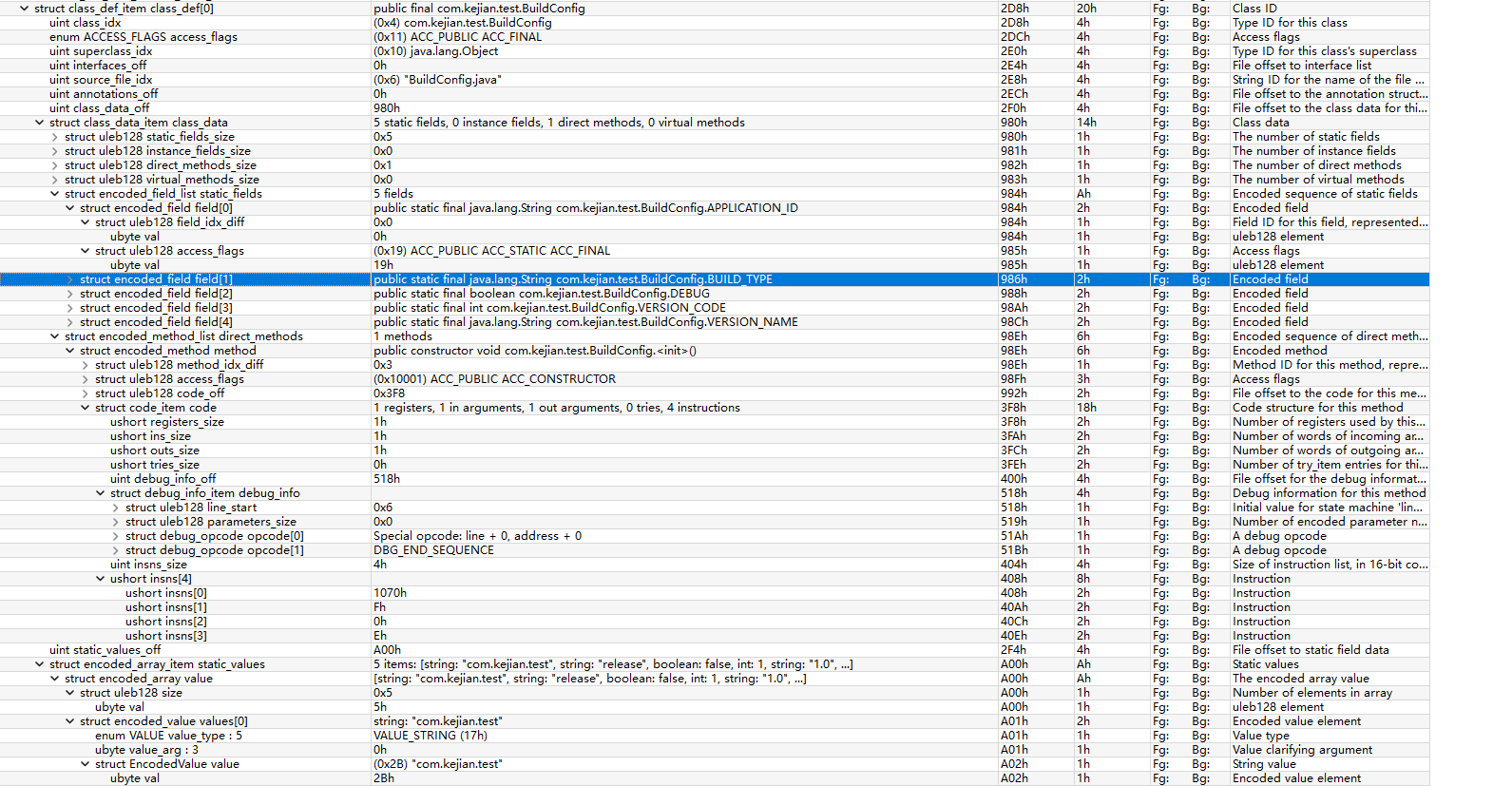 解析静态值 ```plain // 解析静态值 if (class_defs[i].static_values_off != 0) { printf("\n--- Static Values ---\n"); parse_static_values(class_defs[i].static_values_off); } else { printf("Static Values: none\n"); } ``` parse_static_values ```plain // 解析静态值 void parse_static_values(u4 static_values_off) { u1* ptr = dex_data + static_values_off; u1* data_end = dex_data + file_size; u4 size = read_uleb128(&ptr, data_end); printf("Static values count: %u\n", size); for (u4 i = 0; i < size; i++) { printf(" [%u] ", i); parse_encoded_value(&ptr); printf("\n"); } } ``` ```plain // 解析编码值 void parse_encoded_value(u1** ptr) { u1* data_end = dex_data + file_size; if (*ptr >= data_end) return; u1 type_and_arg = **ptr; (*ptr)++; u1 value_type = (type_and_arg >> 5) & 0x1F; u1 value_arg = type_and_arg & 0x1F; switch (value_type) { case VALUE_BYTE: printf("byte: %d", (s1)**ptr); (*ptr)++; break; case VALUE_SHORT: { s2 val = 0; for (int i = 0; i <= value_arg && *ptr < data_end; i++) { val |= ((s2)**ptr) << (i * 8); (*ptr)++; } printf("short: %d", val); break; } case VALUE_INT: { s4 val = 0; for (int i = 0; i <= value_arg && *ptr < data_end; i++) { val |= ((s4)**ptr) << (i * 8); (*ptr)++; } printf("int: %d", val); break; } case VALUE_STRING: { u4 string_idx = 0; for (int i = 0; i <= value_arg && *ptr < data_end; i++) { string_idx |= ((u4)**ptr) << (i * 8); (*ptr)++; } printf("string: \"%s\"", get_string_by_idx(string_idx)); break; } case VALUE_TYPE: { u4 type_idx = 0; for (int i = 0; i <= value_arg && *ptr < data_end; i++) { type_idx |= ((u4)**ptr) << (i * 8); (*ptr)++; } printf("type: %s", get_type_by_idx(type_idx)); break; } case VALUE_BOOLEAN: printf("boolean: %s", value_arg ? "true" : "false"); break; case VALUE_NULL: printf("null"); break; default: printf("unknown_type(0x%02x)", value_type); // 跳过未知类型的数据 for (int i = 0; i <= value_arg && *ptr < data_end; i++) { (*ptr)++; } break; } } ``` 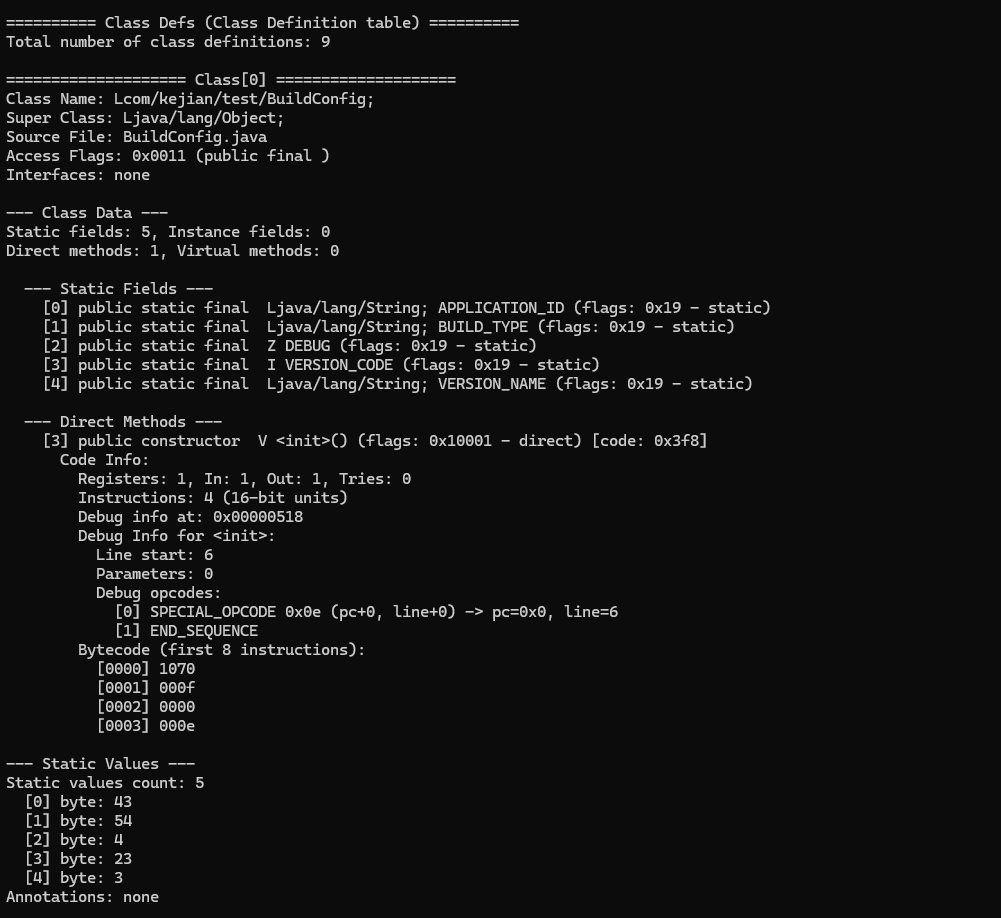 ## Data Data区是DEX文件的核心内容区,**存储所有实际数据**,而**前面的索引表只是"目录"** ## link_data 存储静态链接信息,但是通常为空,因为Android使用**动态链接**,类和方法在运行时解析。link_data是**为早期的静态链接优化设计的**,现代Android基本不用 [参考](https://bbs.kanxue.com/thread-284995.htm)
登录后可查看完整内容
冰与火的战歌:Windows内核攻防实战高级班!从零到实战,融合AI与Windows内核攻防全技术栈,打造具备自动化能力的内核开发高手。
最后于
2026-8-3 10:23 被A0tem编辑 ,原因:
#基础理论
#逆向分析
上传的附件:
Dex结构.zip
(70.33kb,33次下载)
收藏
・
15
点赞
・
13
打赏
分享
分享到微信
分享到QQ
分享到微博
赞赏记录
参与人
雪币
留言
时间
Vincent_sec
你的分享对大家帮助很大,非常感谢!
2026-3-17 11:37
iCookiie
感谢你的积极参与,期待更多精彩内容!
2026-3-2 10:55
wx_0.0_522
感谢你分享这么好的资源!
2026-1-23 18:19
mb_fhpfcoqp
你的分享对大家帮助很大,非常感谢!
2025-12-26 11:17
mb_iesvmzqc
感谢你分享这么好的资源!
2025-12-26 11:13
零_721409
谢谢你的细致分析,受益匪浅!
2025-12-25 15:08
fyrlove
这个讨论对我很有帮助,谢谢!
2025-12-23 14:59
梧桐生
谢谢你的细致分析,受益匪浅!
2025-12-21 19:43
东方玻璃
这个讨论对我很有帮助,谢谢!
2025-12-21 18:44
zgFree
感谢你分享这么好的资源!
2025-12-21 14:55
孤独的街
感谢你的积极参与,期待更多精彩内容!
2025-12-21 11:43
我的小拇指啊
感谢你的贡献,论坛因你而更加精彩!
2025-12-21 02:18
mb_tmbvnlxt
这个讨论对我很有帮助,谢谢!
2025-12-20 19:56
查看更多
赞赏
×
1 雪花
5 雪花
10 雪花
20 雪花
50 雪花
80 雪花
100 雪花
150 雪花
200 雪花
支付方式:
微信支付
赞赏留言:
快捷留言
感谢分享~
精品文章~
原创内容~
精彩转帖~
助人为乐~
感谢分享~
最新回复
(
6
)
温泉划水鱼
雪 币:
95
能力值:
( LV1,RANK:0 )
在线值:
发帖
6
回帖
228
粉丝
28
关注
私信
温泉划水鱼
2
楼
tql,学习
2025-12-21 02:01
1
mb_asiwnxyv
雪 币:
6
能力值:
( LV1,RANK:0 )
在线值:
发帖
0
回帖
100
粉丝
0
关注
私信
mb_asiwnxyv
3
楼
感谢分享
2025-12-21 11:14
1
zgFree
雪 币:
206
活跃值:
(2993)
能力值:
( LV2,RANK:10 )
在线值:
发帖
0
回帖
40
粉丝
0
关注
私信
zgFree
4
楼
感谢分享 ,学习
2025-12-21 14:54
1
huangjw
雪 币:
6762
活跃值:
(11982)
能力值:
( LV2,RANK:10 )
在线值:
发帖
0
回帖
516
粉丝
2
关注
私信
huangjw
5
楼
收藏
2025-12-22 09:29
0
Imxz
雪 币:
110
活跃值:
(9586)
能力值:
( LV2,RANK:10 )
在线值:
发帖
6
回帖
776
粉丝
9
关注
私信
Imxz
6
楼
tql
2025-12-22 10:53
0
mb_wsvngnua
雪 币:
0
能力值:
( LV1,RANK:0 )
在线值:
发帖
2
回帖
2
粉丝
0
关注
私信
mb_wsvngnua
7
楼
感谢大佬分享,欢迎回踩,相互学习
2025-12-25 17:03
0
游客
登录
|
注册
方可回帖
回帖
表情
雪币赚取及消费
高级回复
返回
A0tem
4
发帖
22
回帖
40
RANK
关注
私信
他的文章
[原创]DEX文件格式解析:深入Android字节码结构
88876
[原创]学某通风控参数分析&Frida绕过(下)
76269
[原创]学某通风控参数分析&Frida绕过(上)
74652
[原创]新版****Ollvm混淆Signature参数解析
75237
关于我们
联系我们
企业服务
看雪公众号
专注于PC、移动、智能设备安全研究及逆向工程的开发者社区
谁下载
×
huangyalei
zgFree
powerpcer
zhongdong
龙飞雪
绿雪羚羊
it爱好者_625041
yhock
ONewTach
LQ6H
Sigil
iBa0
Xhani
可乐别念了
x0rrrrr
五彩斑斓的黑
npc0vo
lingyi223
mb_dbfmleyg
Chby3
mb_criqjxad
mb_kujsrqqv
mb_lthgjpwj
看原图
赞赏
×
雪币:
+
留言:
快捷留言
为你点赞!
返回
顶部